Why We’re Losing
Every election cycle, my phone lights up the same way:
“Who should I vote for? Who’s even on the ballot? Do you know what district I live in?
I get dozens of these messages. While well-meaning, they’re always too late. For years, that’s been the rhythm: a burst of panic right before an election, followed by silence until the next one.
We can’t afford that anymore. If we want to stop losing, politically and otherwise, we have to start thinking in years, not weeks. For too long, we’ve assumed that our politicians would protect our community and have our best interests at heart. We’ve relied on the same old playbook: write a check, sign a petition, maybe show up to vote every once in a while, and then tell ourselves that counts as participation.
It doesn’t.
Real power comes from the grassroots and that’s what we’ve been missing. We’re losing because we’ve mistaken symbolic gestures for strategy, because we get angry when politicians use the wrong language but rarely take the next step to replace them.
After October 7th, we saw the best of our community in action. People ran to donate, to deliver supplies, to march in the streets weekly to bring the hostages home. When someone in the community is sick, we organize meals. When there’s a simcha, we flood the room with joy. And we do this instinctively; it’s in our blood to organize in times of urgent need.
But we haven’t applied that same urgency to civic life. Somewhere along the way, we decided that politics was “not for us.” We treat it as something on the fringes or beneath us, as if we’re too important, too educated, too busy, or too sophisticated to bother with something as menial as local elections. But politics is the very thing that determines our safety in our schools, shuls, and on the streets, and grants us the freedom to live proudly as Jews. It doesn’t get more “for us” than that.
A few weeks ago, I got another flood of texts: “Why are you still telling people to register as Democrats? The general election is this month. It doesn’t matter which party you’re in for this one.”
Because this isn’t about this election, it’s about the long game.
In 2026, we’ll have a critical governor’s race. In 2027, a third of the City Council will be up for re-election. Those races–the local ones that shape the future long before anyone’s paying attention–are usually decided in Democratic primaries. If we wait until the general election to care, then we’ve already lost.
We have to stop living with short-range vision and start building lasting power. That means registering early, showing up consistently, and organizing like the communities that are winning–the ones that spent a decade laying groundwork, cultivating candidates, and now hold real influence. The DSA didn’t capture city politics overnight. They played the long game and they’re winning because of it.
And maybe, finally, we’re starting to understand that. For the first time in a while, I’m cautiously optimistic. You can feel a shift. People are paying attention earlier, asking better questions, and realizing that what happens at the ballot box has real consequences for our community. You can hear it in synagogue chatter, on WhatsApp threads, at Shabbat tables: a new kind of curiosity, a civic muscle memory coming back online.
That’s progress. But awareness alone won’t save us. Action will.
Recently, someone suggested organizing a community day of fasting and prayer for a good outcome in the upcoming mayoral election. It was a beautiful instinct–heartfelt and familiar–and it underscored how high the stakes feel right now. But it struck me that this isn’t medieval Europe. We’re not powerless Jews pleading for mercy from rulers who don’t hear us. We live in a country where we can shape our destiny.
We don’t need to fast. We need to vote.
We can show up in droves and make a difference. Not just once every few years, but every single time the ballot box opens. Prayer can be powerful, but participation is what changes policy. And that’s the bridge our community needs to cross: from outrage to action, from emotion to structure, from faith to deed.
We’ve come to think activism means posting online or speaking up in moments of crisis. But real change happens in the everyday grind-the hard, unflashy work no one wants to do. We can’t win through outsourcing or writing checks. We need to build leadership, coordination, and discipline-to act not as a monolith, but as a movement that knows its power. That means building real grassroots engagement: people willing to organize, join community boards, meet with elected officials, attend town halls, and lobby for the issues that shape our daily lives. It’s not glamorous-there are no photo ops, no viral moments-but it’s the kind of work that actually builds change.
Many of our grandparents came to this country fleeing places where they didn’t have a voice, where civic life was something done to them, not by them. We have the privilege of agency, and we owe it to them, and to our children, to use it. Each of us is accountable. When we disengage-when we don’t vote, don’t show up, don’t get involved-we turn our backs on the very freedoms our ancestors prayed for and our children depend on. Our community deserves better from us.
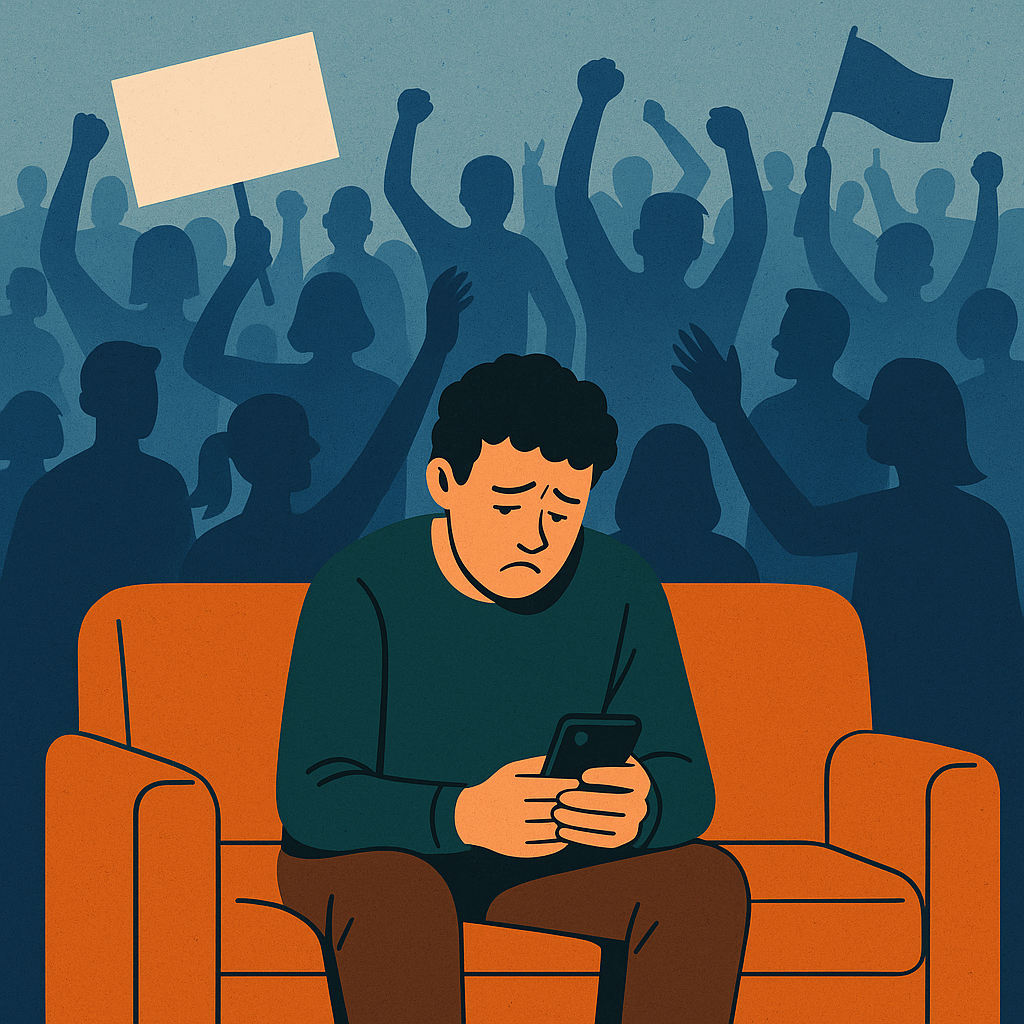
We’re losing not because we don’t care, but because we’ve grown all too complacent with doing the bare minimum. We’ve confused venting online and group chat outrage with building actual power. Maybe that once worked, but not anymore.
We know how to take care of each other. It’s time we start taking responsibility for our future with the same urgency and resolve.