Why Won’t Bibi “Man Up” Like Golda Did? And Now Wants A Pardon!!
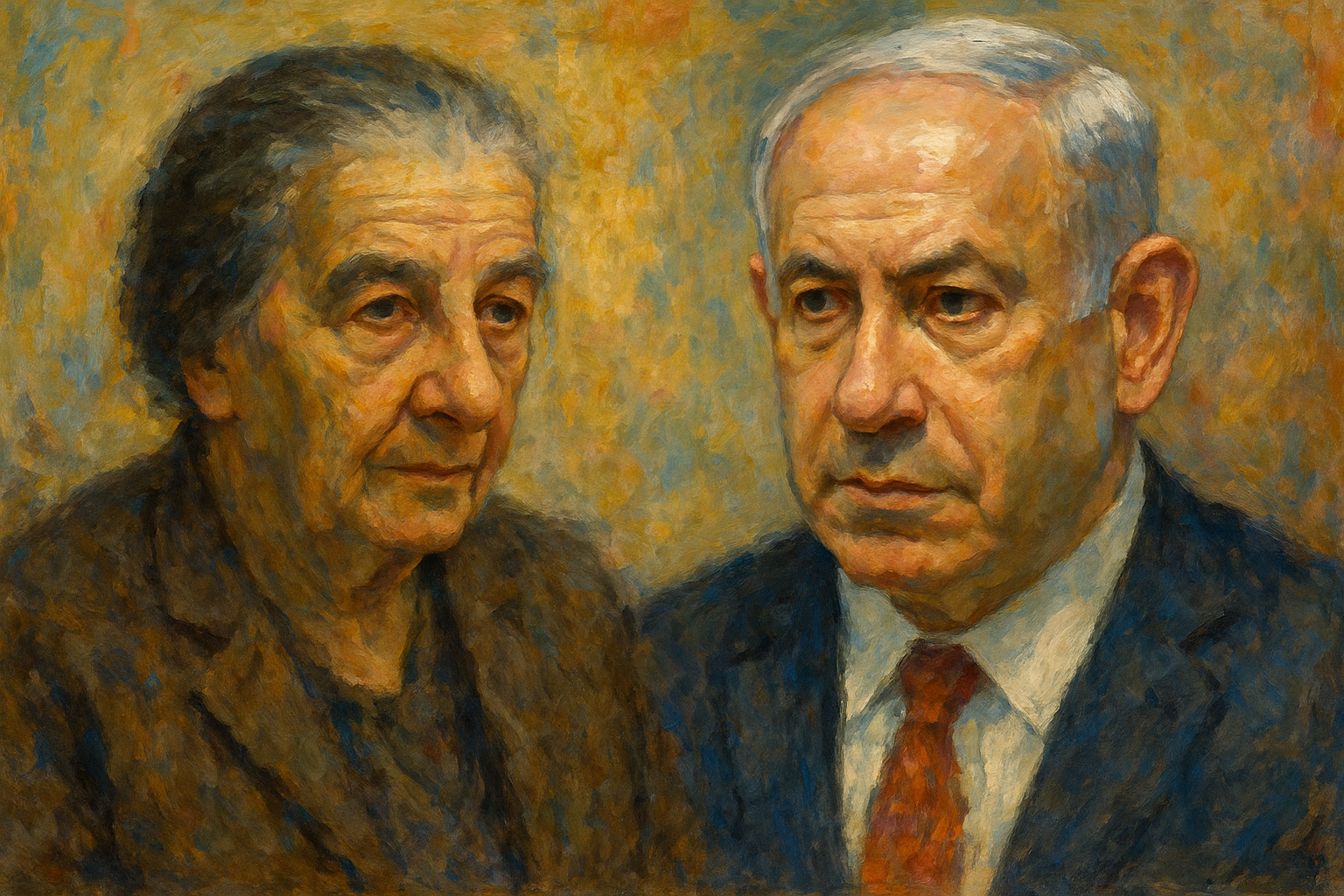
When Israel’s leaders fail, the question isn’t “who messed up,” but “who takes responsibility.”
In 1974, Golda Meir did something Benjamin Netanyahu shows no sign of doing: she looked at a broken, grieving country and concluded that, whatever the lawyers said, the person at the top had to go.
The Agranat Commission did not pin the Yom Kippur War disaster on Golda personally. Legally, she could have stayed. But she understood a basic democratic truth: there is a difference between who can be indicted and who must be accountable. So she resigned.
Netanyahu, by contrast, has spent nearly every day since October 7 working to make sure responsibility never reaches him. And now, in an extraordinary escalation, he is reportedly seeking a presidential pardon from his criminal indictments so he can “focus on leading the nation” without the “distraction” of defending himself in court.
A prime minister who presided over the worst disaster in Israel’s history, refusing to step down, resisting an independent inquiry, and asking to be spared his trial so he can stay in office?
That’s not leadership. That’s chutzpah.
Golda’s standard
After the Yom Kippur War, Israel created the Agranat Commission, a state commission of inquiry headed by the president of the Supreme Court. It was independent, powerful, and not controlled by the government it investigated.
Agranat’s interim report focused blame on the IDF and intelligence services; the political echelon, including Golda and Moshe Dayan, was spared direct personal culpability. Formally, her hands were “clean.”
The public didn’t buy it.
Hundreds of thousands of Israelis were unwilling to accept a system where generals were punished and politicians were untouchable. Within days, Golda resigned. She didn’t do it because a judge ordered her to. She did it because she understood that when the state fails in its most sacred duty — protecting its citizens — the person at the top cannot simply carry on as if nothing had happened.
That became the unwritten norm: after a catastrophic security failure, there is a real, independent inquiry and a real political reckoning.
October 7: worse failure, weaker ethics
On October 7, 2023, Hamas and its allies smashed through the Gaza border, overwhelmed bases and communities, murdered families in their homes, and dragged hostages into Gaza. It was the worst single day of Jewish killing since the Holocaust, and not on a distant battlefield but inside Israel’s own communities.
This was not only an intelligence failure. It was a collapse of borders, early warning, rapid response, and coordination between the IDF, Shin Bet, and police — all on Netanyahu’s watch.
If a prime minister is not responsible after that, when would a prime minister ever be responsible?
Most Israelis understand this. Polls have consistently shown a solid majority who believe Netanyahu bears responsibility for the catastrophe and should ultimately resign, whether now or once the war ends. In public consciousness, October 7 has already become our second Yom Kippur moment.
Yet where Golda chose responsibility, Netanyahu has chosen survival.
The commission Golda faced — and Bibi blocks
The clearest difference is the inquiry.
After 1973, the obvious response was a state commission like Agranat — independent, judicially anchored, with broad powers.
After October 7, the obvious parallel would have been to commit to a state commission of inquiry as soon as the immediate emergency was under control.
Instead, Netanyahu has:
- Rejected calls to establish a state commission on the Agranat model.
- Hid behind “wartime” as a reason to postpone any real commitment.
- Floated government-appointed probes whose members the coalition would choose.
- Fought to keep the power to decide who investigates him, rather than accept an independent body.
This is not a procedural quibble. It is a statement: no one outside his political orbit should have the authority to judge his performance.
And it turns a personal fear of accountability into a national problem. To the outside world, “Israel” is what its government does. When the prime minister resists an independent investigation into the worst failure in the country’s history, it is Israel’s reputation, not just Netanyahu’s, that takes the hit.
From responsibility to chutzpah
Golda’s instinct after 1973 was: I was in charge when this happened. I must answer for it.
Netanyahu’s instinct after October 7 has been: I was in charge when this happened. I must make sure I never have to answer for it.
We’ve seen it in:
- His initial eagerness to highlight security services’ failures while avoiding a clear statement of personal responsibility.
- His vague talk of “collective responsibility” that somehow never quite lands on the prime ministership.
- His ongoing campaign to delay or neuter independent inquiry.
- And now, his reported request for a pre-conviction presidential pardon from his criminal trial — on the grounds that Israel must be spared the risk of losing his “indispensable leadership” to the distraction of court proceedings.
Put simply: after presiding over a national tragedy, he claims the right both to stay in power and to have his indictments disappear so he can focus on staying in power.
That is chutzpah raised to a governing principle.
The stain on Israel’s image
Israel has always argued that, unlike many of its neighbors, it is a real democracy: leaders can be investigated, tried, even jailed; the system can correct itself. That willingness to hold our own leaders accountable has been central to our moral credibility.
Netanyahu’s behavior undermines that claim.
When he blocks a state commission, the message is: this government fears the full truth.
When he tries to bend legal processes to his own needs, the message is: laws are negotiable for the powerful.
When he refuses to resign after the worst security failure in our history and asks for a pardon so he can keep ruling undisturbed, the message is: leadership is not service; it is immunity.
Those messages attach themselves to the State of Israel. They embolden our critics and exhaust our supporters. They teach future leaders that you can preside over a catastrophe, weaken the courts, and dodge a trial — and still expect to stay in the PM’s chair.
This is no longer a personal quirk. It is a spreading ethical stain.
What “man up” means now
The question in the title — Why won’t Bibi “man up” like Golda did? — is not about machismo. It is about moral adulthood.
To “man up” today would mean:
- Clearly acknowledging that October 7 was a foundational failure on his watch.
- Backing a state commission of inquiry, fully independent, with access to everything and everyone, including him.
- Committing to accept its conclusions — including a recommendation to resign.
- Facing his criminal indictments in court like any other citizen, not demanding a pardon because he considers himself too indispensable to be judged.
Golda Meir, for all her mistakes, understood that there is a line beyond which a leader cannot continue as if nothing happened. She stepped aside and, in doing so, helped preserve the idea that Israel’s leadership still had an ethical core.
Netanyahu has crossed that line and now pretends it doesn’t exist.
If we allow his maneuvers to become the new norm, we will lose more than one prime minister. We will lose a piece of Israel’s moral backbone — the belief that power comes with responsibility, not exemption.
We didn’t accept power without responsibility in 1974. We shouldn’t accept it now.
Golda “manned up” and went home. Netanyahu still has the chance — late as it is — to do the same. The longer he refuses, the more his chutzpah becomes not just his problem, but Israel’s.