
Will ‘a new day in God’s coloring book’ rise?
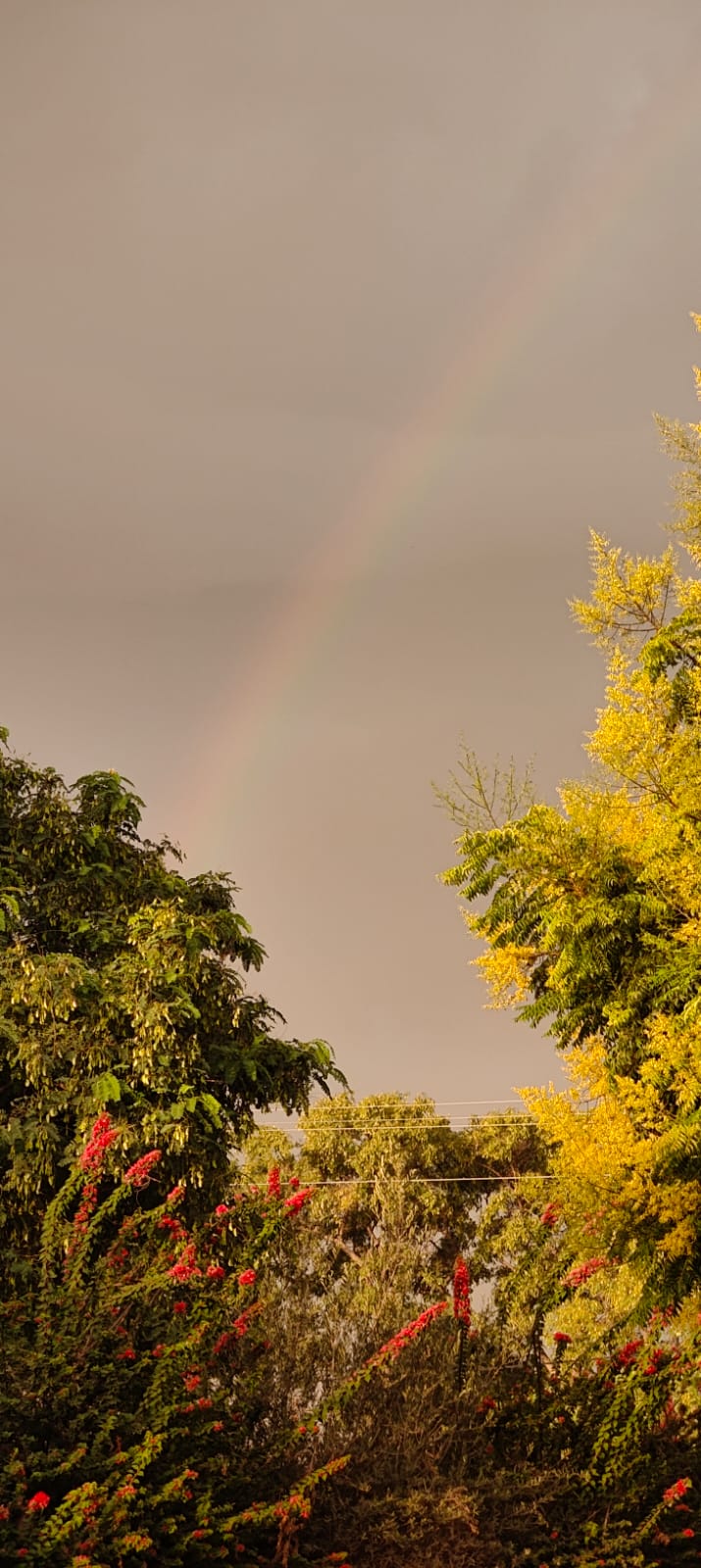
A relative who wishes to remain anonymous shared this photograph of a rainbow along with the following message (translated from Hebrew):
“On Thursday [October 9] morning at 2 o’clock, The media announced the signing of the agreement for the return of the hostages and for a ceasefire. Of course, I didn’t sleep that night because of the excitement. Around 7 o’clock in the morning, the first rain fell: a very large amount of water. And suddenly the rainbow appeared. I immediately thought of the connection between the good news about the return of the hostages and the promise of God in the Book of Genesis—and the sign of the rainbow. A friend took a picture of the rainbow. I felt that it was a sign of good news and change for the better.”
In Genesis, God, frustrated with the corruption of the earth, warns Noah, “For in seven days’ time I will make it rain upon the earth, forty days and forty nights, and I will blot out from the earth all existence that I created” (7.4). God instructs Noah to build an ark and take into it animals so that life will survive the catastrophe. And when the flood has ended, God causes a rainbow to appear as a reminder of his peaceful intentions (almost as if He himself needs a visual reminder to restrain himself):
“I have set My bow in the clouds, and it shall serve as a sign of the covenant between Me and the earth. When I bring clouds over the earth, and the bow appears in the clouds, I will remember My covenant between Me and you and every living creature among all flesh, so that the waters shall never again become a flood to destroy all flesh. When the bow is in the clouds, I will see it and remember the everlasting covenant between God and all living creatures, all flesh that is on earth. That,” God said to Noah, “shall be the sign of the covenant that I have established between Me and all flesh that is on earth” (9. 13-17).
When the Hamas chose to start a sadistic war against Israel on October 7, 2023, they called their operation “Al-Aqsa flood.” I wonder if the metaphor of environmental destruction bothers anti-Israel activists such as Greta Thunberg who also care about the environment—not to mention the many “Zionist” dogs murdered by Hamas in the kibbutzim, for instance this one:
https://www.instagram.com/p/DN1OpLbXrjh/?hl=en
It seems fitting that what the Hamas chose to call a flood ended (or at least paused) with a rainbow—a symbol of protection against future floods.
Another layer of meaning in the rainbow can be found in its association with LGBTQ+ rights. Pink washing is a term that anti-Israel activists sometimes invoke to deal with the inconvenient empirical reality that Israel is a country with high levels of liberty. Specifically, some anti-Israel activists accuse Israel of invoking the country’s protection of LGBTQ+ rights in order to mask cruelty toward the Palestinians. But perhaps the appearance of the rainbow in the sky might stand as a wry natural response to the tendency of Israel haters to attribute malevolent agendas to honest words and actions coming out of Israel. The rainbow that appeared naturally in the sky after the ceasefire was announced is not “rainbow washing;” it is a real rainbow with all the symbolism that it might contain for different people.
“At 7 o’clock in the morning, the first rain fell” in the above message from my relative above might not seem like a remarkable fact to readers who live in places where precipitation is year round. However, in Israel, it does not rain in the summer. Since ancient times (and especially in ancient times when the success of agriculture was a high-stakes matter), the first rain has been a highly anticipated event—so much so that the first rain of the fall has a special name, yoreh. There are several stories in the Jewish tradition about praying for the yoreh and about wise people trying different ways to cause it to arrive when it is overdue. The smell of the yoreh, water hitting dry earth after the long months of summer, is a pleasure that ties modern-day Israelis to their ancient ancestors.
In Deuteronomy, God promises the timely arrived of the yoreh (translated here as early rain) as a reward for good behavior and devotion: “If, then, you obey the commandments that I enjoin upon you this day, loving the Lord your God and serving Him with all your heart and soul, I will grant the rain for your land in season, the early rain and the late. You shall gather in your new grain and wine and oil—I will also provide grass in the fields for your cattle—and thus you shall eat your fill. Take care not to be lured away to serve other gods and bow to them. For the Lord’s anger will flare up against you, and He will shut up the skies so that there will be no rain and the ground will not yield its produce; and you will soon perish from the good land that the Lord is assigning to you” (11.13-17).
The fact that both the first rain and a rainbow arrived shortly after the agreement to release the hostages comes across as a blessing. Since the cease fire was announced, a feeling of hope has rightfully descended upon Israel. At the time that I write this in the early hours of October 12, the hostages have not yet been released. The question of whether their release will go as planned so that they will all be home by Monday is only the most immediately anxious step to the broader question: is the current feeling of promise ultimately an illusion?
Many points that put head over heart have been made: that we do not yet know the faces and names of the people who will be murdered and kidnapped by released terrorists and as a result of not completing the disarming of Hamas, that Israel should consider death penalties for the most dangerous terrorists so that they can never be released—and other arguments that point out that the excitement over the expected release of the hostages and the cease fire might be masking blind spots.
But the picture of the rainbow and the promise of protection that it symbolises makes me want to believe in the idea of promise—even if that idea comes from storytelling that might ultimately clash with empirical reality. Is there such a thing as saying, “please promise me an illusion?”
Even though human nature has the stains of hypocrisy and selfishness upon it, I want to believe that the intense emotion that we are now directing toward the hostages is an indication of a will to protect a world in which the individual human being matters. If we truly lived up to such values every day, then we would do more to help homeless people on the street and many others who are abandoned in various ways, so I know that the flaws of human nature will soon assert themselves, but I also want to believe that all the love directed toward the hostages means something about what human beings might be capable of creating.
In the 2025 Eurovision song context, Yuval Raphael, an October 7 Nova Festival massacre survivor, sang about the resilience and promise of a new day rising. Raphael invoked the symbol of the rainbow (and her outfit might have been a tribute to Ariel Bibas’s love of batman):
… And even if you say goodbye
You’ll never go away
You are the rainbow in my sky
My colours in the grey
My only wish upon a star
Sunshine in the day
The only song that my piano ever plays
… And even if you say goodbye
You’ll always be around
To lift me up and take me high
Keep my feet close to the ground
Are you proud of me tonight?
Dreams are coming true
I choose the light, nothing to lose if I lose you
… New day will rise, life will go on
Everyone cries, don’t cry alone
Darkness will fade, all the pain will go by
But we will stay, even if you say goodbye
https://www.youtube.com/watch?v=_7zHp51j2WM
https://www.youtube.com/watch?v=ve0T0qzWLrM&t=3s
https://www.jfeed.com/culture/yuval-raphael-eurovision-outfit-bibas-tribute
In God’s Coloring Book, Dolly Parton sees God’s creative agency in the colors around her:
Today as I was walking in the fields just down the way
I sat down on a fallen log to pass the time away
And as I looked around me the more that I did look
the more I realize that I am viewing God’s coloring book.
I saw a golden ray of sunlight, a silver drop of dew
A soft, white floating cloud sailing cross the sky of blue
A yellow dandelion, pretty evergreen
And some red and orange flowers growing wild along the stream.
And the more I look around me
And the more that I do look
The more I realize that I am viewing
God’s coloring book.
The greyness in an old man’s hair, the pink in baby’s cheeks
The blackness in a stormy sky, the brown in fallen leaves
And the multicolored rainbow stretched out across the sky
And the purple haze at sunset just before the night.
And the more I look around me
And the more that I do look
The more I realize that I am viewing
God’s coloring book.
Then I turn my face toward the sky and say a silent prayer
Though God doesn’t speak to me I see him everywhere
He is all around me, He’s everywhere I look
And each new day is but a new page in God’s coloring book
https://www.youtube.com/watch?v=Nx4JZ3NL_uI&list=RDNx4JZ3NL_uI&start_radio=1
https://www.streetdirectory.com/lyricadvisor/song/cojcfo/gods_coloring_book/
If “each new day is but a new page in God’s coloring book,” then perhaps the “the multicolored rainbow stretched out across the sky” is a sign of hope that in a world filled with creativity and love, the hostages and every person who loves peace will have a chance live to have “the greyness in an old man’s hair.” And even if that hope will turn out to be an illusion, its innate value will remain.
—
Biblical quotations are from the Jewish study Bible.