
Middle East Analyst
With God on His Side — Trump’s Religious Messaging
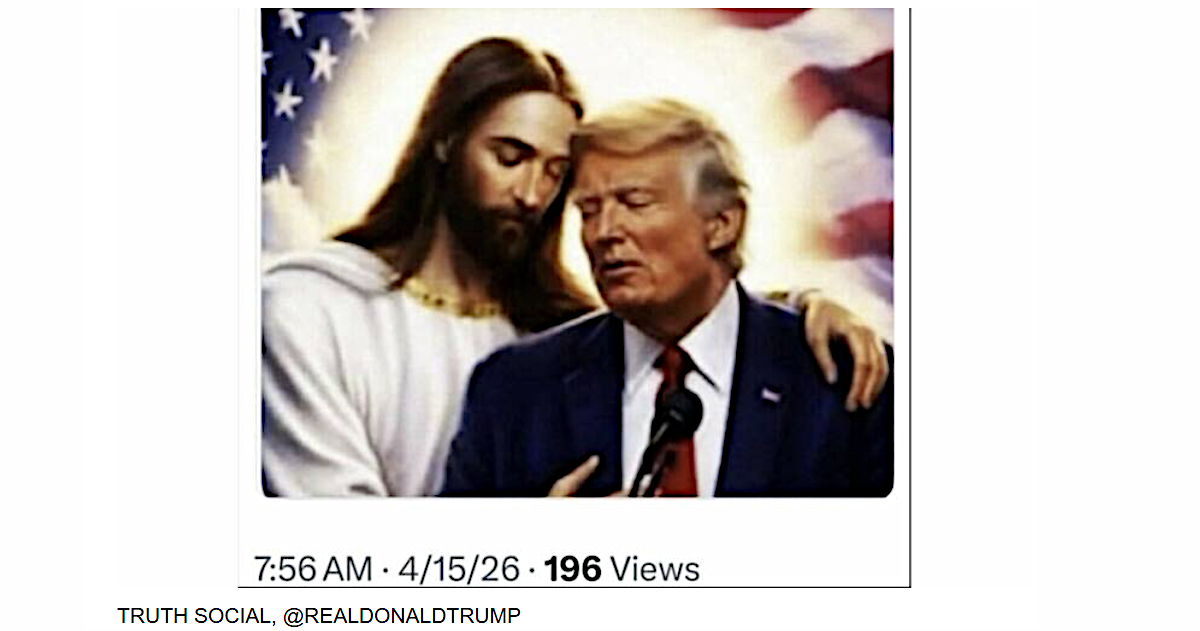
from Trump's Truth Social account
The words fill my head, and they fall to the floor
That if God’s on our side, he’ll stop the next war – Bob Dylan
The Analyst’s Mandate
Strategic analysts are not psychologists, theologians, or interpreters of divine intent. Their work is narrower and more disciplined: to identify and evaluate indicators that clarify the dynamics shaping a conditions, events, and conflicts. They do not predict outcomes, and they do not claim certainty where none exists. Instead, they infer probabilities, articulate confidence levels of their assessments, and map how observable behavior influences the perceptions of actors whose decisions matter. In a conflict as volatile as the Iran War, this requires understanding not only military capabilities and political incentives but also the religious mindsets that animate the region’s publics and leaders. Analysts do not adjudicate the truth of these beliefs. They map how those beliefs shape interpretation, mobilization, and escalation.
A Region Where Religion Is Not Background Noise
The Middle East is not merely a geopolitical arena; it is a landscape where religious identity, sacred history, and apocalyptic expectation are woven into political life. The Iran War is unfolding across a terrain shaped by centuries of religious and ethnic conflict and interpreted through Jewish, Christian, and Muslim theological narratives. Many communities in the region view war not only in strategic terms but in spiritual ones, and for some actors the conflict carries a sense of cosmic significance. This does not mean that every decision‑maker is driven solely by theology, but it does mean that religious frameworks shape how actions are interpreted. In such an environment, symbolic gestures, scriptural references, and religious imagery can have strategic effects independent of intent.
Why Analysts Must Map Religious Mindsets
Mapping religious mindsets is not an exercise in belief analysis; it is an exercise in perception analysis. When a conflict is widely interpreted as a holy war, religious narratives become part of the operational environment. They influence recruitment, morale, risk tolerance, and the perceived legitimacy of violence. They shape how adversaries interpret threats and how allies interpret commitments. They determine whether a population sees compromise as prudence or betrayal. Analysts must therefore understand how religious symbolism interacts with political messaging, because in this region, symbols can escalate tensions as quickly as troop movements.
The Impact of Trump’s Messaging in a Charged Environment
This requirement becomes especially acute when the U.S. president’s public statements and social media posts enter the religious information space. Recent controversies—including a feud with Pope Leo over the Iran conflict, the posting and deletion of an AI‑generated image depicting himself as Jesus, followed by a post of an AI-generated Jesus embracing him. And now the decision to read Scripture from the Oval Office as part of a nationally broadcast Bible‑reading event—demonstrate that the administration’s messaging is becoming increasingly explicit in its religious framing. The selected passage from 2 Chronicles, long associated with American evangelical interpretations of national repentance and divine favor, reinforces this trajectory. Regardless of intent, the timing and content of these gestures deepen the perception among many foreign and domestic audiences that the United States is framing the conflict in religious terms.
In a region where many already view the war through a sacred lens, such messaging lands with disproportionate force. To some Christian constituencies, it may signal divine mission or providential leadership. To secular Americans, it may appear unsettling or inappropriate. To Israeli religious factions, it may resonate with messianic expectations, while secular Israelis may see it as destabilizing. To Sunni and Shia Muslim populations, it may be interpreted as civilizational provocation or confirmation that the United States sees itself in a cosmic struggle against Islam. To Iranian clerical authorities, it may reinforce narratives that the West is engaged in a spiritual assault on the Islamic Republic. None of these interpretations require the president to intend a religious message; they arise from the preexisting symbolic terrain.
Perception as a Strategic Variable
The strategic consequences of these perceptions are real. Allies may question U.S. predictability. Adversaries may misread U.S. intentions, increasing the risk of miscalculation. Non‑state actors may interpret the imagery as a signal that the conflict is entering an apocalyptic phase, accelerating independent escalation. Domestic polarization may deepen as different American constituencies interpret the same message through incompatible worldviews. In each case, the analyst’s task is not to judge the appropriateness of the president’s behavior but to map the effects of that behavior on the perceptions of actors whose reactions shape the trajectory of the war.
Conclusion
Strategic analysis in the Middle East cannot be confined to material capabilities or diplomatic statements. It must account for the religious mindsets that shape how actions are interpreted in a region where symbolism can be as consequential as strategy. Analysts do not determine whether a conflict is holy. They determine whether the participants believe it is—and how those beliefs influence behavior. In the Iran War, where many actors already perceive themselves as operating within a sacred narrative, the increasingly religious tone of U.S. presidential messaging becomes part of the battlespace. Mapping these perceptions is not optional. It is essential to understanding the conflict’s trajectory and the risks that accompany it.
With God On Our Side – Bob Dylan (1963)
Oh, my name, it ain’t nothin’, my age, it means less
The country I come from is called the Midwest
I’s taught and brought up there, the laws to abide
And that the land that I live in has God on its side
Oh, the history books tell it, they tell it so well
The cavalries charged, the Indians fell
The cavalries charged, the Indians died
Oh, the country was young with God on its side
The Spanish-American War had its day
And the Civil War too was soon laid away
And the names of the heroes I was made to memorize
With guns in their hands and God on their side
The First World War, boys, it came and it went
The reason for fightin’ I never did get
But I learned to accept it, accept it with pride
For you don’t count the dead when God’s on your side
The Second World War came to an end
We forgave the Germans, and then we were friends
Though they murdered six million, in the ovens they fried
The Germans now too have God on their side
I learned to hate the Russians all through my whole life
If another war comes, it’s them we must fight
To hate them and fear them, to run and to hide
And accept it all bravely with God on my side
But now we’ve got weapons of chemical dust
If fire them we’re forced to, then fire them we must
One push of the button and they shot the world wide
And you never ask questions when God’s on your side
Through many dark hour I been thinkin’ about this
That Jesus Christ was betrayed by a kiss
But I can’t think for you, you’ll have to decide
Whether Judas Iscariot had God on his side
So now as I’m leavin’, I’m weary as hell
The confusion I’m feelin’ ain’t no tongue can tell
The words fill my head, and they fall to the floor
That if God’s on our side, he’ll stop the next war
End Times Belief and The Iran War – When Prophecy Replaces Intelligence
Related Topics
Related Posts