A Moroccan Journalist
With Mojtaba’s anointment, Iran has restored the dynastic rule it once rejected
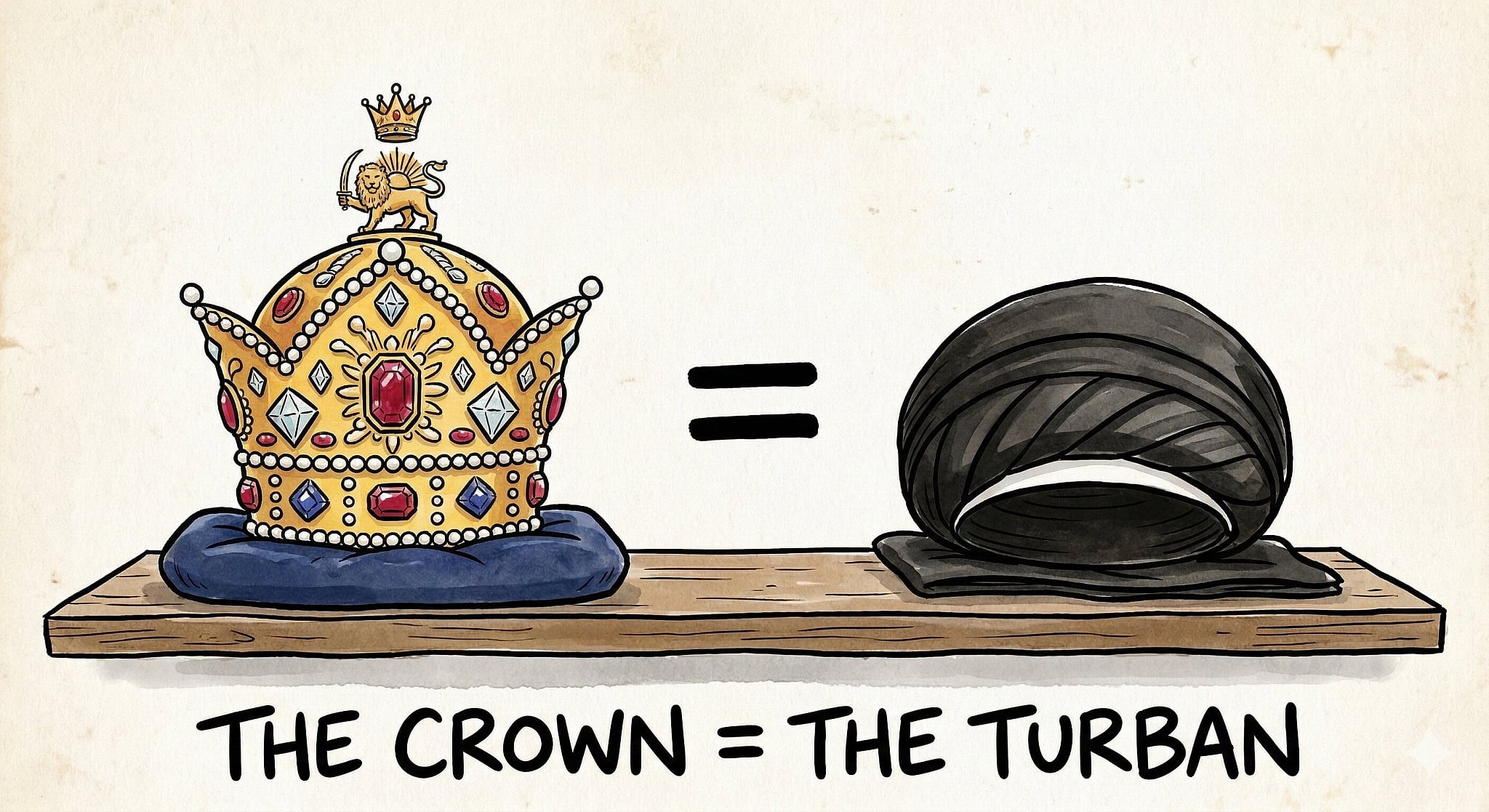
The turban has become, functionally, a crown. (AI-generated)
On March 8, the Islamic Republic of Iran completed the most exquisite act of self-cannibalization in the history of modern political theology. The Assembly of Experts – that eighty-eight-member clerical body whose sole constitutional purpose is to ensure that supreme power in the Islamic Republic passes through the needle of jurisprudential merit rather than the birth canal of dynastic entitlement – announced the elevation of Mojtaba Khamenei, son of the assassinated Ali Khamenei, to the office his father occupied for thirty-seven years. With that single, coerced, IRGC-choreographed proclamation, the revolution that was born to bury monarchy climbed into the coffin beside it and pulled the lid shut from the inside.
The betrayal is not subtle, and it is not partial. It is totalizing – a contradiction so structurally complete that it does not merely embarrass the Islamic Republic’s founding mythology but vaporizes it. Ayatollah Ruhollah Khomeini, in his 1970 treatise Islamic Government, did not argue that the Pahlavi monarchy was merely corrupt, or inefficient, or Western-aligned.
He argued that hereditary kingship was ontologically illegitimate – that the transmission of sovereign authority through bloodline was an affront to the very architecture of Islamic governance, a pre-Islamic jahiliyyah practice incompatible with the prophetic model. The entire edifice and theoretical scaffolding of Velayat-e Faqih (the Guardianship of the Islamic Jurist) was constructed as the antithesis of lineal succession, and was erected on this single, load-bearing claim: that the Islamic jurist derives his authority from jurisprudential merit, religious erudition, knowledge, piety, and divine sanction mediated through clerical consensus – not from the accident of patrilineal descent.
In other words, he did not merely criticize the Pahlavi monarchy on political grounds; he insisted that the very institution of monarchy was fundamentally incompatible with Islam.
The Shah’s throne was not merely vacated; it was doctrinally annulled, declared metaphysically void, ceremonially incinerated alongside twenty-five centuries of Persian monarchical tradition. And the ashes were still warm when the son of the second Supreme Leader was handed the office his father held, by the same Guards who swore their oath to the principle that such a thing could never happen.
Mojtaba Khamenei holds the clerical rank of Hojatoleslam – a mid-level seminary credential that, in the hierarchy of Shia jurisprudential authority, qualifies him to lead a neighborhood prayer circle, not a theocratic state of ninety million people. It qualifies him for neither the theological authority nor the jurisprudential gravitas the constitution ostensibly demands of a Supreme Leader. His father suffered the identical deficiency in 1989, and the constitution was obediently amended to accommodate him – an early symptom of the institutional tuberculosis that has now metastasized into full organ failure. That precedent alone should have served as an early warning: the Islamic Republic was never as constitutionally scrupulous as its architects advertised.
But where Ali Khamenei at least possessed a presidential tenure, revolutionary battlefield credentials, and decades of political visibility, his son’s public record is a void – a deliberate, cultivated, strategically maintained void. His curriculum vitae reads like that of a shadow operative. He has never held elected office. He has never delivered a public lecture, a Friday sermon, or a political address. Most Iranians have never heard his voice.
What they have heard, through the investigative reporting of Bloomberg, Iran International, and dissident networks, is the sound of money moving: billions of dollars routed through offshore networks, luxury assets accumulated across multiple jurisdictions, and a financial empire so sprawling that it would make a Gulf sovereign-wealth fund blush.
His qualifications for supreme spiritual leadership of the Shia world are the qualifications of a Cosa Nostra underboss promoted to capo di tutti capi because the family name was right and the enforcers said so.
And the enforcers did say so. The IRGC muscled the Assembly of Experts into anointing the son of the departing sovereign as his successor. Iran International’s sources describe an and atmosphere of coercion and institutional violation: online sessions riddled with intimidation convened under the fog of American and Israeli bombardment, IRGC commanders placing “repeated contacts and psychological and political pressure” on members, dissenting voices allocated truncated speaking time, deliberation cut short, and a vote rammed through before the rubble from a March 3 Israeli strike on the Assembly’s own office in Qom had finished settling. The very body designed to ensure meritocratic clerical selection was reduced to a rubber-stamp conclave choreographed by uniformed men. The Pahlavi court, at least, never pretended to be anything other than what it was.
Former Prime Minister Mir Hossein Mousavi, caged under house arrest since 2011, once asked the question that now detonates with prophetic precision: “Have the dynasties of 2,500 years returned so that a son succeeds his father to power?” The answer, delivered under the rubble of American cruise missiles and the opportunistic machinations of the IRGC, is an unequivocal yes.
The answer arrived on March 8, delivered not by a constitutional process but by a Praetorian Guard of theocratic absolutism that has finally dispensed with the pretense that the turban was ever anything other than a crown worn sideways. The Beyt – the Supreme Leader’s household office – has become, in substance, a royal court. And the Assembly of Experts, that supposedly sovereign clerical body, has been exposed as no more independent than the Majlis was under the Pahlavis.
Trump called Mojtaba “a lightweight” and declared him “unacceptable.” Israel vowed to assassinate any successor. And still the IRGC installed him – not because he possesses religious authority, strategic vision, or popular legitimacy, but because he possesses none of these things, and a Supreme Leader who possesses nothing is a Supreme Leader who owes everything to the men with guns.
What Mojtaba does possess, in grotesque abundance, is the apparatus of coercive power. His decades-long cultivation of IRGC intelligence networks, his alleged orchestration of the fraudulent 2005 and 2009 elections, his reported personal supervision of the Basij’s savage repression of the Green Movement, and a sprawling financial empire of offshore assets documented by Bloomberg – these are the qualifications of a mafia patriarch, not a spiritual guide.
Even his own father reportedly opposed the idea of filial succession, telling associates he feared it would resurrect the monarchical specter the revolution had sworn to bury. That even Ali Khamenei’s dying wish was overridden by the Guards speaks volumes about where real power in the Islamic Republic has always resided: not in the seminary, not in the constitution, and certainly not in the will of the people – but in the barracks.
The Guards do not need a jurist. They need a signature. Mojtaba provides it, and the theological fiction that once distinguished the Islamic Republic from every other military dictatorship wearing a clerical costume has been discarded like a prayer rug that outlived its decorative usefulness. Mojtaba is controllable, and a controllable Supreme Leader is worth more to the Guards than a legitimate one.
Khomeini thundered that Islam was “repelled by the very notion of monarchy.” Forty-seven years later, his revolution has not merely tolerated monarchy; it has reproduced it – stripped of the Pahlavi aesthetics, shorn of the peacock throne’s honesty, but structurally identical in the single dimension that matters: a son inherits power from his father because the men with weapons decided he should, and the clerics who were supposed to prevent exactly this signed the paperwork under duress and called it the will of God.
The Islamic Republic did not abolish dynasty. It merely laundered it through a seminary, armed it with a Revolutionary Guard, and stamped it with a fatwa. The Shah, wherever his ghost resides, is entitled to the last laugh – because the men who melted his crown have just forged a new one, and the only difference is that this one comes wrapped in a turban.
Related Topics
Related Posts