
Middle East Analyst
Featured Post
Without Israel there would be no America?
The US ambassador's sweeping biblical claim reflects a growing movement to redefine America's identity — and the foundations of its support for Israel
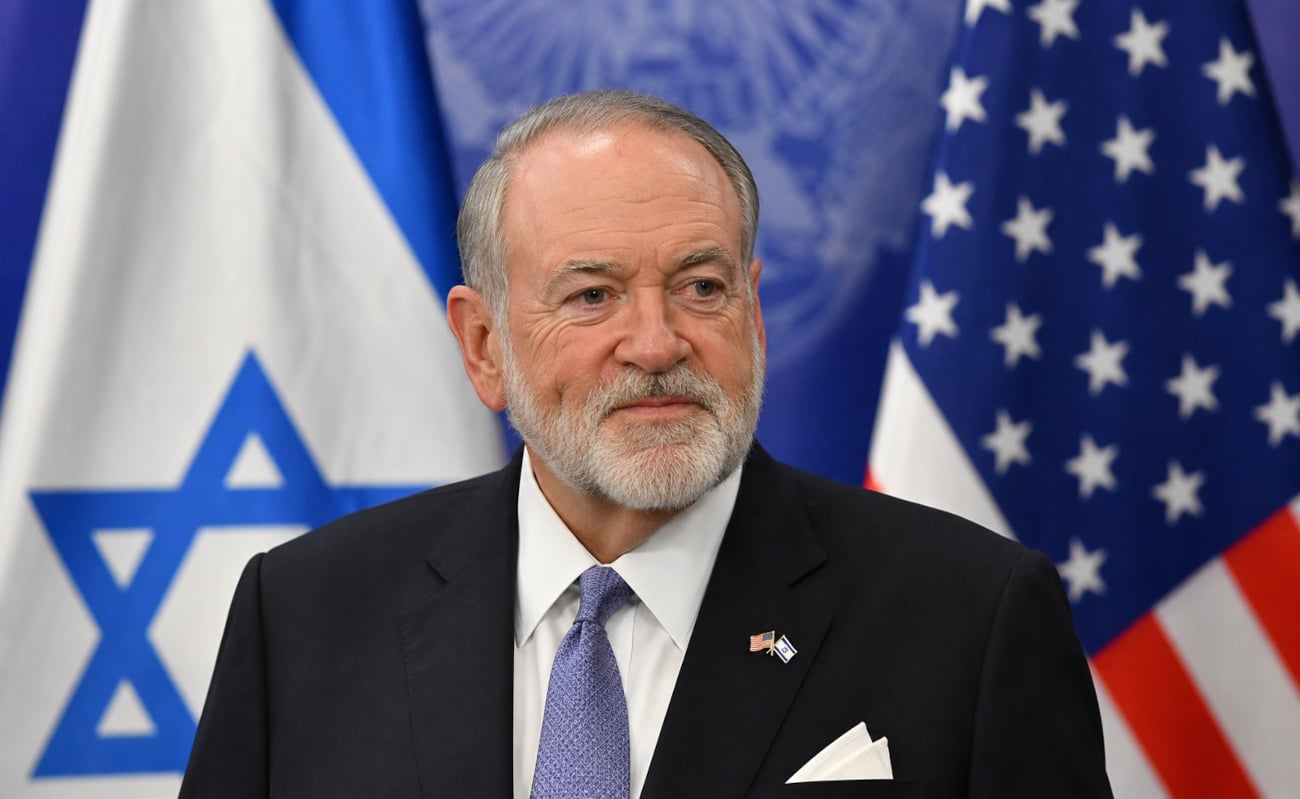
by author (AI)
The Ambassador of Christian Nationalism
When U.S. Ambassador to Israel Mike Huckabee declared, “Without Israel, without the Jewish foundation, there would not be America. We owe our very existence to what happened in this land,” he was not offering a historical thesis. He was performing a political and theological act. The remark, delivered in mid‑June 2026 at the International Conference on Israeli Heritage in Judea and Samaria, immediately drew attention because it inverted President Trump’s contemporaneous claim that “without me, there would be no Israel.” Huckabee’s statement, however, deserves analysis on its own terms. It is a window into the secular‑religious narratives that shape American political rhetoric. From his perspective that includes the theological overlap of Christian Zionism and Christian Nationalism, and his belief the U.S. Constitution needs to be transformed from a secular contract to a biblically aligned covenant. The strategic implications of grounding foreign policy in religious identity rather than strategic interest are profound and likely unsettling to the clear majority of Americans who believe in the separation of church and state. Pew Research Poll
The Setting: A Heritage Conference in Judea and Samaria
The venue matters. Huckabee was speaking not in Washington or Tel Aviv but at a heritage and archaeology conference in the West Bank, a setting steeped in biblical symbolism and political sensitivity. The audience consisted of Israeli officials, scholars, and advocates for the historical and cultural claims of the Jewish people to the land. In such a setting, Huckabee’s words were calibrated to resonate emotionally and spiritually. They were meant to affirm a shared narrative: that the roots of Western civilization, and by extension the United States, lie in the ancient traditions of Israel.
The timing also matters. The remark came just days after President Trump, speaking at the G7, asserted that Israel owed its survival to him personally — an apparent reference to his having allegedly obliterated Iran’s nuclear program. Huckabee’s line was widely interpreted as a counter‑narrative: where Trump claimed personal indispensability, Huckabee claimed civilizational indebtedness. The juxtaposition created a moment in which two competing visions of U.S.–Israel relations were on display — one rooted in personal political credit, the other in theological identity.
Intent: A Statement of Heritage, Not History
Huckabee’s intent was not likely intended to offer a historical argument but to articulate a moral and spiritual bond. As a long‑time figure in the Christian Zionist movement, he has consistently framed American support for Israel as a religious duty. His language is steeped in the belief that the United States is a Judeo‑Christian nation whose moral foundations derive from biblical Israel. In this worldview, America’s identity is inseparable from the covenantal history of the Jewish people.
Thus, when Huckabee said that America would not exist without Israel, he was not claiming that the U.S. Constitution was drafted in Jerusalem or that American political institutions were modeled on ancient Israelite governance. He was asserting that the moral and spiritual foundations of American civilization — the belief in human dignity, the ethical monotheism that shaped Western thought, the biblical narratives that informed early American culture — originated in the land of Israel. His statement was a form of civil‑religious reassurance to Israelis and a reaffirmation of his own theological commitments.
Historical Accuracy: A Symbolic Claim, Not a Literal One
Measured against the historical record, Huckabee’s claim is not accurate in a literal sense. The political architecture of the United States emerged from the European Enlightenment, British constitutionalism, classical republicanism, and Indigenous political models. The Founders drew on Locke’s theory of natural rights, Montesquieu’s separation of powers, the Roman concept of civic virtue, and the federal structures observed in the Iroquois Confederacy. They were shaped by the English Civil War, the Glorious Revolution, and the intellectual ferment of eighteenth‑century Europe.
The Hebrew Bible and Christian scripture did contribute to the moral vocabulary of early America. Concepts such as justice, human dignity, and ethical restraint were part of the cultural fabric. Biblical language permeated sermons, political speeches, and public discourse. But the mechanisms of American government — elections, constitutionalism, checks and balances, popular sovereignty — do not derive from ancient Israelite political structures. They are products of Enlightenment rationalism and European political evolution.
The modern phrase “Judeo‑Christian tradition,” often invoked to describe American values, is itself a twentieth‑century invention. It emerged during World War II and the Cold War as a rhetorical tool to unify Christians and Jews against totalitarian ideologies. Over time, it became a political shorthand used by religious conservatives to ground policy preferences in a shared civil‑religious identity. Huckabee’s statement belongs to this rhetorical lineage. It is symbolic, not genealogical.
Political Implications: Mobilization and Identity
Domestically, Huckabee’s remark serves a clear political function. It energizes Christian Zionist constituencies who view support for Israel as a biblical mandate. It reinforces the narrative that American identity is rooted in religious heritage rather than secular Enlightenment principles. For politicians who rely on religious voters, such rhetoric is a powerful mobilizer. It creates a sense of moral obligation that transcends policy debates and anchors foreign policy in spiritual identity.
But this approach also narrows the space for strategic discussion. If support for Israel is framed as a sacred duty, it becomes difficult to debate the terms of that support. Questions about military aid, diplomatic posture, or policy disagreements become morally fraught. Theological narratives can harden political positions and reduce flexibility. They can also obscure the diversity of American religious and cultural traditions, flattening a complex history into a single lineage.
Strategic Implications: Identity vs. Interest
Internationally, the implications are mixed. To Israeli audiences, Huckabee’s statement is reassuring. It signals that at least some American leaders view the relationship as more than strategic — as civilizational. But to other regional actors, such rhetoric signals ideological partiality. It undermines the perception of the United States as an impartial mediator and reinforces the belief that U.S. policy is driven by religious commitments rather than national or international interests.
There is also a strategic irony. At the very moment Huckabee was asserting America’s civilizational dependence on Israel, Israeli leaders were arguing for greater strategic independence from the United States. Prime Minister Netanyahu’s call for Israel to “free itself” from reliance on U.S. arms reflects a recognition that alliances grounded in political cycles and identity narratives are inherently unstable. Israel’s pursuit of defense autonomy underscores the limits of theological rhetoric as a foundation for long‑term strategy.
Conclusion
Mike Huckabee’s declaration that “without Israel there would not be America” is a powerful piece of political theology. It resonates emotionally, especially among audiences who view the U.S.–Israel relationship through a biblical lens. But as a historical claim, it is symbolic rather than literal. And as a basis for foreign policy, it carries risks. Religion‑based narratives can mobilize supporters and strengthen diplomatic bonds, but they can also constrain strategic flexibility and distort policy debates. There is also the risk to democracy itself. The founders chose not to mention the Christianity in the Constitution not because they lacked faith, rather because they wanted to avoid the kind of religious civil wars that plagued Europe for centuries — and the kind of religious polarization that has deeply fragmented American and Israeli societies today.
Related Topics
Related Posts