


Award-winning feminist author, anthropologist, educator, coach, publisher, and activist
Women are ready to lead. Are Israelis ready to follow?
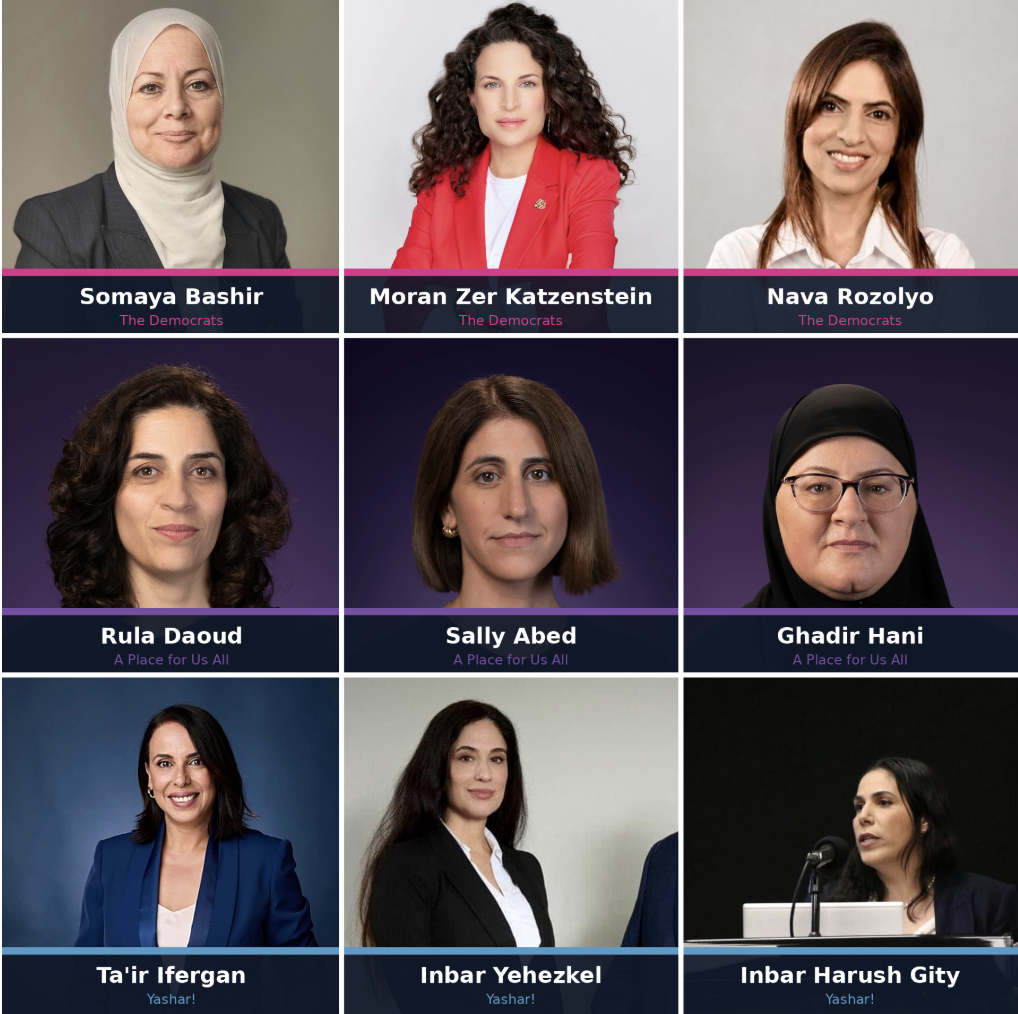
Some of the new women running for the Knesset
Something genuinely interesting is happening in Israeli politics ahead of the October 27 elections. Across the political map, parties are recruiting women, promoting women as candidates, talking about gender equality and, in some cases, building parity directly into their candidate lists.
That matters. Israel currently has only 31 women among 120 members of Knesset and has fallen below the global average for women’s parliamentary representation. Ahead of an election, the renewed attention to women in political life is therefore welcome.
But there is an important distinction between announcing women candidates and electing women to positions of power.
For those of us concerned with women’s equality, the standard has to be the same across the political spectrum. The question is not whether we agree with a particular party or candidate. It is whether women are represented, whether they are placed in realistic positions, whether parties have created mechanisms that make representation sustainable rather than symbolic, and ultimately whether women have meaningful access to political leadership
Women’s representation is suddenly trending
In good news, several parties have made conspicuous efforts to recruit women.
The Democrats adopted rules intended to create gender parity in their slate. Their July primary produced five women in the first ten positions: Naama Lazimi at No. 2, Efrat Rayten at No. 4, Gaby Lasky at No. 6, Michal Rozin at No. 8 and Somaya Bashir at No. 10. Party chairman Yair Golan remains at No. 1. The Times of Israel reported on the primary results here, and the party had explicitly designed its primary rules to guarantee gender parity.
That matters. Five women in the first ten realistic positions is not accidental representation. It is representation built into the political mechanism.
Still, the person at No. 1 is a man.
Naftali Bennett and Yair Lapid’s joint Together list announced 17 women candidates. Among the women recruited are former senior public officials, business leaders and women with substantial professional and civic experience. The four latest additions are AI entrepreneur Orly Harel, a former Likud activist who founded the party’s Jerusalem women’s forum; Bruria Naim Arman, director general of Together, a public relations specialist who previously held senior positions in the Transportation and Deputy Defense ministries; attorney Esti Ayalon Kobo, former head of Israel’s Economic Mission in China; and businesswoman and philanthropist Olesia Kantor, a domestic violence survivor who founded initiatives supporting battered women and trauma survivors. Earlier additions included Keren Terner, former director general of both the Finance and Transportation ministries and the first woman to lead the Transportation Ministry, and Liran Avisar Ben-Horin, former director general of the Communications Ministry and former CEO of Masa Israel Journey, who was the first woman to head the Communications Ministry. Bennett has also pledged that a government led by him would work toward women holding 50 percent of senior public-service positions within five years.
That is a substantial change in tone and numbers, and the focus on women has extended beyond the composition of the list to policy issues, including violence against women.
All of this reflects welcome changes. But the party is still explicitly led by two men. The women may be arriving in impressive numbers, but we still need to see where they ultimately land on the final ordered list, how many receive realistic Knesset seats and how much influence they are given over the party’s agenda.
Gadi Eisenkot’s Yashar party has publicly committed to a 50:50 division between women and men on its list. Women already announced include former minister Orit Farkash-Hacohen, former Welfare Ministry official Inbar Yehezkeli and Inbar Harush Gity. Again, the eventual ordered slate will tell us whether parity extends through the positions the party is realistically expected to win.
Yisrael Beytenu has likewise recruited a number of prominent women from business and civil society, including several women who served on the board of the Israel Women’s Network, Michaela Levin and Shelly Shamir Keinan. Shamir Keinan, a former senior business executive who has been active in promoting gender equality and women’s representation in leadership, joined Yisrael Beytenu in May. Levin, a lawyer and civil-society activist, joined shortly afterward. Another new addition to his party is the inimitable Lily Ben Ami, a force of nature who used the awful tragedy of her sister’s murder by her husband to create the organization Forum Michal Sela, which has protected thousands of women from domestic violence, promoted practical solutions for women, and raised the issue to the public sphere. These are all accomplished feminist women who have dedicated their lives to advancing women – though where they will all be placed is still unknown.
A Place for Us All has incorporated gender parity into its announced structure in the boldest way. Its initial six-person candidate group was divided evenly between women and men as well as between Jewish and Arab candidates, and the party is officially led by two people, Roula Daoud, an Arab woman, and Alon-Lee Green, a Jewish man, making it the most balanced as well as the only major party with a woman in the top spot. A Place for Us All demonstrates what we can be shooting for, and serves as a prototype highlighting the achievements as well as the limitations of what is happening elsewhere.
Women at the helm
That is progress. It is certainly better than excluding women. And there are some great women currently running, as I wrote about previously.
Still, there is one major piece missing from these actions: Women at the head of the table. These different models are worth watching because they move the conversation beyond the question of whether a party can find a few accomplished women to recruit. They raise the more structural question of where women are actually placed.
Equality is not achieved merely when powerful men are willing to choose women to stand behind them. It also requires men, and women, to be willing to choose a woman to stand in front of them.
Who do we picture at the head of the table? Whose judgment do we trust in a crisis? Who looks “prime ministerial”? Who gets described as experienced and authoritative, and who is expected to serve as somebody else’s impressive No. 2?
That is why the emerging party lists are both encouraging and revealing. They show that the demand for women’s representation is being heard. They also show us how far there is still to go.
The disappearing women of Likud
In other news, the results of last week’s Likud primary represent a new low for women.
Miri Regev finished fourth in the primary, making her the only woman among the ten highest-ranking candidates chosen by Likud members, and there is no other woman until number 20. (Two places within the top ten remain reserved and have not yet been filled, so the final gender composition may still change.)
Similarly, the Chadash Party that in the past has been quite dedicated to gender equality, does not have a woman in the top four. The woman in the fifth slot, Nihaya Wishahy, is also an impressive and accomplished woman who would do great things in the Knesset. But her chances are currently slim, and may be even worse if the Arab parties combine into a joint list which would likely bump her out of the top ten entirely.
And then there are the ones who admit that they don’t care about women. Like Chili Tropper’s new party. When asked about women’s equality, his partner, Yoaz Hendel, said that they “don’t look at gender”.
Sounds nice when someone says that they don’t look at gender? Well, not if you know anything about the history of women’s exclusion from politics. Israel currently ranks 95th in the world for women’s parliamentary representation, with women holding just 25.8 percent of Knesset seats, according to the Inter-Parliamentary Union. Israel has been moving backward relative to the rest of the world. In December 2015, it ranked 46th globally for women’s representation in parliament. While much of the world has increased women’s political representation, Israel has essentially moved backwards.
A key question, then, is not only how many women are on the lists but also where are they on the list? How many positions are actually realistic?
What do the women stand for?
Another question is what the elected women stand for. In the current coalition, the few women represented do not fight for women’s rights and protection in any systematic way. The current head of the Knesset Committee on Gender Equality frequently attacks feminists and women’s rights groups, and calls herself a “proud racist”. Other women in the coalition have actively advocated for women’s exclusion in public and in higher education, as well as from Knesset events for women (!).
Numbers of women are not a sufficient indication of whether women will be protected.
Religious Zionism, for example, produced a different configuration. Orit Strock received the most votes among candidates in its internal election and will occupy the No. 2 position because Bezalel Smotrich had previously been reelected separately as party chairman. That is a significant placement for an individual woman.
But big questions remain. For one thing, what does the entire slate look like, and how many women occupy realistic positions?
And more importantly, what does Strock represent? She has passionately supported some of the virulently homophobic legislation, and has acted as the megaphone for proud anti-LGBT legislator Avi Maoz. She also has some deeply disturbing accusations against her, including that she and her husband and their religious leader Rabbi Tau have been operating a violent sex trafficking cult that targets vulnerable and gay youth in order to “convert” them to straight via violent sexual assault. Her daughter was one of the first to go public with accusations, which Strock denied, and the daughter recently died, possibly by suicide or possibly via suspicious circumstances. Strock fought for gag orders on this story, but all these details are already in the public sphere.
Which makes Strock’s political rise not quite the celebration for women.
The standard has to be higher than women’s visibility
“It is certainly exciting that party heads are finally listening to women’s voices,” said Israel Women’s Network Acting CEO Atty. Gali Zinger. “We have been advocating for many years for women’s equal representation in leadership and
politics. But this is not enough. We need our representatives to fight for the issues that matter to women, such as equal pay, protection of women, an end to gender-based violence and sexual assault, and opportunities for women’s diverse perspectives, experience, and knowledge to impact policy.”
This election is signaling some potentially important changes. Parties are paying attention to women. Some are deliberately recruiting accomplished women. Some have introduced mechanisms designed to guarantee representation. Women who have spent years influencing public life from business, government and civil society are entering electoral politics themselves.
But recruitment is only the beginning.
A photograph filled with women does not tell us how many will enter the Knesset. An announcement that a party has recruited ten, fifteen or seventeen women does not tell us whether they will be placed in its first ten seats or its last thirty. Even a commitment to parity matters only if it is reflected in the positions from which political power will actually be exercised.
That is why the next stage of the campaign will be so important.
As the lists become final, we should be looking beyond the headline numbers. Are women in realistic positions? Are they represented throughout the slate rather than clustered toward the bottom? Are mechanisms for parity built into party structures? Do women participate in setting policy and negotiating coalition agreements? Are they appointed to ministries associated with security, finance and political power as well as those traditionally associated with care and welfare?
“After her!”
There is still one question hanging over Israeli politics that candidate lists alone cannot answer.
Israel has had women ministers, lawmakers, party leaders, judges, directors-general, military officers, academics and leaders in virtually every other sphere. Yet more than half a century after Golda Meir, the possibility of a woman again becoming prime minister still seems strangely remote.
Women are clearly ready to lead. But are Israelis ready to follow? We will shortly find out.