Geopolitical Analyst: Bridging Somaliland & Israel to the world
Words Matter: Trump Opens the Somaliland Recognition Door
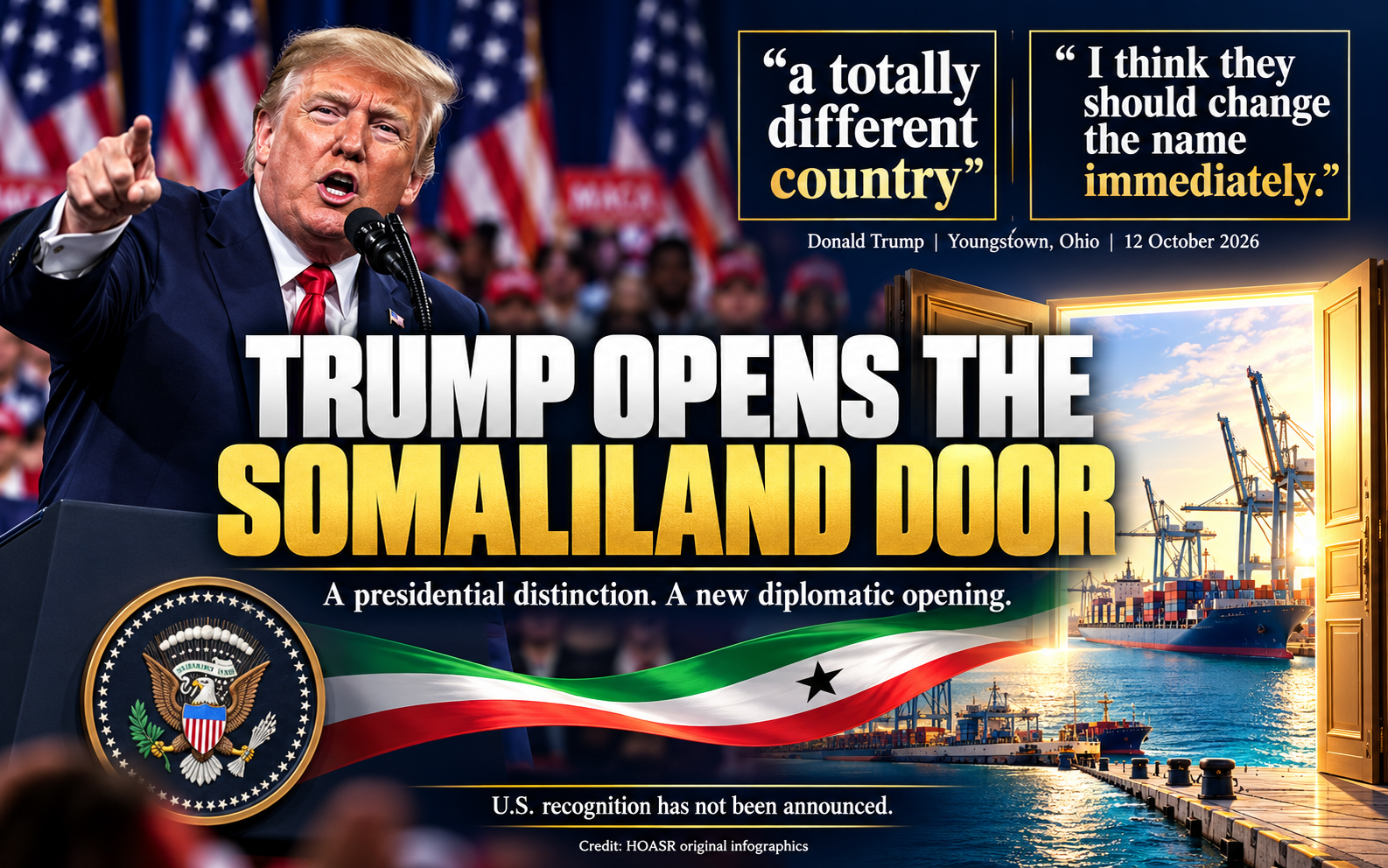
Trump’s public distinction gives Somaliland’s recognition campaign a new political opening. Credit: HOASR original infographics.
Trump’s distinction between Somaliland and Somalia—and his advice to change the name—give recognition advocates a sharper argument as Washington’s confidence in Mogadishu weakens.
Donald Trump has given Somaliland’s recognition campaign more than a memorable rally quotation. By calling Somaliland “a totally different country” and suggesting it should “change the name immediately,” he brought two longstanding Somaliland arguments into the presidential spotlight: its separate statehood and the confusion created by its name.
His remarks come as Washington questions Mogadishu’s security performance, congressional supporters press for closer engagement with Hargeisa, and Berbera’s strategic value grows.
The opportunity now is to connect the distinction Trump has publicly drawn with a practical recognition proposal—and to take seriously the naming debate he has unexpectedly joined.
Donald Trump has given Somaliland something American diplomacy has rarely offered so plainly: a sitting president publicly calling it a different country. At his Youngstown campaign rally on 12 October, he said, “I call it Somalia land, not Somaliland, because actually it’s a totally different country.”
Trump also stepped directly into Somaliland’s debate over its name: “I think they should change the name immediately.” For Somalilanders concerned about being confused with Somalia, that remark touches a serious reputational problem.
Headlines about immigration controversies, fraud and trafficking can feed sweeping stereotypes that erase distinctions between countries and communities. Individuals must answer for their crimes; Somaliland should be judged by its own institutions, conduct and achievements.
I would urge Somaliland’s leaders to begin a national consultation now on a distinctive country name, pursuing any change through constitutional procedures and public consent.
There is historical precedent: the Gold Coast became Ghana, while Ceylon became Sri Lanka or Bombay was renamed Mumbai—different circumstances, but both demonstrate, just to mention a few, how many nations did replace uncomfortable labels with identities and had chosen names of their own distinction.
A new name would not deliver recognition by itself, but it could make Somaliland’s separate identity easier to separate it from Somalia.. And there is a little diplomatic humor here: before asking Trump to sign a recognition document, Hargeisa might consider whether he will first reach for a pen—or ask them to hire a re-naming committee.
Israel broke the diplomatic taboo through formal recognition; Trump has now challenged the language that helps sustain it, publicly drawing a distinction other leaders often bury beneath references to African Union deliberations and Somalia’s territorial integrity.
His remark could now embolden others to speak more plainly. For recognition advocates, this is Pandora’s box in reverse: instead of releasing new troubles, it opens possibilities that the guardians of indefinite postponement may struggle to contain.
As viral rally clip circulates on social media, the distinction is becoming harder to keep inside Washington’s diplomatic waiting room. The remark was brief. Its political value could prove considerably larger. Rally transcript.
For many Somalilanders, the joy is understandable. After decades of explaining their history, institutions and separate political identity, the distinction has finally come straight from the horse’s mouth. Indeed this particular horse happens to occupy the Oval Office. Whatever the diplomatic machinery recommends, the buck on American recognition stops with him.
Trump announced no recognition decision. But he supplied a useful premise for one. Somaliland’s supporters should now bring together congressional backing, Irro’s diplomatic outreach and Berbera’s strategic value in a proposal the president can act on. A moment worth celebrating should also become a moment worth organizing around.
The change in language matters
In August 2025, Trump responded to a recognition question by saying the administration was looking into Somaliland and describing the issue as complex.
After Israel recognized Somaliland in December, he again withheld immediate American recognition and indicated that further study was needed. Those answers kept the door open while leaving him free to remain outside it. Earlier response.
Youngstown brought a more direct statement about Somaliland’s identity. No earlier comparable statement by a sitting U.S. president has been identified in the public records reviewed for this editorial. Since Somaliland restored its independence in 1991, American diplomacy has generally preferred more cautious language.
His acknowledgment does not prove that recognition is imminent. However, recognition advocates can now take their next approach using a distinction the president himself has already expressed in his own words and in the American public domain.
US policy: Strategic ambiguity
Washington’s hesitation has a long history. In 2007, the State Department described the African Union as the appropriate forum for resolving recognition. The 2010 dual-track approach then expanded engagement with Somaliland and Puntland while maintaining support for Somalia’s transitional government.
American officials could acknowledge capable local partners without resolving the sovereignty question. Policy history. That arrangement became comfortable for Washington and frustrating for Hargeisa. Somaliland could provide stability and cooperation while recognition remained somewhere between consultation and another consultation. Diplomatic patience is admirable; after thirty-five years, it begins to resemble a waiting room with no receptionist.
Following Israel’s recognition, Washington still reaffirmed Somalia’s sovereignty and territorial integrity. The problem for that approach is strategic rather than semantic: the United States increasingly needs practical partners along a dangerous maritime corridor. Policy should be judged by what it delivers there, including whether indefinite ambiguity makes dependable cooperation harder. U.S. position.
Congress has already built part of the foundation
Senator Ted Cruz deserves a central place in this argument. On 14 August 2025, he formally urged Trump to recognize Somaliland, linking its strategic location and security cooperation to its Taiwan relationship, interest in Israel and support for the Abraham Accords.
Cruz argued that statehood recognition would allow the partnership to serve American interests more effectively. This was a specific policy appeal to the president, rather than a general expression of sympathy. Cruz letter.
Cruz followed with a July 2026 appeal to Secretary of State Marco Rubio for a separate Somaliland travel advisory. His argument was that a blanket Somalia warning misrepresented conditions in Somaliland and discouraged useful engagement.
This is economically significant: distinctions on a map have limited value if American investors and visitors still encounter an undifferentiated warning on the State Department website. Travel advisory.
In the House, Representative Scott Perry’s H.R. 3992, the Republic of Somaliland Independence Act, was introduced on 12 June 2025 with Tom Tiffany, Andy Ogles and Pat Harrigan. Its text rejects Somalia’s territorial claims over Somaliland and authorizes presidential recognition. It supplies a direct legislative expression of the recognition argument, though introduction is not passage. H.R. 3992.
Representative John Rose’s H.R. 7993, introduced on 19 March 2026 with Ogles and Harrigan, addresses the economic side. The Somaliland Economic Access and Opportunity Act would require Treasury to report on barriers to financial access and recommend responses.
Its provisions cover recognition-related obstacles, remittances, compliance and financial messaging. It proposes an assessment and recommendations; it does not itself grant automatic banking access. H.R. 7993.
Representative Chris Smith’s H.R. 10461, introduced on 16 September 2026, adds another practical route. The Somaliland Travel and Investment Act would require the secretary of state to consider a representative office in Hargeisa and separate travel advisories for Somaliland and Somalia.
Recognition, financial access and a diplomatic presence are different policy steps, but together they describe a relationship Washington could build. H.R. 10461.
The Senate foundation also predates Cruz’s campaign. Jim Risch, Chris Van Hollen and Mike Rounds introduced S. 3861, the Somaliland Partnership Act, in March 2022; it subsequently advanced through the Foreign Relations Committee.
It sought reporting and a security-partnership feasibility study without recognition. That earlier bipartisan effort demonstrates an established constituency for engagement, rather than a new Senate recognition bill awaiting passage today. Senate record.
The foundation combines current House proposals with earlier bipartisan Senate work and Cruz’s direct appeals to the executive branch. The opportunity is to coordinate these efforts around a workable policy package. Congressional support can make a presidential decision easier to implement and harder to dismiss as an isolated impulse.
Irro made the strategic offer
President Abdirahman Mohamed Abdullahi Irro’s September visit brought Somaliland’s case into Washington’s security debate. His Hudson Institute appearance placed it alongside concern about Yemen, maritime insecurity and competing foreign influence.
In an interview conducted in late September and published by Breitbart on October 11, he described meetings with lawmakers and administration departments and offered cooperation against terrorism and piracy, alongside commercial and logistical opportunities. Irro interview.
Trump’s remark followed that outreach, but chronology alone cannot establish causation. The more defensible conclusion is that Somaliland’s argument is reaching influential American audiences while the president’s language has become more explicit.
Irro’s approach gives advocates a practical answer when Washington asks what closer relations would deliver.
China makes the choice larger than Somalia
Beijing’s role gives the debate a wider strategic dimension. China maintains a military base in Djibouti, alongside substantial commercial and infrastructure interests.
For Washington, deeper cooperation with Berbera could diversify access in a region where Chinese influence is already established. It would not require pretending that Somaliland can replace every capability available in Djibouti. China assessment.
Somaliland has also maintained its Taiwan partnership despite pressure from Beijing and Mogadishu. Reuters reported that commitment again when Somaliland opened a new office in Taiwan in June 2026. Cruz’s recognition appeal explicitly identified Chinese coercion as a reason for stronger American support.
His argument raises a clear strategic question: what message does Washington send when a willing partner absorbs pressure for its alignment and receives only indefinite encouragement? Taiwan ties.
Recognition could give that relationship a more durable diplomatic foundation. The case for it should nevertheless rest on a workable partnership, rather than treating opposition to China as a sufficient policy by itself. Somaliland’s value lies in what it can help the United States accomplish.
The regional map is becoming more dangerous
UN reporting has documented contacts and reported weapons and technical support between the Houthis and Al-Shabaab. More recent reporting describes American concern about expanding cooperation.
The significance is the potential connection between armed networks across the Gulf of Aden, increasing the value of intelligence sharing, coastal surveillance and reliable logistics. UN reporting.
Renewed fighting in Ethiopia and escalating accusations between Addis Ababa and Asmara add another source of regional instability. A negotiated commercial route through Berbera could help ease pressure over Ethiopia’s maritime access.
It would not settle the Tigray conflict, but it could offer an alternative to a widening confrontation over the coast. Regional conflict.
This is where Trump’s transactional instincts could change the calculation. A proposal offering defined security cooperation, dependable access and commercial gains may receive a different hearing from an appeal based on diplomatic fairness alone.
Hargeisa should provide clear terms, reciprocal commitments and an implementation sequence. Its sovereignty must remain the objective of negotiation, rather than a reward postponed after cooperation has already been delivered.
The Scoop: The buck stops with the horse
The president already holds recognition authority. The Supreme Court’s decision in Zivotofsky v. Kerry affirmed the president’s exclusive recognition power; Congress can support the surrounding diplomatic, financial and security arrangements.
Trump therefore does not need to wait for a recognition bill before making the decision, although congressional backing would strengthen its political foundation. Recognition authority.
His Youngstown words offer reason for optimism, rather than proof of a promised signature. The next step is to connect Cruz’s advocacy, the House proposals and Irro’s strategic offer to a serious executive decision.
Washington should assess the benefits, address the risks and stop allowing the question to drift indefinitely.
Somalilanders are entitled to enjoy hearing the distinction from the man at the top. The world now has his words on record, and everyone knows where the buck stops. The horse has spoken. Diplomacy should now put something worth signing on Trump’s desk.
Related Topics
Related Posts