Geopolitical Analyst: Bridging Somaliland & Israel to the world
Cruz Exposes Washington’s Somaliland Contradiction
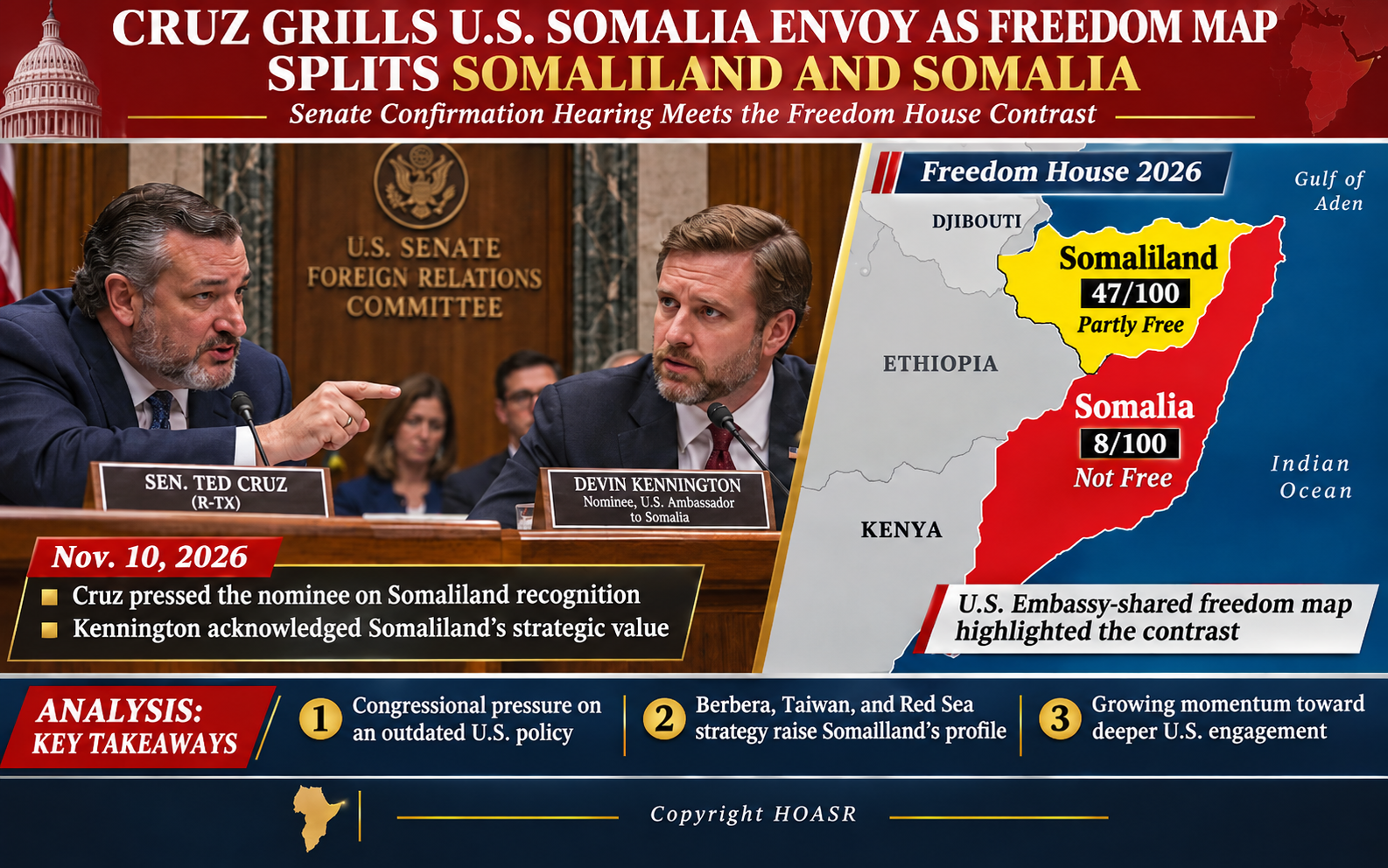
Senate confirmation scrutiny of Somaliland recognition coincides with renewed attention to Freedom House's separate assessments of Somaliland and Somalia. Illustration © HOASR.
As the State Department clings to an outdated diplomatic formula, Senator Ted Cruz forces an ambassadorial nominee to acknowledge the strategic reality Washington has spent decades avoiding. From China’s military foothold in Djibouti to Israel’s recognition and Taiwan’s partnership with Somaliland, the Red Sea map is moving faster than American diplomacy.
Washington’s longstanding policy toward Somaliland encountered an unusually direct challenge on November 10 when Senator Ted Cruz confronted President Donald Trump’s nominee for US ambassador to Somalia. What began as a confirmation hearing became an examination of a diplomatic contradiction the State Department has managed to preserve for more than three decades.
For years, American officials have responded to questions about Somaliland’s independence with essentially the same formula: the United States supports Somalia’s sovereignty and territorial integrity. That position has survived changes of administration, Somaliland’s democratic elections, growing American interest in Berbera, and the emergence of a new geopolitical contest along the Red Sea.
Cruz challenged that comfortable arrangement by asking nominee Devin Kennington to reconcile the State Department’s position with President Trump’s description of Somaliland as ‘a totally different country’ from Somalia.
When Kennington declined to endorse the president’s remarks as a recognition policy, Cruz pressed him on what was preventing the State Department from moving forward. His questions reached beyond the qualifications of one ambassadorial nominee. The hearing exposed the widening distance between Washington’s diplomatic language and the strategic realities its own officials increasingly acknowledge.
The most revealing part of the hearing was not Kennington’s refusal to endorse recognition. It was everything he admitted before reaching that familiar diplomatic boundary.
Cruz’s Strategy: Make the State Department Explain Itself
Cruz approached the November 10 Senate Foreign Relations Committee hearing with a carefully constructed argument.
He established Somaliland’s history of self-government since 1991, its competitive elections and peaceful transfer of power, its relationship with Taiwan, China’s hostility toward Somaliland’s independence, and Israel’s formal recognition in December 2025.
Kennington acknowledged these developments. He also accepted that Somaliland offered significant American commercial opportunities and played an important role in Red Sea security.
Then Cruz turned to the question Washington has repeatedly avoided: if Somaliland is strategically distinct, politically different, and increasingly valuable to American interests, why should the United States continue treating it through a diplomatic framework built around Mogadishu?
Kennington defended the existing policy supporting Somalia’s sovereignty and territorial integrity, but acknowledged that conditions in Hargeisa were substantially different from those elsewhere in Somalia. More significantly, he confirmed that greater engagement with Somaliland served American interests because of its position on China, economic opportunities, and Red Sea security.
According to the November 11 account published by Jewish Insider, Cruz demanded to know what specifically prevented the State Department from proceeding toward recognition. Kennington could not identify the obstacles.
That was also another revealing moment. The nominee could articulate the reasons for strengthening relations with Somaliland, but could not explain the barriers to recognizing it.
His inability to answer was not proof that no obstacles exist. The diplomatic objections from Somalia and the African Union are well established. But it exposed the absence of a clear explanation from the prospective ambassador about how Washington weighs those objections against its evolving strategic interests.
Cruz concluded by warning that his support for the nomination depended on the State Department following what he considered President Trump’s guidance. The senator had turned the hearing into a test of policy accountability.
The Ambassadorial Admission Washington Cannot Easily Retract
Kennington’s testimony deserves particular attention because it went further than the familiar State Department responses of earlier years.
Previously, officials could acknowledge Somaliland’s stability, welcome elections, or express appreciation for security cooperation before retreating behind Washington’s established territorial-integrity position. That formula allowed diplomatic engagement without confronting its underlying contradictions.
Yet practical engagement had already been expanding. Former US ambassador Larry André confirmed in a July 2022 interview with Somaliland Chronicle that he had visited Hargeisa and Berbera in his official capacity, met President Muse Bihi Abdi, inspected Berbera’s airport, and viewed the port from the air.
His successor, Ambassador Richard Riley, continued this engagement. In December 2024, Riley joined a senior American military delegation that met outgoing President Bihi and President-elect Abdirahman Mohamed Abdillahi Irro following Somaliland’s presidential election.
In June 2025, Riley returned to Hargeisa alongside General Michael Langley, then commander of US Africa Command, for discussions concerning security and defense cooperation.
These were not routine courtesy visits to an insignificant provincial administration. They reflected growing recognition within American diplomatic and military institutions that Somaliland had become a partner worth engaging directly.
Kennington’s confirmation testimony moved the discussion another step forward. Under Cruz’s questioning, he openly identified the strategic considerations driving that engagement.
Washington’s own nominee has now acknowledged that strengthening relations with Somaliland serves American national security and economic interests. The remaining argument concerns why those interests should continue to be managed through a diplomatic framework that does not recognize Somaliland’s separate sovereignty.
Cruz did not extract a commitment to recognition. He extracted an acknowledgment that makes the existing policy more difficult to defend without a substantive explanation.
The strategic geography is central to Cruz’s argument.
China operates its first overseas military base in Djibouti, immediately west of Somaliland, near the Bab al-Mandab Strait. The United States also maintains Camp Lemonnier in Djibouti, making the small country an important location for overlapping American and Chinese military interests.
The Congressional Research Service’s assessment of China’s Djibouti base documents the proximity of the installations and the strategic importance of Chinese naval facilities.
A September 2026 Reuters report described new Chinese communications infrastructure at the Djibouti base, drawing on research by the Center for Strategic and International Studies. Analysts concluded that the upgrades could expand Beijing’s capacity to monitor military activity across the surrounding region.
China has established a significant military and logistical presence in Djibouti. Taiwan has developed political, technical, and economic cooperation with Somaliland. Both relationships intersect with the maritime approaches linking the Gulf of Aden, Bab al-Mandab, and the Red Sea.
Yet Washington continues to maintain a recognition policy developed long before this regional strategic competition assumed its present architecture.
The United States does not need Somaliland to replace Djibouti. But an American strategy that depends heavily on access through Djibouti while failing to develop the full potential of Berbera risks overlooking opportunities for geographic diversification and strategic resilience.
Somaliland offers a potential additional partner along the same maritime corridor, with a government that has openly embraced relations with Taiwan and demonstrated interest in expanded security cooperation with Washington.
As I argued in my earlier analysis, The Bureaucracy Says Wait. The Strategic Map Says Move. diplomacy becomes increasingly costly when institutional caution remains detached from changing strategic circumstances.
Another Diplomatic Setback for Somalia’s Territorial Narrative
The same day Cruz questioned Kennington, another development illustrated the growing international visibility of Somaliland’s separate political circumstances.
On November 10, the U.S. Embassy in Australia circulated a global freedom map produced by Statista using Freedom House data. The graphic depicted Somaliland separately from Somalia, assigning them different classifications.
Somaliland received 47 out of 100, classified as Partly Free. Somalia received eight out of 100, classified as Not Free.
The underlying Freedom House assessment of Somaliland acknowledges its competitive political institutions and democratic transfers of power while recording shortcomings in civil liberties and political freedoms. The organization’s separate assessment of Somalia explicitly excludes conditions in Somaliland.
The embassy’s publication, reported on November 10 by Qaran News, did not specifically discuss Somaliland. Its message emphasized the importance of freedom to America’s international partnerships.
Nevertheless, the image created an unmistakable contrast. An official American diplomatic account shared a map that visually separated Somaliland from Somalia, while Washington’s formal diplomatic framework continued to maintain the One Somalia policy.
For Mogadishu, whose diplomatic strategy relies heavily on international acceptance of Somalia’s territorial claims, the continuing normalization of separate references to Somaliland is an unwelcome development.
A freedom index does expose a political reality that territorial-integrity declarations cannot erase: Somaliland and Somalia have developed substantially different institutions, security conditions, and political experiences.
Cruz articulated that unique difference through questioning. Freedom House demonstrated it through comparative evidence. The embassy’s circulation brought that evidence into an official American diplomatic communication. The significance of the two latest developments lies in how they reinforce the same underlying reality on the ground.
From Diplomatic Denial to Strategic Acknowledgment
Washington’s Somaliland policy has not changed overnight. Its evolution has been gradual, marked by a series of developments that increasingly challenge the assumptions behind the old approach.
For much of the period following Somaliland’s restoration of independence in May 1991, international diplomacy treated its status principally as an unresolved issue within Somalia’s political reconstruction. The emphasis was on preserving Somalia’s territorial integrity and encouraging negotiations between Mogadishu and Hargeisa.
Somaliland’s own political institutions, constitutional processes, security achievements, and elections gradually became more visible, but the established recognition formula survived.
The emergence of Berbera as a major logistics and investment project began changing the strategic calculation. The UAE-backed port expansion and Ethiopia’s interest in diversified maritime access gave Somaliland greater relevance to regional trade and security.
Taiwan’s establishment of representative relations with Somaliland in 2020 introduced an additional geopolitical dimension. American congressional interest grew alongside these developments. Legislative proposals and correspondence increasingly framed Somaliland through the language of security, commercial opportunity, and competition with China.
Cruz’s August 2025 letter urging President Trump to recognize Somaliland made that argument explicit.
The momentum accelerated further with Israel’s recognition on December 26, 2025. Israel’s official declaration placed the new relationship within the diplomatic spirit of the Abraham Accords, the normalization framework associated with Trump’s first administration.
In fact, Israel recognition broke the international longstanding barrier to contemporary formal recognition of Somaliland and gave Hargeisa a new diplomatic relationship through which to develop economic, technological, and security cooperation.
It did not remove opposition from Somalia, Djibouti, or the African Union. But it demonstrated that an internationally recognized state could make a different diplomatic calculation. The recognition debate was no longer entirely hypothetical.
President Irro’s September 2026 visit to Washington further advanced Somaliland’s recognition campaign. His engagements with American policy institutions and political figures, including Senator Cruz, brought Somaliland’s position directly into discussions about American strategic interests.
Cruz’s subsequent public statements reflected on that engagement. He called for Washington to stop treating Somaliland as interchangeable with Somalia and urged the State Department to consider a separate security assessment reflecting conditions on the ground.
Then came Trump’s October 12 rally in Youngstown, Ohio. During his remarks, the president described Somaliland as a country different from Somalia. The published transcript of the rally records the remark that Cruz later invoked during the confirmation hearing.
Trump’s language did not follow the cautious vocabulary traditionally associated with State Department statements. Cruz recognized the political opportunity as I articulated in my earlier analysis: Words Matter
By asking Kennington whether he agreed with the president, the senator reframed Somaliland recognition as a question of whether the diplomatic bureaucracy was aligned with the administration’s publicly expressed position.
Kennington’s answers revealed the gap between those policies. He affirmed the value of greater engagement but stopped short of recognition. Cruz then asked what was preventing the State Department from acting.
The senator’s strategy placed the burden of explanation on Washington’s existing policy rather than leaving recognition advocates to repeat their case indefinitely.
Sydney Extends Somaliland’s Diplomatic Reach
The next phase of President Irro’s international engagement is expected to take him to Australia. His scheduled appearance at the Jerusalem Post Australia Summit in Sydney on November 19 places Somaliland before an audience concerned with international security, business, technological innovation, and strategic partnerships.
As examined in my earlier Times of Israel analysis, *Somaliland Pushes Beyond the Containment Ring by China–Djibouti–Somalia Axis*, the significance of Sydney extends beyond a conference appearance.
Australia belongs to the Five Eyes intelligence partnership alongside the United States, United Kingdom, Canada, and New Zealand. It is also an important Indo-Pacific democracy facing strategic questions about China’s expanding regional influence.
Somaliland’s presence in such a forum provides an opportunity to connect Berbera’s maritime position, Taiwan’s technological partnership, Israel’s diplomatic opening, and American security interests within a broader Indo-Pacific discussion.
The timing is particularly notable. Cruz has just intensified scrutiny of the State Department. An American embassy in Canberra has circulated a freedom map separating Somaliland from Somalia. President Irro is scheduled to appear in Sydney under Somaliland’s presidential title.
These developments clearly demonstrate how Somaliland is building international visibility. The more Somaliland engages directly with foreign institutions, the harder it becomes to sustain a diplomatic description that ignores the separate political institutions in Hargeisa and Mogadishu.
Republicans Lost Congress, But Trump Retains Recognition Authority
The November 3 American midterm elections introduced a significant complication for the Trump administration. Democrats are projected to control both the House of Representatives and the Senate, ending Republican control of Congress and increasing the administration’s exposure to legislative resistance, investigations, and political confrontation.
However, for Somaliland recognition, congressional political power is totally different than presidential constitutional authority.
The American president retains the constitutional authority to recognize foreign states. The Supreme Court reaffirmed the executive branch’s exclusive recognition power in Zivotofsky v. Kerry in 2015. That authority does not depend on Republicans controlling Congress.
Trump’s current term continues until January 20, 2029, leaving a little more than two years in which his administration can review and potentially alter its policy towards Somaliland recognition.
Congressional opposition, regional diplomatic pressures, competing American interests, and the administration’s own priorities could influence the decision. But the loss of Republican congressional majorities does not remove the president’s ability to act.
While congressional setback for Republicans changes the political environment in Washington, nevertheless, it does not eliminate the executive pathway to recognition.
Indeed, Cruz’s intervention illustrates that congressional advocacy can still continue even as the broader balance of power shifts. His position on Kennington’s confirmation is a reminder that individual senators retain important oversight functions, although the incoming congressional composition will affect future committee leadership and confirmation politics.
For now, Somaliland must translate such growing strategic engagement into a substantive presidential policy review before the current administration leaves office.
The Policy Belongs to Another Strategic Era
The State Department’s territorial-integrity position was shaped by a diplomatic environment in which Somalia’s reconstruction and the preservation of inherited African borders dominated international discussions.
Those concerns have not disappeared. Somalia continues to assert its sovereignty, and the African Union continues to oppose Somaliland’s recognition. But the regional environment has changed substantially.
China now maintains a military base in Djibouti and has expanded its strategic reach across the Horn of Africa. Taiwan maintains a direct partnership with Somaliland. Israel has recognized Somaliland and associated that decision with the spirit of the Abraham Accords.
Berbera has emerged as a significant commercial and potential security asset. American ambassadors and senior military officers have engaged Hargeisa directly. President Irro has carried Somaliland’s case into prominent international policy forums.
Now an American ambassadorial nominee has publicly acknowledged the security and economic logic of strengthening those relationships.Cruz’s hearing did not settle that issue. It forced it into the open.
Somaliland’s case has moved from a largely excluded diplomatic claim to a subject of sustained strategic consideration. The barriers remain, but the environment in which those barriers are defended is no longer the same.
The Scoop: The Map Is Moving. Washington Must Decide.
The November 10 confirmation hearing and the U.S. Embassy’s circulation of the freedom map are not formal American recognition of Somaliland. Nor do they establish that the Trump administration has made a final decision.
Their significance lies elsewhere. Cruz demonstrated that the State Department’s position can be subjected to sustained congressional questioning. Kennington acknowledged the strategic basis for stronger American engagement. The embassy’s freedom map offered another illustration of Somaliland’s separate political circumstances.
These developments join a broader sequence: Berbera’s growing strategic value, Taiwan’s partnership, Israel’s recognition, President Irro’s Washington campaign, Trump’s public distinction between Somaliland and Somalia, and Somaliland’s expanding international diplomatic outreach.
Together, they weaken the argument that Somaliland can be considered solely through the assumptions that shaped Washington’s One Somalia policy decades ago.
For Mogadishu, the accumulation of direct international engagement with Hargeisa complicates its efforts to maintain diplomatic exclusivity over Somaliland. For Washington, it raises the cost of preserving ambiguity without explaining its strategic purpose.
Somaliland’s next diplomatic challenge is to convert these openings into durable agreements, wider international partnerships, and a clearer pathway toward American recognition.
The opportunity is real, although the outcome remains a political decision rather than a foregone conclusion.
The strategic map has already changed. China is established in Djibouti. Taiwan is working with Somaliland. Israel has crossed the recognition threshold. Berbera is increasingly relevant to the security of the Gulf of Aden.
Cruz has now compelled an American ambassadorial nominee to acknowledge part of that changing reality before the Senate.
The bureaucracy continues to defend an old diplomatic map. The strategic map has moved beyond it.
Related Topics
Related Posts