
CEO of Time to Stand Up for Israel
Would You Rather Send an Israeli Soldier or a Robot Into a Terror Tunnel?
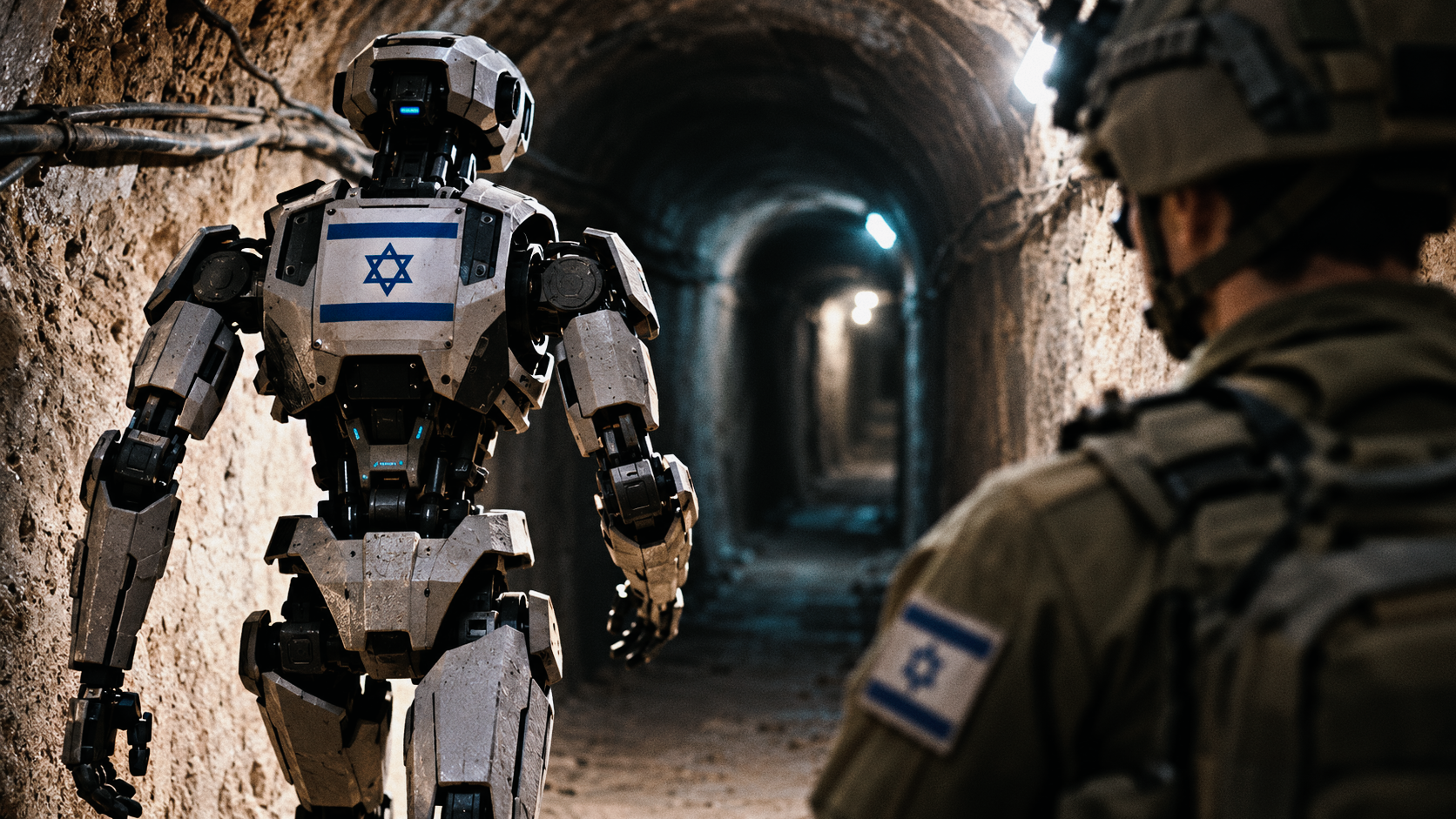
Photo Credits: Sabine Sterk (AI)
When technology can save human lives, why should Israel hesitate to use it?
A fascinating development in military technology has emerged, and once again, Israel finds itself at the center of a discussion that should concern every civilized nation. An American robotics company is reportedly in preliminary discussions with the Israel Defense Forces about supplying up to 1,000 humanoid robots for operations inside Gaza’s underground tunnel networks. These robots, known as Phantom MK1, could potentially identify trip wires, detect explosives, and neutralize booby traps. Their purpose is simple: to reduce the number of soldiers exposed to deadly dangers. And my first reaction was equally simple. Why on earth would anyone object to technology that could prevent another Israeli family from burying its son or daughter?
For decades, Israel has been forced to develop military solutions to threats that most Western countries have never experienced on their own territory. Terror tunnels, suicide bombings, rockets, kidnappings, and enemies deliberately operating from densely populated civilian areas have created security challenges that demand innovation. Hamas did not build its extensive underground infrastructure to improve the lives of Gaza’s population. It invested enormous resources in a military network designed to conceal weapons, protect fighters, facilitate attacks, and complicate Israeli military operations. While ordinary families in Gaza needed functioning infrastructure, economic opportunities, and a future for their children, Hamas prioritized the construction of an underground military system. And when Israeli soldiers are sent into those tunnels, they face the possibility of explosives, ambushes, collapsing structures, and death around every corner.
Now imagine a different scenario. Instead of sending a 20 year old Israeli soldier into a narrow passage filled with potential explosives, the IDF sends a robot. A machine that does not have parents waiting anxiously for a telephone call. A machine that does not have children, a husband, a wife, or a future that can be destroyed in a fraction of a second. A machine that can be repaired or replaced. If that robot detects an explosive device and prevents a soldier from being killed, what exactly is the moral objection? Since when has protecting human life become something that requires an apology?
Of course, there is an important distinction between using robots to detect explosives and allowing machines to independently decide who lives and who dies. The latter raises legitimate ethical and legal questions that every responsible military must address. Human oversight, accountability, the distinction between combatants and civilians, and compliance with international humanitarian law remain essential regardless of how sophisticated the technology becomes. A robot cannot simply be given unrestricted authority to kill because someone programmed it to recognize a potential enemy. But that is precisely why the debate should distinguish between defensive robotics and autonomous lethal weapons. Using a machine to inspect a dangerous tunnel is not the same as allowing artificial intelligence to independently select human targets.
What interests me particularly is the international reaction that such developments can provoke. When American or European armed forces invest in technologies designed to protect their personnel, these developments are often presented as progress. Yet Israel’s military innovations frequently become part of a much broader political argument about the country’s conduct. I am not suggesting that every criticism of Israeli military technology is antisemitic or illegitimate. I am saying that the same ethical standards must apply to every army. If a technology is acceptable when it protects an American soldier, it should not suddenly become unacceptable simply because the soldier being protected is Israeli.
There is another uncomfortable question that deserves attention. Why is the discussion so often focused on how Israel responds to threats rather than on the organizations that created those threats in the first place? Hamas constructed an underground military infrastructure beneath Gaza, turning tunnels into an essential part of its military strategy. The resulting danger to Israeli soldiers is real. Yet Israel is expected to confront that danger while simultaneously facing intense international scrutiny over nearly every operational decision it makes. Scrutiny is necessary in warfare, but it must be accompanied by intellectual honesty. A country defending its population should not be expected to sacrifice soldiers merely to satisfy the political expectations of foreign observers.
I also believe this development represents something larger than the immediate conflict with Hamas. We are entering a new era of warfare in which robotics, artificial intelligence, advanced sensors, and remotely operated systems will increasingly determine how military operations are conducted. Israel, with its extraordinary technological capabilities and experience confronting unconventional threats, has every reason to participate in that transformation. The possibility of replacing soldiers in particularly dangerous tasks is not evidence of a society becoming less humane. Under responsible human control, it can represent precisely the opposite. It demonstrates that a country values the lives of its soldiers enough to invest in alternatives to sending them into situations where death may be almost inevitable.
Naturally, the technology is not yet a proven solution. Preliminary discussions are not a signed contract, and the successful operation of humanoid robots in complex underground environments cannot simply be assumed. Questions about reliability, communications, mobility, costs, and operational effectiveness still need answers. Nevertheless, the principle is worth defending. If military technology can reduce casualties without increasing the danger to civilians, responsible governments should seriously investigate its potential.
Ultimately, my position is uncomplicated. I would rather see a thousand destroyed robots than one thousand Israeli families receiving the devastating news that their loved ones will never return home. I would rather see engineers repairing machines than surgeons desperately trying to save young soldiers who have been torn apart by explosives. And I would rather see Israel investing in technology that protects its people than accepting unnecessary casualties as an unavoidable price of defending its existence.
A robot is replaceable. A human life is not.
And if the world genuinely cares about protecting human life, perhaps it should welcome technology that can help achieve precisely that.
Related Topics