
Yayoi Kusama, Selfies, and Self-Obliteration
Every image we make of ourselves seems to add something. One more selfie, one more profile, one more clip: a little more presence, a little more of us in the world. The assumption is so ordinary that it is difficult to see as an assumption at all – that a thing repeated becomes more itself.
Yayoi Kusama, whose death at 97 was announced in late August, spent six decades testing that proposition, though she was not thinking about us when she began.
She was one of the most recognizable artists in the world, and her exhibitions drew extraordinary crowds from New York to Tokyo. In Israel, her 2021–22 retrospective at the Tel Aviv Museum of Art drew some 670,000 visitors, the most the museum had ever recorded for a single exhibition. One of the works she created for that exhibition went on long-term display at the museum in June 2025 and can be seen there today.
Kusama’s own subject was more elementary than repetition. She returned again and again to an assumption we rarely notice: that things are separate from the environments in which they appear. Her work did not simply reject that distinction. It tested how many different ways it could be made unstable.
Much of what made her instantly recognizable grew from experiences far less playful than the work can appear. From childhood, she recounted hallucinations in which patterns spread beyond the objects on which she first saw them, across rooms and surfaces and eventually across her own body, an experience she described in terms of self-obliteration.
Consider The Spirits of the Pumpkins Descended into the Heavens (2015). At the center of a yellow room covered in black dots stands a large mirrored cube. Its geometry is unmistakable, yet its surfaces return the room around it. Yellow and black continue across the cube rather than stopping where the thing begins. Its edges insist on its separateness; its surfaces work against it.
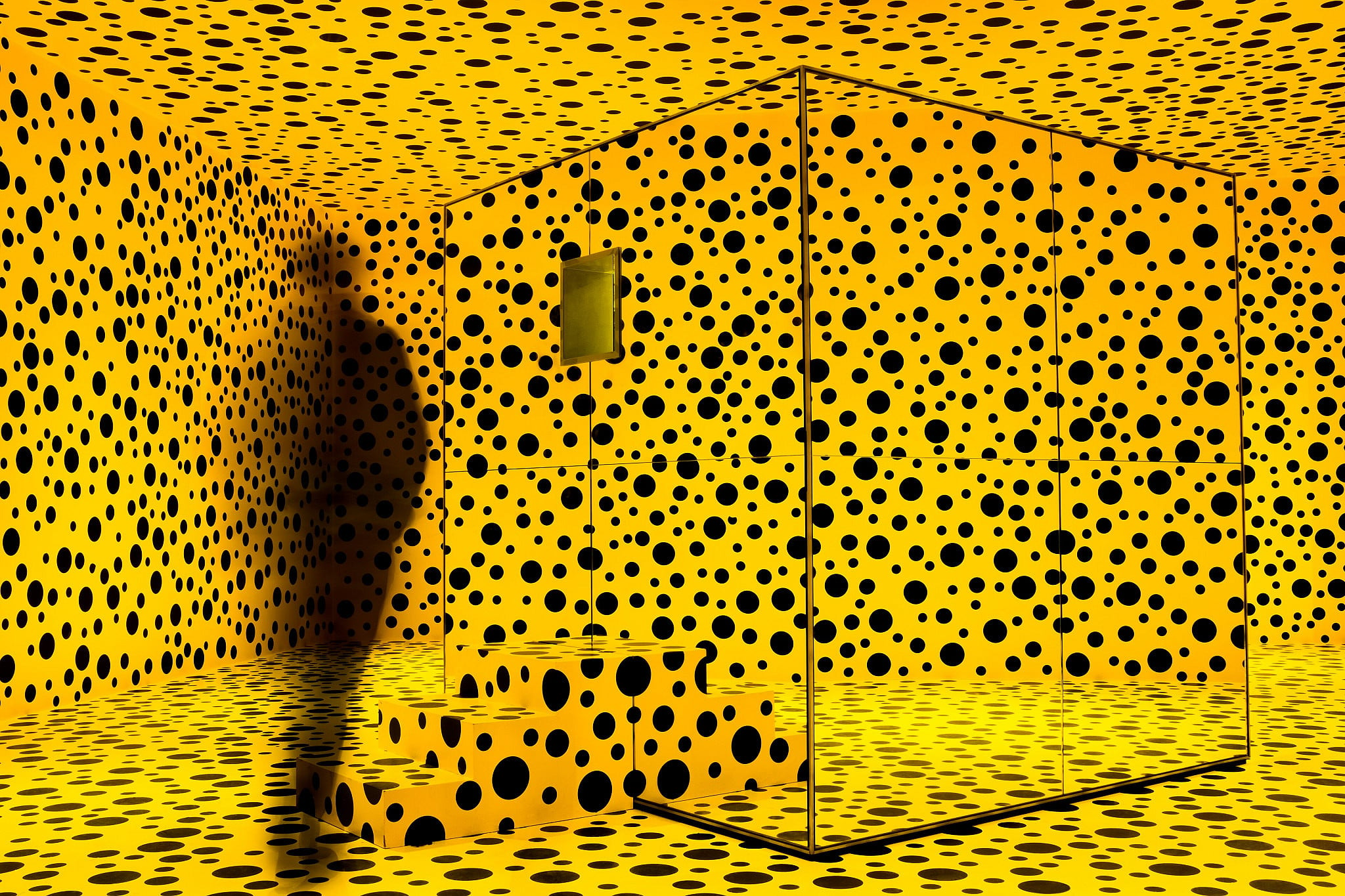
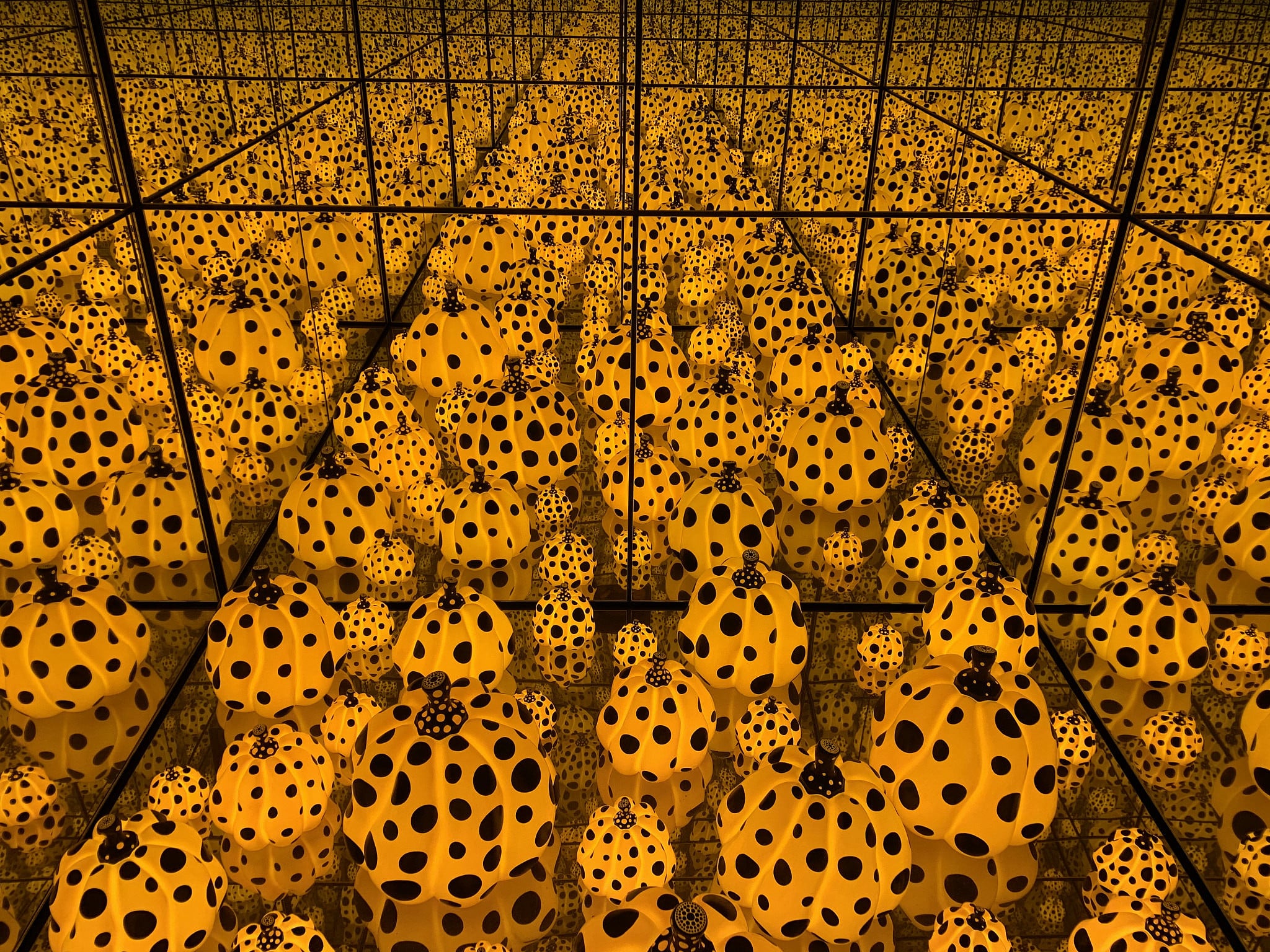
A small opening in the cube reveals another disturbance. Inside, illuminated yellow pumpkins covered in black dots are multiplied by mirrors into an apparently endless field. The pumpkins remain recognizable, but their multiplication changes their visual status: the individual thing becomes increasingly difficult to separate from the field produced by its own repetition.
The same installation thus unsettles separateness in two ways. Outside, the surrounding room spreads across the surface of a thing. Inside, the multiplication of things begins to produce an environment. The second of these is worth holding onto. Repetition here does not intensify the pumpkin. Past a certain density it converts the pumpkin into surroundings, into the field that other pumpkins appear in.
Kusama began exhibiting in Japan in the early 1950s and moved to New York in 1958, as Abstract Expressionism still dominated American art and Pop, Minimalism, performance and installation were emerging. After returning to Japan, she voluntarily entered a psychiatric hospital in Tokyo in 1977 and continued to live there, working from a studio nearby. She worked across painting, sculpture, performance and eventually entire environments, without comfortably belonging to any one movement.
She could place human beings inside the same visual field. In works associated with Self-Obliteration, dots spread across bodies, furniture, objects and the spaces around them. A woman remains recognizable as a woman and a chair as a chair, but the pattern passes across both without respecting the boundary between them. With the human figure, another distinction begins to give way. A person ordinarily occupies a privileged position as the subject among objects; Kusama’s pattern grants no such privilege. Person and thing are subjected to the same visual order.
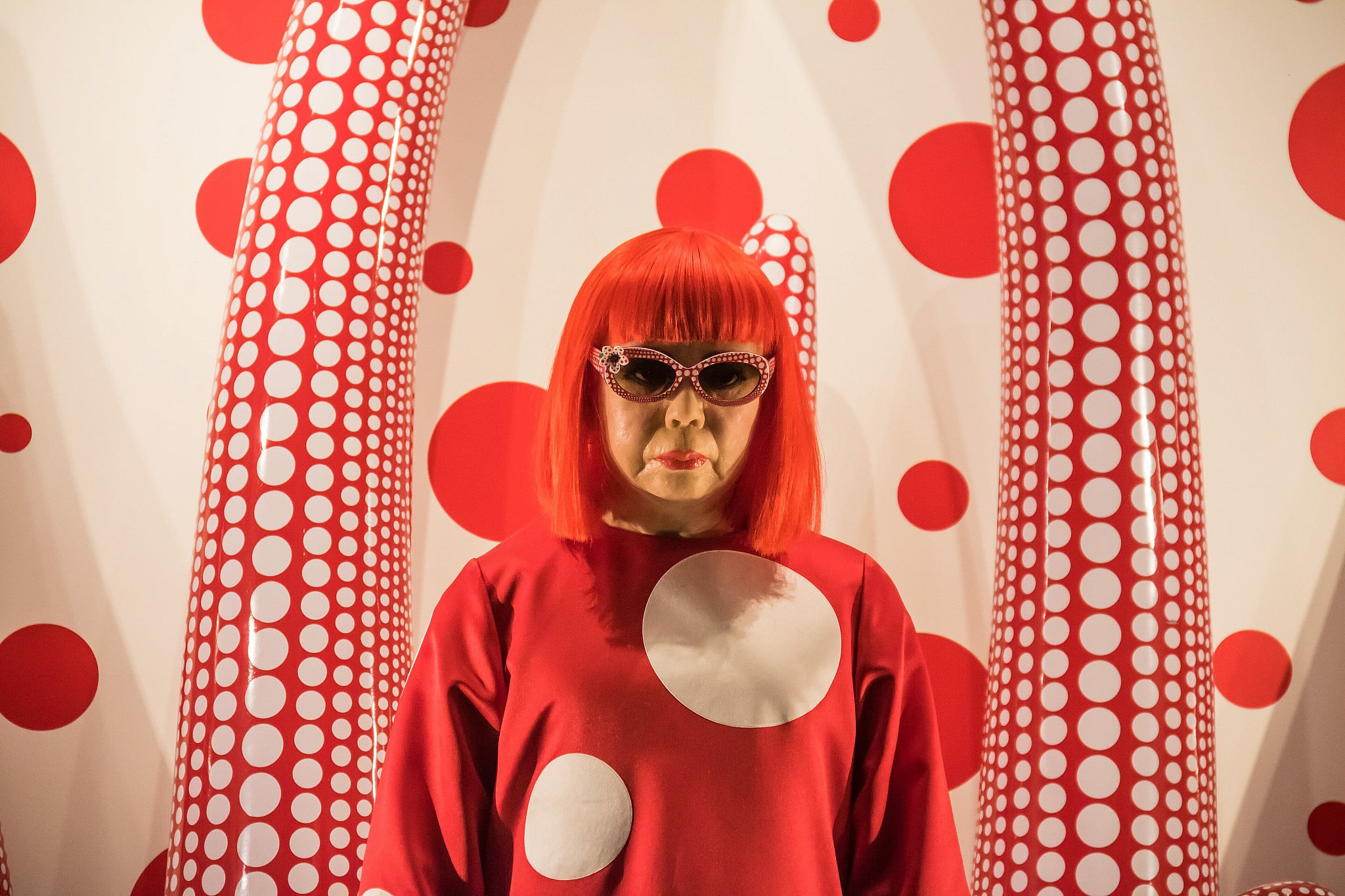
She sometimes placed herself inside that experiment. Photographed among the red-and-white forms of one of her installations, her clothes, hair and oversized dots extend its visual language onto her own body. She seems to dissolve into the environment she created, while the enormous forms rising around her resemble limbs or tentacles. As the figure becomes more like its surroundings, the surroundings themselves begin to resemble a living organism.
That reversal has a history. In 1935, in the surrealist journal Minotaure, the young French writer Roger Caillois described insects that come to resemble the surfaces they sit on. The essay was translated into English half a century later, in the art journal October. Biologists explain this resemblance as camouflage. Caillois was after something else. What draws them, he argued, is space itself: a temptation to dissolve into it rather than a way of surviving in it. He connected the idea to people who said they knew where they were but did not feel that they were there.
Something similar is happening now, for reasons that have nothing to do with insects or with Kusama. The environments most of us move through are built largely from reproduced images, a great many of them images of ourselves, and they raise their own version of the question: what becomes of a self that is reflected back, copied and distributed without limit. Kusama did not anticipate any of this. But she built an object that puts the question with unusual precision, and she built it in 1966.
Narcissus Garden approaches the relation differently from the mirrored cube. Hundreds of polished metal spheres sit together, each clearly bounded from the space around it. Yet the visible surface of each is made almost entirely from what lies outside it: the room, the floor, neighboring spheres, lights and passing visitors.
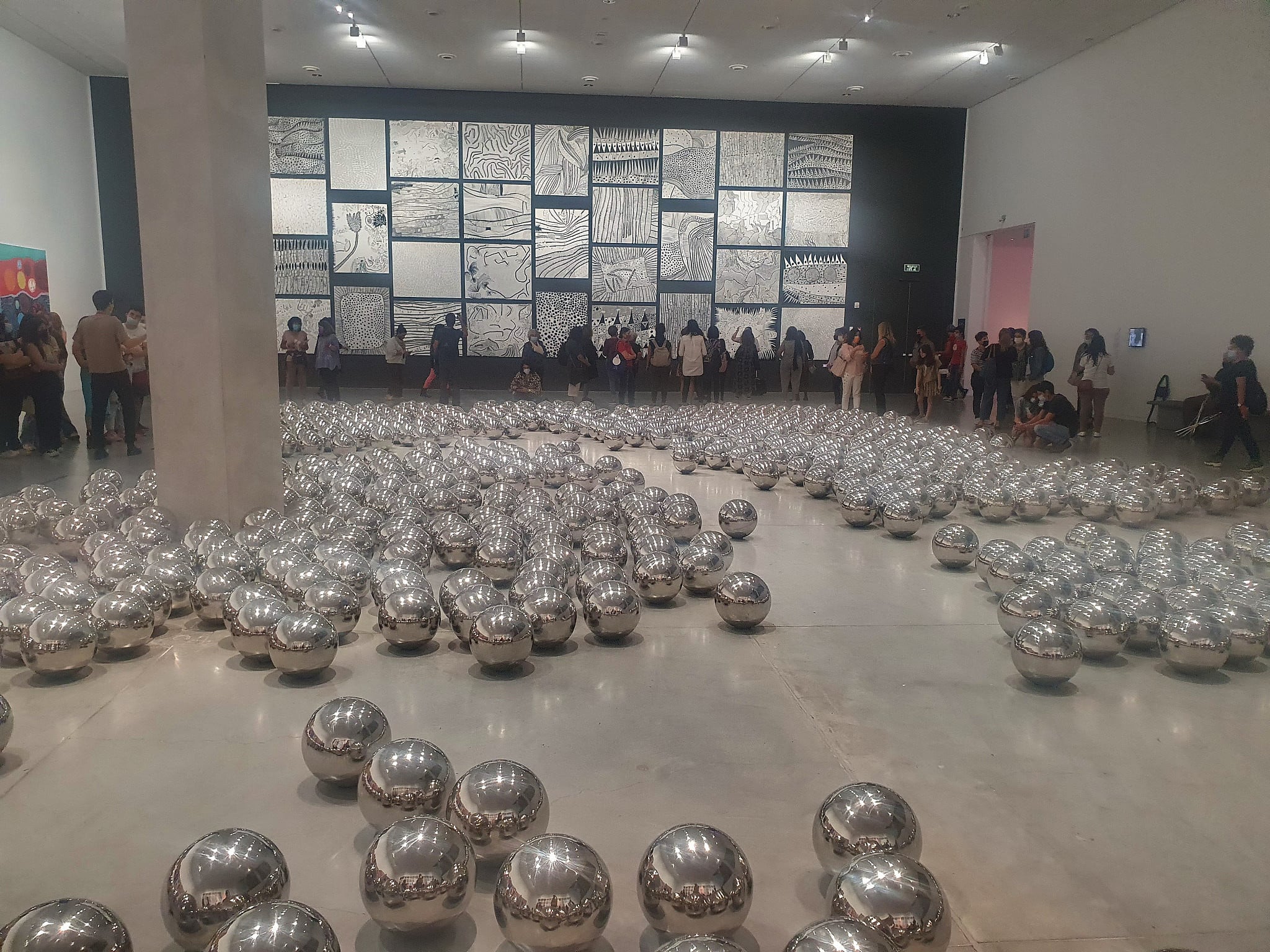
The environment is no longer merely the space containing the work; it is fragmented, curved and redistributed across the things within it. Almost everything we see on the object belongs, in another sense, to what surrounds it. And the viewer cannot remain outside the exchange. Approach one of the spheres and your image joins the walls, lights, floor and other visitors reflected there – then joins them again in the sphere beside it, and again in the one beyond that. The viewer approaches the object as a subject and returns from its surface as part of the environment.
Kusama’s Infinity Mirror Rooms produce a related effect on a larger scale. The viewer enters the work and encounters her own image repeated across the space, multiplied among lights, objects and other reflections.
This complicates a familiar criticism of Kusama’s later work. The avant-garde artist eventually became a highly commercial global brand and a social-media phenomenon, and the crowds entering those mirrored rooms to take selfies are often taken as evidence of that transformation. But the selfie does not stand quite as far outside the logic of the work as the criticism assumes.
Which returns us to where we started. We take each image of ourselves to be an addition, and at small numbers it is. Kusama’s work suggests that this stops being true. Repetition does not go on amplifying what it repeats; at sufficient scale, the repeated thing becomes part of the field itself, the surroundings against which other things are seen. What multiplies past that point is not presence.
It is another form, perhaps, of self-obliteration.