Yoetzet Halacha, Midreshet Nishmat
Yearning for the Shelah’s Prayer: A Rooftop Gathering of Hope
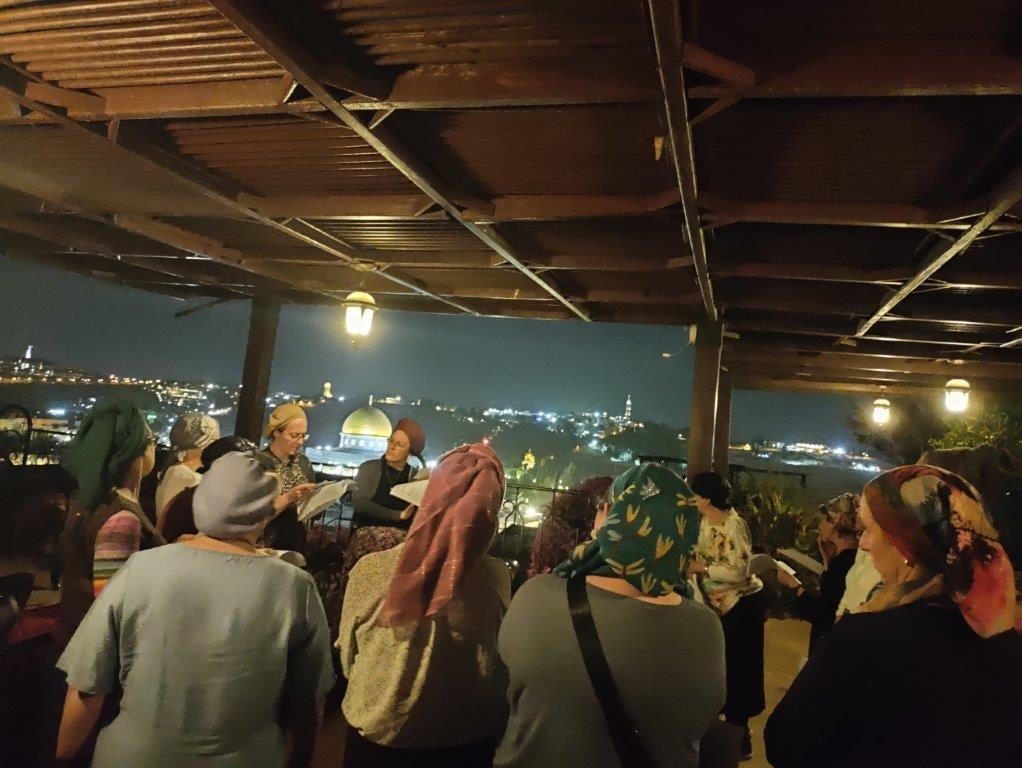
Yoatzot Halacha Fertility Counselors in prayer opposite Har Habayit
As Yoatzot Halacha Fertility Counselors, there are often moments on Erev Shabbat, after lighting candles and davening for our own families, when our thoughts turn to the women and couples we accompanied during that week.
Perhaps it is the woman who suffered a miscarriage and asked when she would be able to return to the mikveh.
The couple struggling with whether to use a donor egg and grappling with the halachic implications if the donor is not Jewish.
The woman preparing to begin her tenth round of IVF, asking why Hashem is putting her through such an ordeal.
The woman struggling with Taharat HaMishpacha as she tries desperately to reach the mikveh before ovulation.
Each story is an entire world of yearning, waiting, hoping, and so often, crying.
As we usher in Shabbat, we daven for these women and couples. We pray that their tefillot will be answered, and that our guidance and support might make their journey just a little less painful and lonely.
Last week was Rosh Chodesh Sivan. As is customary on Erev Rosh Chodesh – and especially before the month of Sivan – parents around the world recited the special tefillah attributed to the Shelah HaKadosh.
This remarkable prayer gives voice to the deepest hopes and fears of a parent: for the physical and spiritual wellbeing of our children; that they fulfill their own dreams and the dreams we hold for them; that we merit pride in them and deep connection with them; that they have health, strength, and happiness; and that they go on to build homes and families of their own.
As Yoatzot Halacha Fertility Counselors, we could not help but think of the women we counsel – women who long to one day recite this tefillah like every other parent.
Our hearts went out to them.
And so an idea was born: that we would gather to daven specifically for these women and couples who are still waiting to say the Shelah’s prayer for their own children. We would hold them in our hearts one by one, crying out to Hashem to bless them with the possibility of someday soon to stand among all the other parents saying this tefillah for their children too.
So, on the evening following Rosh Chodesh Sivan, we gathered on a rooftop in the Old City. Surrounded by the view of the Old City, the cemetery on the Mount of Olives, and the holiest of places – the Temple Mount, where generations before us have stood in prayer. There we gathered together to daven.
In preparation for the gathering, we invited people to send us the names of women and couples for whom they wanted us to daven. We planned to think about the women we had spoken with over the last year – those with whom we had shared moments of heartbreak, uncertainty, hope, and joy. But when we arrived that Sunday night, we found ourselves holding an additional list of 250 anonymous names.
Before we began, our host, Pamela Clamen, addressed us. The message to the Yoatzot was powerful: trust the Torah and learning you carry. Your answers are grounded in deep knowledge and responsibility, and you should feel confident standing behind them.
Following her moving words, we learned with Rabbanit Chana Henkin, Chancellor of Midreshet Nishmat, the Gemara in Masechet Shabbat describing the questions a person is asked upon reaching Heaven: Did you involve yourself in pru urevu (building the world)? And did you long for redemption?
Building the world is not merely a physical endeavor; it is a spiritual labor rooted in hope and longing. This duality is beautifully mirrored in the two Aronot that escorted the nation through the desert: one holding the whole, unbroken Luchot at the center of the camp, and the other carrying the broken fragments three days ahead, scouting the path to find a safe place to rest.
For women dreaming of children, this image resonates deeply. The journey to motherhood often carries both Aron HaBrit. There is the “unbroken” vision of the family they long to build, anchored securely in their hearts. Yet, there is also the Aron of the broken pieces—the painful fragments of waiting and unanswered prayers. Just as the forward Aron navigated the harsh wilderness to find peace, a woman’s quiet tears and persistent yearning are not lost; they are actively charting the path forward. In their deepest longing, these women are doing the ultimate work of yishuv ha’olam (building the world), transforming the brokenness of waiting into a sanctuary of hope.
We then gathered together in a circle. We sang softly, we said Tehillim and then we read out 250 names. 250 women and men waiting.
We prayed;
for those carrying disappointment after disappointment,
for those whose hopes have repeatedly been shattered,
for those who have endured physical pain and emotional anguish.
We prayed for those who have grown distant from their husbands, their families, or their communities through the loneliness of this journey.
For those who feel utterly alone.
For those surrounded by caring people, yet with no one they truly feel they can share.
For those who feel isolated, who struggle to find a place where they belong, because everywhere they turn, every gathering, every conversation, every simcha seems to revolve around children.
And together, overlooking the place toward which Jews have turned in prayer for generations, we carried their names and their tears with us as we cried out to Hashem on their behalf. And from the depths of that cry, we pray that these broken pieces will be transformed into binyan adei ad, and that the tears of waiting will be answered with the joyful sound of children and complete comfort, speedily.
–-
For a free consultation with a Nishmat-Gefen Yoetzet Halacha Fertility Counselor contact Whatsapp +972-2-640-4330 or through the form on the website.
Related Posts