Yes, Hamas ideology in universities is financed and programmed!
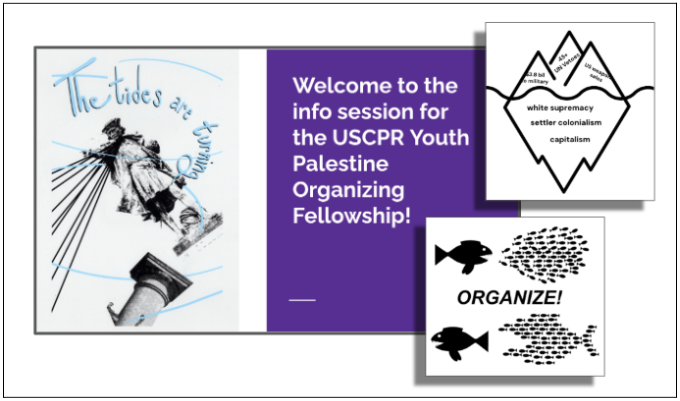
“We are Hamas.”
So declared the students of SJP (Students for Justice in Palestine) on October 10, 2023, just three days after the Hamas massacre in southern Israel. The following day, October 11, 2023, SJP Sciences Po in Paris was officially launched, following in the footsteps of its big brother on the other side of the Atlantic.
A few months later, pro-Palestinian student movements plunged the campuses of the world’s leading universities into absolute chaos, reminiscent of the darkest hours in European history.

A purely American organization?
The USCPR (US Campaign for Palestinian Rights) has adopted a more neutral name: Education for Just Peace in the Middle East.
It’s not an insignificant choice, but part of a global strategy that’s far more sophisticated and long-term than you might think. Explanation.
The USCPR was created in 2001, in the wake of the second Intifada, sparked off in Israel by Fatah and Hamas. Very quickly, the founding principles of the organization were to support the BDS campaign in every way possible, in its broadest sense (educational, political, artistic, economic, military…), thus becoming the heart of the pro-Palestinian activist network in the United States and the hub of pressure campaigns on a national scale.
The organization quickly gained a foothold in universities and among young people, and the USCPR became one of the main supporters – if not the founder – of organizations such as SJP, the student arm of BDS, JVP (Jewish Voice for Peace), AMP (American Muslims for Palestine) and CODEPINK, a feminist peace movement. As you can see, the field of minorities, as diverse as they are varied, is covered by the parent organization, and they fall into place like good contingents, ready for battle.
Once the foundations and ideology had been laid, the next step was to create the training courses, write the manuals, develop the teaching aids to unify a single line of thought, and above all find the funding to match their needs and ambitions – in other words, unlimited.
Who funds the pro-Hamas organizations on university campuses?
I’d be very tempted to say that Qatar is behind much of the funding of these organizations, but to date there are no official sources to prove this.
On the other hand, according to an ISGAP report, between 1986 and 2018, Qatar invested more than $4,955,969,671 (nearly $5 billion) in American universities, of which less than $2 billion was reported to educational and financial institutions.
At the same time, we learn that Qatar has also invested in the boards of local companies, which can then donate to the causes of their choice, without this appearing to come from a foreign entity.
But if Qatar isn’t funding the pro-Hamas student movements, who is? Who funds the students who are paid between $24 and $28 an hour to organize their blockades? Who finances the salaries of the fellowships – those USCPR members who can earn up to $7,800 for the most senior positions, and between $2,880 and $3,660 for those who are required to spend 8 hours a week actively involved in the organization and its cause?
In pole position is George Soros and his Open Society Foundation. The latest available reports, drawn up in 2022, reveal that the financier and his foundation have contributed $700,000 in funding to the USCPR. Since the outbreak of the war in Gaza, they have also been known to be very generous: tents, pizzas, grants and, presumably, legal support have been provided to students in the encampments that have shaken the country.
In second place, the Rockefeller Brothers Fund donated $355,000 to the same organization over the same period. Here again, we know that since October 2023, their solidarity has remained proportional to the outpouring of hatred witnessed on university campuses.
But what’s even more interesting to note is that this funding isn’t limited to USCPR. JVP (Jewish Voice for Peace) also benefits from a generous share of this distribution: the organization received $775,000 and $490,000 respectively from these same funding sources. This figure is particularly alarming when you consider that this organization, which claims a religious identity, is in reality nothing more than a disguised bastion of the Hamas cause in American universities, blurring the trail and serving as a relay for a nauseating narrative emanating from the terrorist movement, and in effect legitimizing anti-Semitic hatred against Jewish students who have the misfortune to be on campus.
In short, if we add to these already staggering sums the hundreds of thousands of dollars allocated to other USCPR satellite structures, as well as generous donations from other “anonymous” sources, a total of billions of dollars has been poured into radical student movements close to or directly derived from the ideology of Hamas, i.e. the Muslim Brotherhood.
A well-honed recruitment system
As mentioned above, Fellowships (or “comrades”), USCPR’s mid-managers, are paid up to $7,800 a month. When you consider that the median salary in the United States is less than $5,000, this is understandably highly motivating.
USCPR’s federating principle is based on the creation of local action poles, according to a logic structured on three levels:
- First, the Fellowships. These “comrades” are paid and are responsible for managing, training and supervising their local structure.
- Next come the support groups, organized in regular sessions. They communicate the movement’s strategies, train and coach members, and network with groups abroad.
- Finally, training courses are organized four times a year, as well as an annual retreat. These events enable members to learn how to carry out targeted actions, manage resources and, incidentally, find and generate funding.

Edited by Sophie Chemla
So… we understand that the structure is perfectly honed and highly effective. It is inspired by the model championed by Ella Baker, the African-American civil rights activist who advocated grassroots activism and collective leadership.
Thus, the Fellowship’s mission is to create its own local structure, generate campaigns to change the balance of power and influence policy, organize its resources, and act as a mentor to younger members. In short, it must prepare the next generation of leaders, to enable USCPR to grow and develop, and if necessary, beyond our borders.
Their target audience? Young people aged 15 to 35.
Their commitment? To advocate revolution, not reform.
Why is it important for Europeans to understand this phenomenon?
It is important because the United States is a human-scale laboratory for what’s brewing in Europe. We have the opportunity to observe, witness and analyze the determination with which the ideology of the Muslim Brotherhood is unfolding.
It is important because this ideology is head-on opposed to Western and democratic values, and it is unfortunately acting with great determination among the youngest members of society.
It is important because we’re discovering the scale of the resources deployed and the long-term strategy put in place.
It is important because we understand that the student movements that broke out and destabilized the academic world in the spring of 2024 were not organic, but the result of orchestrated, financed and perfectly synchronized preparations.
And finally, it is important because, even if not all pro-Palestinian student movements in Europe operate directly under the aegis of SJP, like SJP Sciences Po in France, we note that they share the same rhetoric and modes of action. Above all, we observe that in the aftermath of October 7, 2023, these movements are abounding in major universities, celebrating violent actions, the intifada, and the abolition of all that opposes their ideology.
Let’s take a closer look at the European structure
FEMYSO is a transnational European association considered to be close to the Muslim Brotherhood. It brings together Muslim youth and student associations across the continent. The youth branch of the FIOE (Federation of Islamic Organizations in Europe), it oversees more local movements, such as the LMB (Ligue des Musulmans de Belgique – Muslim League of Belgium), and maintains close links with the EMF (Etudiants Musulmans de France – Muslim Students of France) and the Turkish ICMG (Islamic Community Milli Görüs), all of which are student organizations financially supported by the European Union.
The European Union is regularly called to account for subsidies and support granted to these organizations, which promote values that are far from compatible with those defended by the European Union, and which are supposed to be a condition for the granting of aid. Unfortunately, these warnings have had no effect, and the funding continues to pour in, because “Member State authorities do not monitor or account for EU funding to NGOs.” (EU Court of Auditors report on the European Commission)
Hundreds of thousands of euros are therefore granted by the EU, directly feeding the coffers of these associations, which defend the idea that “Beauty is found in diversity, like freedom in the hijab” (Campaign supported by FEMYSO in November 2021).

Edited by Sophie Chemla
Admittedly, FEMYSO doesn’t – yet – have the firepower of USCPR, and funding doesn’t reach American heights. However, European organizations such as Islamic Relief (originally from the UK) maintain close links with student movements and benefit from grants worth tens of millions of dollars from prestigious foundations such as the Bill and Melinda Gates Foundation, even though they also find themselves implicated in the scandal of USAID grants to organizations close to or in direct contact with terrorist groups.
It’s clear. Radical student structures do exist in Europe. Their influence and narrative are transmitted directly from the United States, where their effectiveness has already been validated.
And the funding is starting to be substantial.
We need to be prepared !