
The views expressed herein are solely mine.
Brazil and Serbia Seal Black Day for Israel Allies
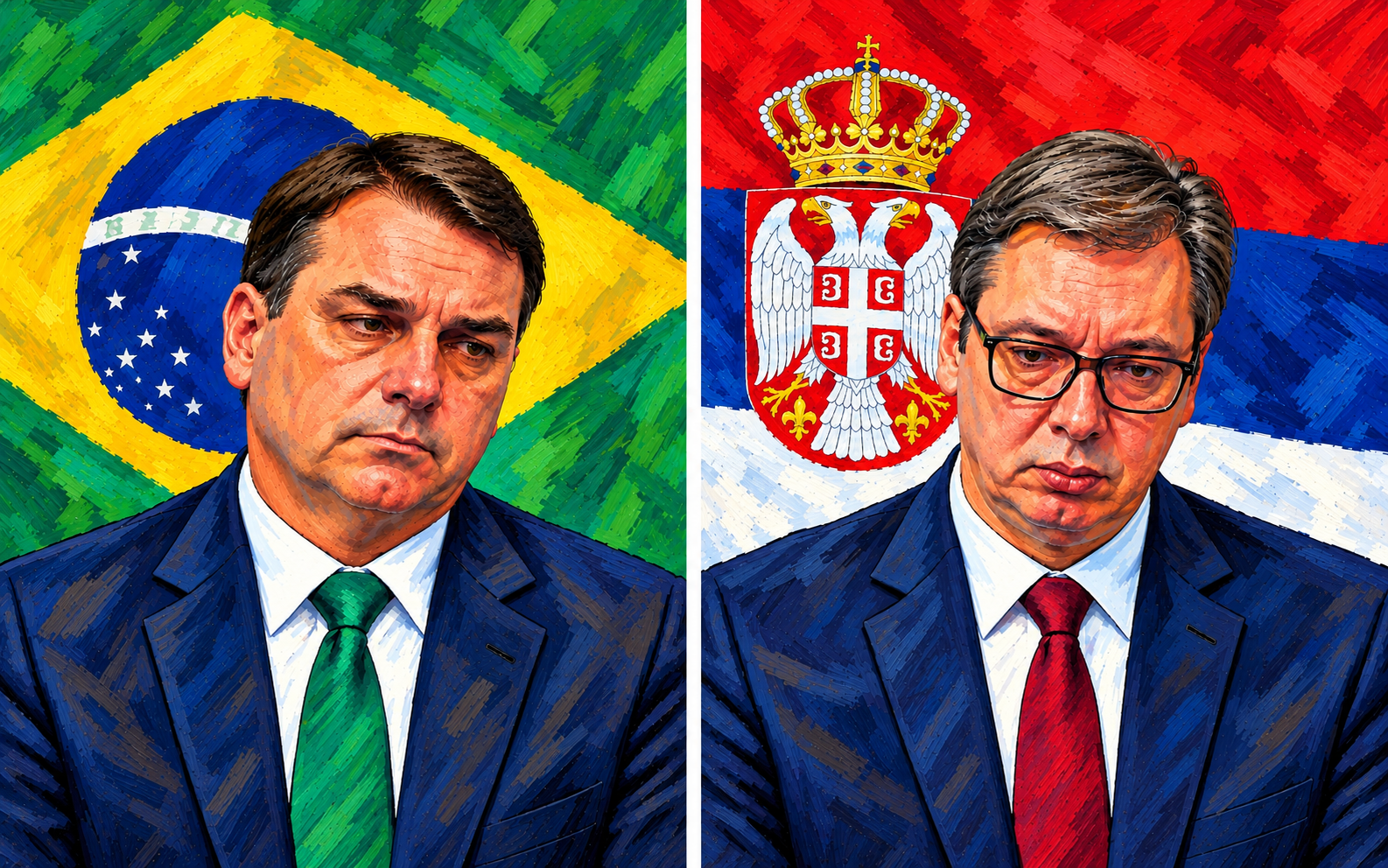
Credits: AI-generated illustration of Flávio Bolsonaro (left) and Aleksandar Vučić (right) following their electoral defeats on October 25, 2026.
In a razor-thin victory, Brazilian voters re-elected Luiz Inácio Lula da Silva—long shadowed by the Odebrecht corruption scandal—to the presidency with 51.79% of the vote (64.26 million ballots), defeating right-wing challenger Flávio Bolsonaro at 48.21% (59.83 million). Simultaneously, across the Atlantic, Serbian voters rejected former President Aleksandar Vučić’s bid to reclaim the premiership, handing a seismic victory to the student-led “Student List” opposition movement and ending a decade of unwavering Balkan support for Israeli security needs. On the same day, these twin electoral outcomes effectively closed vital pathways that could have expanded Israel’s strategic depth in both Latin America and the Balkans.
Lula’s fourth term will certainly maintain the hostile diplomatic fronts that his conservative predecessor had closed. During Lula’s third term, Brazil recalled its ambassador from Jerusalem, joined South Africa’s “genocide” case against Israel at the International Court of Justice, and publicly compared Israel’s military campaign in Gaza to the Holocaust. Beyond rhetoric, Lula expanded defense cooperation with Turkey by initiating co-production talks for drones and armored vehicles, while actively aligning Brazil’s United Nations votes with Iran, Qatar, and Algeria. These aggressive steps completely erased Brasília’s plans of recognizing Jerusalem as Israel’s capital and upended its recent pattern of diplomatic support on key United Nations resolutions.
Conversely, a victory for the Bolsonaro coalition would have positioned Brazil on the opposite trajectory. Under conservative leadership, Brazil would have joined the Isaac Accords, curbed Turkish defense market penetration in Latin America, and launched a refined-oil partnership that could have eased Israel’s high fuel costs through Brazil’s 2.3 million barrels-per-day refining capacity. Administratively, a right-wing government would have returned its ambassador, relocated its embassy to Jerusalem, and withdrawn from the ICJ case. The incoming administration would have likewise also recognized Israeli sovereignty over the Golan Heights, restored pro-Israel voting alignments at the United Nations, and reinstated the nearly one-billion-real artillery contract with Elbit Systems. In exchange, Israel would have supplied critical crime-reduction technology, water-management systems for the Brazilian northeast, and precision-agriculture tools for the Cerrado.
Vučić’s historic electoral defeat strips the Jewish state of a uniquely reliable weapons supplier in Europe. Serbian military exports to Israel had reached €114 million in 2025, with Belgrade maintaining multiple contracts to supply ammunition and critical components to Israeli forces throughout the Gaza campaign. The incoming “Student List” government in Belgrade, however, faces immediate and intense pressure from both European Union accession mandates and domestic left-wing factions to halt these sales and align with broader European condemnation of Israeli operations.
Ultimately, these dual electoral defeats closed concrete, operational opportunities rather than abstract diplomatic alignments. Brazil under the previous administration had already proven its capacity to break from Lula’s historic hostility, leveraging the 2022–2023 period to deliver tangible defense contracts, high-level diplomatic visits, and true alignment at the United Nations. Similarly, Serbia under Vučić consistently stepped up to supply vital matériel when traditional European allies delayed or restricted deliveries. The sudden ascent of these two new governments effectively freezes both pipelines—Latin American energy and diplomatic backing, alongside Balkan ammunition flows.
Oswaldo Aranha’s 1947 chairmanship of the UN General Assembly partition vote long served as the definitive benchmark for proactive Brazilian-Israeli alignment, proving how calculated procedural statecraft could outmaneuver aggressive Arab and Soviet opposition. Today, no such diplomatic pathway remains open under Lula, nor is one tenable under Serbia’s incoming leadership. By severing these vital geopolitical channels, the concurrent October 2026 election results have firmly locked in a more restrictive, adverse strategic landscape for Jerusalem over the next four years.
Related Topics
Related Posts