
Yes, You Can Quit the New York Times
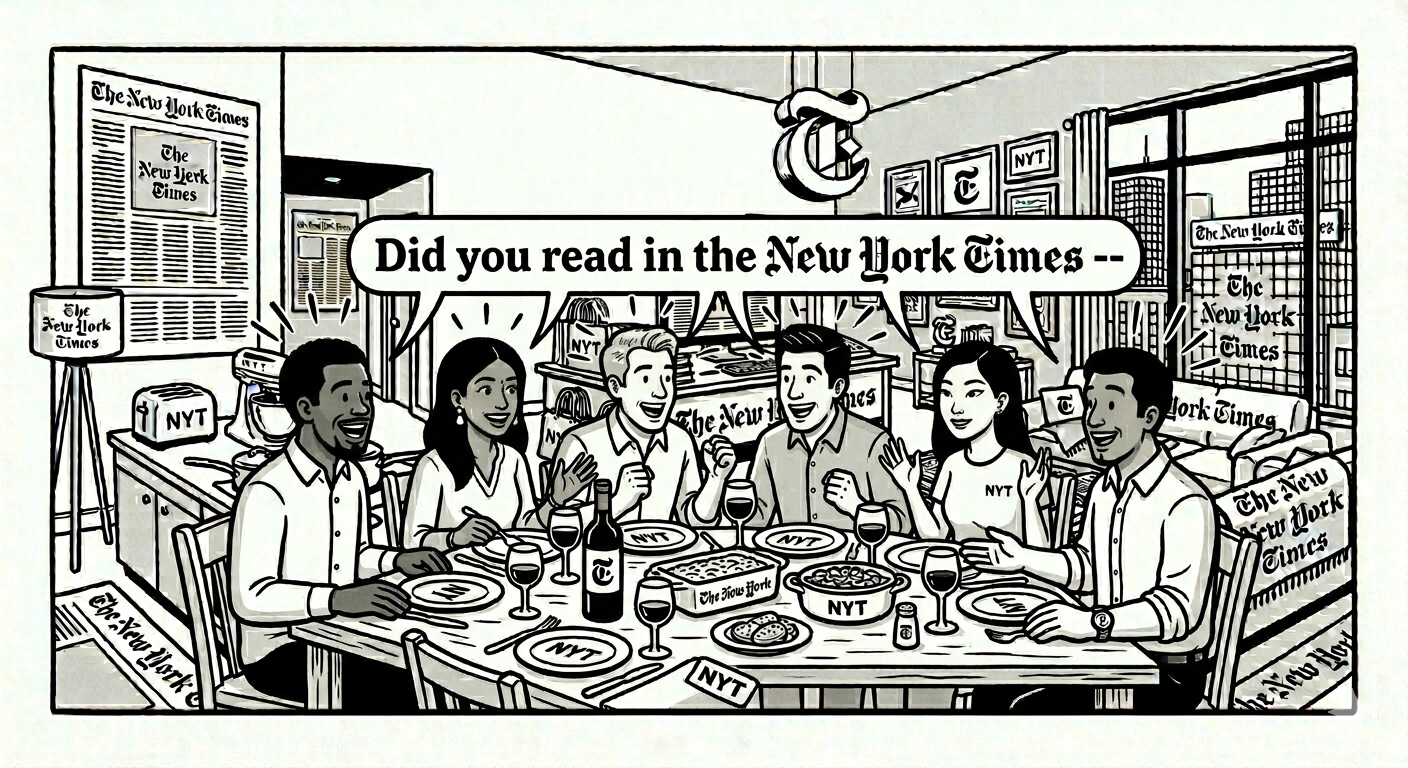
A field guide for those who know better but have not—yet.
There is a particular panic that sets in when one considers canceling The New York Times. Not fear of losing the paper so much as fear of losing the self that comes bundled with it.
“Where will I get recipes?”
“The crossword keeps my marriage alive.”
“I can’t just abandon a 200-day Wordle streak!!”
These are real concerns. I had some of them myself.
The modern New York Times is not merely a newspaper. Somewhere along the way, it somehow colonized breakfast, podcasts, recipes, games, product reviews, restaurant choices, movie reviews, and the tiny spaces in life once occupied by silence. For a certain group of us, reading the Times has become less a habit than an identity. At some point, it stopped being something we subscribed to for news about the world and became part of how we understood ourselves. It is no longer just a news source. It is a teacher, ethicist, restaurant guide, therapist, travel agent, film critic, shopping consultant, interior decorator, mechanic, political interpreter, dinner-party conversationalist, and — admittedly — a really, really good lemon pasta recipe.
And yet, for many of us, the paper’s moral and political sensibilities began to feel increasingly narrow, performative, and frankly way too predictable to be interesting. Divergent perspectives still appear from time to time, but in ways that feel curated and episodic — the exceptions to ultimately reinforce the boundaries of acceptable understanding and opinion rather than expand them.
For many Jewish Americans and their allies, after October 7, a relationship that had been wobbly became toxic — and, like many toxic relationships, hard to leave. Not because of any single story. Rather, it was the cumulative effect of framing choices, moral emphases, stories elevated and stories softened, incendiary claims later walked back, factual failures, and narratives that traveled globally long before corrections caught up. And a persistent spotlight placed on a very narrow slice of Jewish voices — overwhelmingly those that fit comfortably within the paper’s existing moral and political framework.
More corrosive than any individual error was the growing recognition that the errors always bent in the same ideological direction.
But canceling the Times no longer feels like changing newspapers. It feels like defecting from a social class — one conveniently set to auto-renew.
But here is the thing: leaving The New York Times does not require your life to shrink. In many ways, it can expand. Particularly if you resist the temptation to replace one ideological monoculture with another. You do not need one institution to provide your news, recipes, puzzles, product reviews, podcasts, movie criticism, restaurant recommendations, and hamster cage liner.
In retrospect, it seems slightly absurd that I outsourced so much of my intellectual and domestic life to a single organization. Whole Foods sells excellent cheese. But there’s something to be said for getting it from a cheese shop.
Here is what I learned from my experience quitting The New York Times.
Morning news — Straight Arrow News’s Unbiased Updates, Axios Today, and The Intelligence and Espresso from The Economist, can get you oriented in under ten minutes.
Breaking news—The Times feels like the center of the information universe until you discover the much larger reporting ecosystem around it. Reuters, AP, Bloomberg, Axios, The Financial Times, Politico, and Stat News often draw, in different ways, from the same broader stream of press briefings, wire reports, court filings, policy leaks, market disclosures, and on-the-ground reporting that now circulates globally in real time. No single institution has a monopoly on knowing what is happening in our world this very minute.
Long form news stories — RealClearPolitics offers a genuinely useful cross-spectrum snapshot of what different outlets emphasize. Ground News lays out the same story side by side across left, center, and right sources, showing the gaps clearly marked. The gaps are often the most revealing part — the gray in a world that is too often cast as black-and-white world.
Book reviews and recommendations — Goodreads remains one of the best guides to what actual readers enjoy, powered by millions of readers. BookScan tracks what people are actually buying rather than what the Times wants readers to think is selling. The Times Literary Supplement — still arguably the English-speaking world’s most prestigious literary review — offers serious and deep commentary and criticism. The Critic, The Free Press interactive Book Club, and the ever-growing universe of independent reviewers and Substacks can give a broader and more eclectic literary ecosystem.
Markets and economy — The Financial Times, The Economist, Bloomberg, and The Wall Street Journal are serious, globally minded, and genuinely excellent. Between them, they cover markets, policy, and economic trends with a depth and precision that no general-interest newspaper can match.
Film and culture—Sadly, Roger Ebert is gone, but RogerEbert.com remains a most humane and literate film site. Sight & Sound and Film Comment still publish criticism that treats cinema as art. The Atlantic, The New Yorker, and The Guardian offer cultural essays that balance intellect with readability. Letterboxd has become the most democratic film conversation in human history (think Goodreads for movies). For broader culture — books, theater, music, design — The Paris Review, Frieze, and Artforum are just the tip of an iceberg.
Cooking — Giving up this one scared me too. Alison Roman’s salted-butter chocolate-chunk shortbread rightly broke the internet. But the broader web is full of competent cooks with great ideas and clear instructions. Serious Eats, Epicurious, Food52, and Saveur offer enormous archives. America’s Test Kitchen and Cook’s Illustrated get millions of people through dinner, simple and ambitious. And Recipes.com — yes, the one you likely used in 2008 — remains weirdly reliable.
Consumer advice — In lieu of Wirecutter, consider Consumer Reports and RTINGS.com, both known for rigorous, data-driven testing and fewer of the commercial entanglements. Tom’s Guide, TechRadar, Good Housekeeping, and Which? all do solid work as well. And somewhere on YouTube there is always a man with terrible lighting and extraordinarily detailed opinions about vacuum cleaners. More often than not, he is surprisingly useful.
Travel — Condé Nast Traveler, Travel + Leisure, Saveur, and Gastro Obscura all send writers into the world. Lonely Planet, Rick Steves, Fodor’s, and the Michelin Guides remain indispensable for travelers who value reporting. The Financial Times and National Geographic Travel publish travel writing with a sense of place and history. And, of course, Tripadvisor hosts millions of travel obsessives eager to explain which Amalfi hotel has “lost its soul.”
Real estate — Like The New York Times does, Curbed. Dwell, Architectural Digest, Dezeen, and House & Garden all understand understands that real estate is partly utility and partly voyeurism and envy.
Crossword puzzles—The Times of London runs the world’s most famous cryptic crossword, widely regarded as the gold standard for clueing and a lasting influence on crossword design internationally. The Guardian, The Telegraph, The Washington Post, and The Los Angeles Times all publish excellent puzzles online, many free.
And now we come to the mountain: Wordle.
Wordle addiction is real. The good news is that Wordle remains free after you end your subscription–you do not need a New York Times subscription to preserve your streak, your reputation, or your standing in the increasingly fragile social fabric of group chats. And remember: the Times did not invent Wordle — it bought it. The very ecosystem that produced Wordle is teeming with the games that will one day define our post-Wordle world.
For many of us, The Times became a kind of cultural lingua franca — not just a newspaper, but a shared understanding of politics, food, taste, morality, travel, parenting, shopping, and even what counts as an interesting conversation.
At some point, it became weirdly normal for one institution to shape not only what a certain class of people knows, but how we furnish our apartments, choose vacations, buy dishwashers, pick books, dress — and cook pasta.
Regardless of its politics, that level of cultural concentration is just unhealthy. No institution should define so much. Especially one that, for many readers, increasingly seems to disdain them, their communities, and their values — even as it continues charging their credit card each month.
Leaving takes some effort. You have to curate your own ecosystem again, choosing among voices rather than inheriting one convenient fully bundled worldview. But the payoff is real: a sense that the world is larger, messier, more interesting, and frankly more intellectually alive than any single editorial board’s version of it.
Trust me. Your news still arrives. Dinner still gets cooked. The dishwasher you picked still works. Your friends keep texting. Your Wordle streak marches on!
Life goes on — except now with a broader range of voices, perspectives, and ways of seeing the world.
I did it. You can too.