NAnews - Nikk.Agency Israel News
Yevhen Konovalets returns to Ukraine: Jews who stood beside him in his struggle
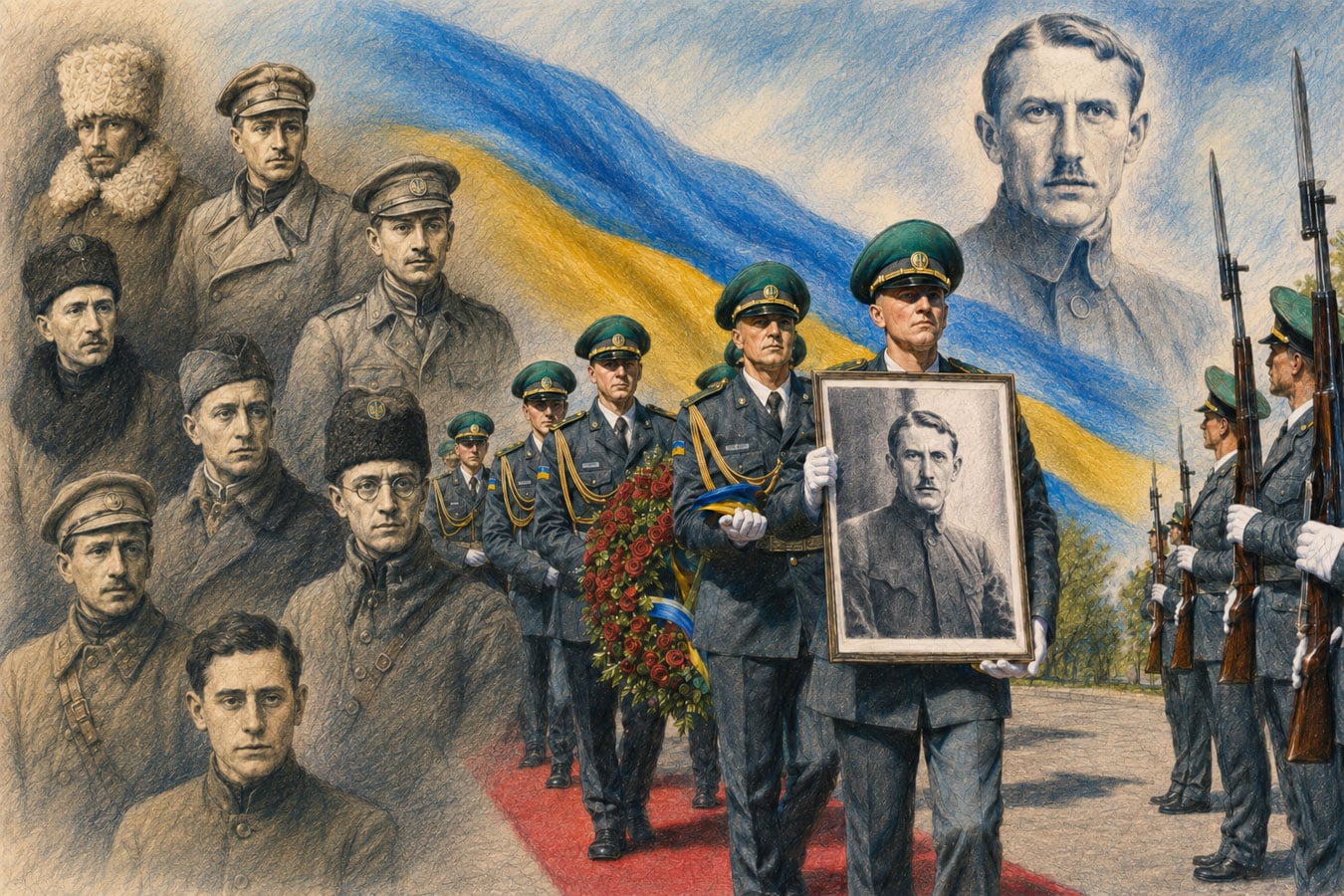
Yevhen Konovalets returns to Ukraine: Jews who stood beside him in his struggle. The image was created using AI.
On August 18, 2026, Yevhen Konovalets was reburied at Ukraine’s National Military Memorial Cemetery near Kyiv. His remains had been exhumed at Rotterdam’s Crooswijk cemetery on August 11 and returned to Ukraine on August 13, ending an 88-year period in which one of the most important figures of the Ukrainian independence movement remained buried abroad.
For Ukraine, the symbolism is direct: Konovalets fought for Ukrainian statehood when that state failed to survive, and he has returned while another generation is again defending Ukrainian independence against Russia. For an Israeli reader, however, the story is considerably more complicated, because the name Konovalets leads almost immediately to the Organization of Ukrainian Nationalists, antisemitism, World War II and the wider argument over how Ukraine remembers its nationalist movement.
I write about Israel, Ukraine and the historical connections between the two countries for The Times of Israel Blogs and NAnews. In preparing this article, I returned to archival references, biographical material and the earlier NAnews — Israel News investigation into Konovalets and the Jews around the Ukrainian independence movement. I am not presenting myself as a professional academic historian; where the documents establish a fact, I state it, and where they leave uncertainty, that uncertainty should remain visible.
August 18 changed the tense: Konovalets is no longer “returning”
Until only a few days ago, the story was about a return that was still taking place. Now the date matters: on August 18, Konovalets was formally reburied at the National Military Memorial Cemetery, with President Volodymyr Zelensky, Ukrainian officials, military personnel and clergy participating in the ceremony.
Zelensky placed the event inside Ukraine’s present-day understanding of its own statehood. The idea is not merely that an émigré political figure has been brought home, but that a commander from the failed Ukrainian state-building project of 1917–1921 has returned to an independent country with its own army, flag and political institutions.
There is also an important distinction that can easily disappear in headlines. The National Military Memorial Cemetery is the place where Konovalets has now been reburied, but Ukrainian memory institutions have described this as an interim stage: after the Ukrainian National Pantheon is established, his remains are expected to be moved there. The cemetery and the future Pantheon are therefore connected, but they are not the same thing.
This distinction matters because Ukraine is not simply transporting historical remains. It is constructing a hierarchy of national memory while fighting a war for its own survival, and the figures it places in that story will inevitably be examined outside Ukraine as well.
Before the OUN, there was the Ukrainian People’s Republic
For many Israelis, Konovalets enters history through three letters: OUN. Yet his political and military biography began much earlier. Born in 1891 near Lviv, he served in the Austro-Hungarian army during World War I, was captured by Russia, and after the Russian Revolution became one of the organizers of the Sich Riflemen in Kyiv.
He later commanded the Sich Riflemen Corps of the Army of the Ukrainian People’s Republic, the UPR. That state existed during the revolutionary upheaval that followed the collapse of the Russian Empire and fought, among other enemies, Bolshevik forces seeking to establish control over Ukraine.
The chronology is essential. The Ukrainian Military Organization, or UVO, was created in 1920 after the defeat of the UPR, while the OUN was founded only in 1929. By the time Konovalets became the OUN’s first leader, he had already spent more than a decade in military and political activity connected with the attempt to establish an independent Ukrainian state.
This does not remove the OUN from his biography, nor should it. Konovalets founded and led the organization for nine years, participated in shaping its strategy and personnel, and therefore bears historical responsibility for the movement he actually headed. But beginning his story in 1929 erases the state-building experience that explains why he became an anti-Soviet nationalist in the first place.
On May 23, 1938, Soviet intelligence operative Pavel Sudoplatov met Konovalets in Rotterdam and gave him an explosive device disguised as a gift. Konovalets was killed at the age of 46, and declassified material later showed that Soviet security structures had treated his elimination as a major intelligence operation.
The Soviet campaign did not end with his death. Documents examined in the earlier NAnews investigation show that decades later the KGB was still collecting and selecting archival material for publications whose stated purpose was to compromise Konovalets and the Ukrainian nationalist movement.
The Jew whom Konovalets trusted
The most interesting part of this history for an Israeli audience begins not with accusations but with a man named Ludwik Rosenberg, who also used the name Volodymyr Chornyi. Rosenberg was Jewish, had been associated with Poale Zion, served in the Ukrainian Sich Riflemen and later became an officer in the Kyiv Sich Riflemen and a member of their leadership circle.
Historian Yaroslav Dashkevych, who personally knew Rosenberg, wrote that Konovalets placed considerable trust in him during the period of the Ukrainian People’s Republic. Rosenberg was not simply a Jewish soldier who happened to be somewhere in the same army; he belonged to Konovalets’ immediate political-military environment and was entrusted with responsible assignments.
Before the uprising of the Directorate against Hetman Pavlo Skoropadsky, Rosenberg participated in negotiations with German military representatives. The objective was to secure German neutrality and prevent German forces from intervening against the Ukrainian units preparing to act against Skoropadsky.
After the defeat of the UPR, Rosenberg became one of the early participants in Konovalets’ Ukrainian Military Organization. Their paths later diverged: Rosenberg moved toward Ukrainian national communism and the communist movement in Western Ukraine, but that political evolution did not protect him after the Soviet occupation.
The NKVD arrested Rosenberg on October 5, 1939, and he was killed in Kyiv on July 7, 1941. Soviet investigators included his earlier service under Konovalets and participation in Ukrainian national organizations among the accusations against him.
That biography matters because it destroys an easy retrospective assumption: that a Jew could not have belonged to the Ukrainian independence movement around Konovalets. At least one did, and he was trusted enough to perform politically sensitive work.
Rosenberg was not alone — but 1919 was also a year of pogroms
Rosenberg was not the only Jew who chose the Ukrainian military project during the revolutionary period. Archival research has identified Jewish officers, cadets, medical personnel and soldiers in the armies of the Ukrainian People’s Republic and the Ukrainian Galician Army, including men who were wounded or killed while fighting for Ukrainian formations.
Semen Yakerson is one of the clearest examples. Born into a Jewish family in Vinnytsia and Jewish by religion, he volunteered for a Ukrainian formation, was wounded twice in 1919 and later reached officer rank. In one surviving questionnaire he identified his nationality as Ukrainian and his religion as Jewish, a formulation that says much about the complexity of identity in that generation.
Henrikh Dubelsky, a Jewish officer from Drohobych, served in Ukrainian formations and was killed fighting Bolshevik forces in 1920. Other documented Jewish servicemen included officers and cadets in several UPR formations, showing that Rosenberg cannot be treated simply as an extraordinary exception.
The Ukrainian Galician Army even had a specifically Jewish military formation commanded by Solomon Leinberg. The Jewish Battalion of the Ukrainian Galician Army did not serve under Konovalets personally, and no evidence establishes a personal relationship between Konovalets and Leinberg. That boundary is important, because turning separate units into a fictional picture of “Jews under Konovalets” would replace one distortion with another.
What can be said is more precise. In August 1919, Konovalets’ Sich Riflemen and Leinberg’s Jewish unit belonged to different formations participating in the broader Ukrainian military campaign against Bolshevik forces. They moved along different routes and had different chains of command, but they were fighting within the same Ukrainian state project.
At the same time, 1919 was catastrophic for many Jewish communities in Ukraine. On February 15 of that year, one of the bloodiest pogroms of the revolutionary period took place in Proskuriv, today Khmelnytskyi, where Ukrainian troops under Otaman Ivan Semesenko murdered hundreds of Jews; some historical estimates place the number above one thousand.
Konovalets’ Sich Riflemen were not in Proskuriv when the massacre began. According to Konovalets’ later recollection, his troops arrived approximately three days afterward, saw the consequences of the killings and initiated an investigation under his order.
That fact has limits, and those limits should not be blurred. The material examined by NAnews did not establish that the investigation resulted in judicial punishment of the pogrom’s organizers specifically for the murder of the Jewish population. It therefore cannot honestly be used to present Konovalets as the man who “stopped the pogrom”; it supports the narrower conclusion that his forces arrived afterward and that he ordered evidence to be collected.
Thus two realities existed simultaneously. Jews served and died in Ukrainian uniforms, while other men wearing Ukrainian uniforms murdered Jews. Any history that preserves only one of those realities is incomplete.
The 1934 letter cannot be hidden behind Jewish officers
If the story ended with Rosenberg, Yakerson and the Jewish Battalion, it would become flattering but misleading. There is also a document written by Konovalets himself on April 17, 1934, to Mykola Stsiborsky, one of the leading ideologues of the early OUN, after Stsiborsky had married a Jewish woman.
In that letter, Konovalets discussed his opposition to mixed marriages with members of peoples whom the nationalist movement viewed as hostile to the Ukrainian cause. He referred to Poles and Russians and then extended the same logic to Jews, placing Jews within a collective ethnic framework that cannot be explained by a territorial conflict with a Jewish state, because no such state was occupying Ukrainian territory.
This is an uncomfortable document, and it should remain uncomfortable. Rosenberg’s presence near Konovalets does not cancel the letter, just as the letter does not erase the documented trust Konovalets had earlier placed in Rosenberg. The evidence shows that personal relationships and collective nationalist prejudice could coexist in the same person.
Chronology also defines another limit of responsibility. Konovalets was assassinated on May 23, 1938, more than a year before World War II began, and the OUN split between the movements later associated with Andriy Melnyk and Stepan Bandera only after his death. He therefore cannot be assigned personal responsibility for every decision taken by people and organizations after 1938.
That does not mean the later development of the organization he founded is irrelevant to his legacy. Konovalets shaped the OUN for nine years, selected cadres and influenced its ideological and organizational culture, so historians are entirely justified in asking what continued from his period into the later movement. The line should simply be drawn where evidence and chronology draw it: influence may be studied, but posthumous personal responsibility cannot be invented.
Why Konovalets’ return matters in Israel
Israel was already part of Ukraine’s argument over historical memory before Konovalets came home. In May 2026, Ukraine reburied Andriy Melnyk and his wife, Sofia Fedak-Melnyk, at the National Military Memorial Cemetery, prompting criticism from Israel and Yad Vashem over Melnyk’s historical record. NAnews examined that dispute in a separate analysis of Ukraine, Israel and the problem of difficult historical memory.
The next step in that dispute was more useful than another exchange of accusations. Ukrainian parliamentarians proposed shifting the discussion toward professional archival work and a possible joint Ukrainian-Israeli historical commission, an approach that recognizes that neither political slogans nor inherited Soviet categories are sufficient for examining figures from this period.
Konovalets is an especially revealing test of that approach because his biography refuses to remain inside a single familiar label. He was a commander of the UPR army, an opponent of Bolshevik rule, the founder of the UVO and OUN, a man assassinated by Soviet intelligence, a political leader who trusted a Jewish officer, and the author of a later letter containing an unmistakable collective prejudice toward Jews. All of those statements can be true at the same time.
For Israel, the point is not to approve every choice Ukraine makes in constructing its national memory. Israel has every reason to ask difficult questions when figures associated with nationalist movements are honored, especially when Jewish history, antisemitism and the Holocaust are part of the wider historical landscape.
But difficult questions work only when they are attached to the correct dates, people and documents. Konovalets died in 1938; Rosenberg stood near him during the UPR period; Jews served in Ukrainian military formations; pogroms killed Jews in the same revolutionary era; and Konovalets’ own 1934 letter contains language that should not be sanitized. Removing any one of these facts makes the picture easier and less accurate.
Ukraine, meanwhile, is constructing its Pantheon during a war in which Russia continues to challenge not only Ukrainian territory but the legitimacy of Ukrainian statehood itself. In Ukrainian historical logic, the line runs from the state-building attempt of 1917–1921, through decades of movements that tried to preserve the idea of independence, to the restoration of the state in 1991 and the army defending it today.
That continuity does not require Ukraine to turn every historical figure into a saint. A serious national pantheon should be able to honor a person’s role in the struggle for statehood while preserving documents that reveal prejudice, political errors and moral contradictions. In fact, the ability to do both is a stronger form of historical confidence than the search for flawless heroes.
Yevhen Konovalets has now returned to Ukraine, but his reburial should not close the argument about him. For Israelis, it should open a more precise one — beginning with Ludwik Rosenberg beside him, continuing through Jewish officers in Ukrainian armies and the victims of the pogroms, and reaching Konovalets’ own difficult words in 1934.
Ukraine will decide whom it places in its national Pantheon. The more important measure of that Pantheon will be whether the country can remember those people whole, while Israel’s challenge is to judge them by the same demanding rule: not by inherited labels, but by dates, documents, actions and the boundaries of what can actually be proven.
Related Topics
Related Posts