From memory to meaning to action
Yom HaShoah Doesn’t Live in Our Homes. It’s Time It Did.
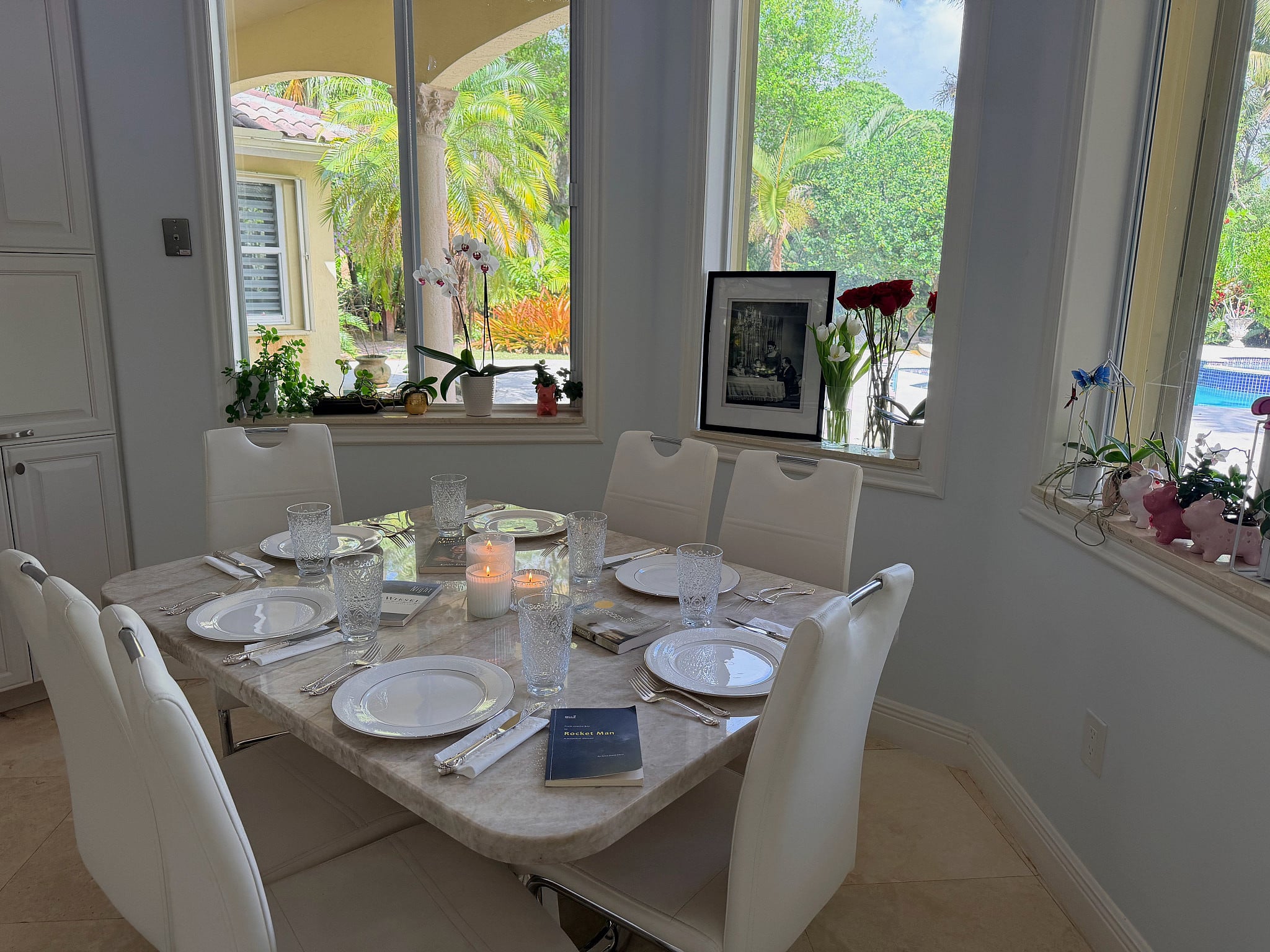
A Yom HaShoah table set at home, with candles, a family photograph, and survivor memoirs, creating space for remembrance and conversation across generations.
Yom HaShoah in Miami used to draw hundreds of Holocaust survivors to gatherings across the city, including outdoor ceremonies at the Holocaust Memorial in Miami Beach. I remember standing there with my grandparents and their friends. Their wrinkled skin and the way each of them aged differently stayed with me. Each survivor had a distinct personality. I remember my grandparents crying, and yet also smiling at me. I remember hugging them, listening to them sing along, and feeling something I didn’t have words for.
What didn’t follow the ceremony was a clear, deliberate way of honoring Yom Hashoah in my own home.
Now that my grandparents are gone, the day feels different. It’s not that it feels less important, or distant from my life. I share their stories often, as a docent and through 3GMiami. In many ways, their memory is still present in my daily life. But when they were alive, I wasn’t creating meaning. I was entering into theirs. The day lived in them, in their presence, and in their complex emotions. I didn’t need to explain anything or start a conversation. Just being with them made the day feel real and heavy and meaningful. Now, that doesn’t happen on its own. What’s missing is my grandparents holding my hand and sharing their emotional stories. And without them, I can’t rely on that presence anymore.
Year after year, I attend ceremonies in synagogues, schools, and public memorials. I listen, I stand in silence, and then I leave, seamlessly returning to my daily routine. I’ve begun to feel that showing up isn’t enough. The day should include creating intentional space for these stories in my own home, in a way that invites my children into them. I’ve started to wonder what my children will actually take with them when I’m no longer here to tell my grandparents’ stories.
In Israel, a siren sounds commemorating the day and the entire country stops. Young children notice and ask questions. The day enters the home whether it was planned for or not. In the United States, it doesn’t. If I don’t go to a ceremony, the day can pass quietly, almost unnoticed. If this day is going to have meaning in my home, I have to create it, talk about it, and bring it in.
For my grandparents, that was never the case. Memory didn’t live in institutions for them. It lived in them.
My grandfather, Boris, always had the biggest smile across his face. He would grab me for a dance and make me giggle, sometimes even popping out his dentures just to prolong my laughter. And yet he told his Holocaust stories with that same smile. He described his father’s long white beard being shaved so closely that the Nazis took his skin with it, his own handkerchief stuck to his face with blood. And still, he was smiling, remembering his father.
My grandparents didn’t remember in the same way. My grandfather spoke about his experiences often, sometimes even with a sense of energy, especially when he told the stories of helping other Jews escape. There was something almost adventurous in the way he described those moments, even within the horror. My grandmother, Rose, was different. She was mostly silent, except for the moments she chose to share with me.
I remember going with my grandfather to the Holocaust Memorial in Miami Beach after my grandmother passed away. He didn’t want to go alone. We walked arm in arm as we approached the outdoor memorial space, where people had gathered.
There were protesters shouting nearby, turning something deeply personal into something loud and public. My grandfather tightened his arm around mine, and I tried to steady him, to shield him from what was happening around us. He didn’t have a cemetery to visit his family. The memorial was his cemetery. And I remember thinking that this wasn’t what a visit like this was supposed to feel like.
For my grandparents’ generation, a public day of mourning made sense. They were the memory. They carried it in their bodies, in their silences, and in the lives they rebuilt.
But we are not them. And without them, something essential doesn’t automatically continue on its own.
My children are no longer little. The window for what I pass to them isn’t closing, but it is changing. That realization has made something clearer to me: if remembrance exists only in public spaces or formal settings, it risks becoming something my children encounter occasionally, rather than something that shapes how they think, what they value, and how they choose to live.
It is not enough to simply know what happened. I want my kids to engage with the history, to think about human nature, about moral choices, and about what allows people to harm others and what allows others to help, resist, and rebuild. These are not only stories of loss; they are also the lessons that can influence the kind of people they become and the lives they choose to lead.
But how do you bring their stories into the home in a way that still feels as meaningful as it once did when they were still here?
For years, I wasn’t sure that you could.
My 17-year-old son once told me he doesn’t like thinking about the Holocaust. It’s too depressing. He wants to avoid sadness. I understood exactly what he meant, and it made me realize something uncomfortable: if Yom HaShoah only feels like sadness, the next generation will turn away from it.
Then I remembered a moment we shared in Poland. We were standing inside an old synagogue the Nazis had tried to destroy when a group of Israeli teens began singing and dancing in a circle. My son didn’t hesitate, he joined them. I watched him put his arms around the other kids, smiling and singing, teenagers in a place filled with absence and loss choosing unity and joy for a few moments. Not instead of the history, but alongside it.
It didn’t feel disrespectful. It felt necessary, like they were reclaiming something, not just the space, but themselves.
That’s when I began to understand change is needed.
Who knows what this should look like or can become? But I know this: I want to bring Yom HaShoah into my home in a more intentional way. I want to sit with my family and tell Holocaust stories, not only how our ancestors suffered, but who they were, the values they lived by, and the lives they rebuilt after everything was taken from them.
I want to feel the grief, but also make room for something else alongside it: gratitude, resilience, even moments of connection that make the next generation willing to step closer rather than turn away.
Because what my children take from this will not come from a ceremony. It will come from what we choose to create at home. From the stories we tell. From the values we make room for around our own table. If I don’t do this, then it risks becoming just another date. And I lose the chance to pass on not only what my grandparents suffered, but how they chose to live.
The kindness they showed when they had nothing.
The way they held onto their humanity.
The understanding that no group of people is disposable.
One day, my children will tell these stories. And when they do, I hope what they pass on is not only memory, but the values that come with it. Love. Compassion. The responsibility to see other people as human.
Related Topics
Related Posts