Professional Indian author and strategic affairs writer.
You Cannot Divorce Someone You Were Never Officially Dating
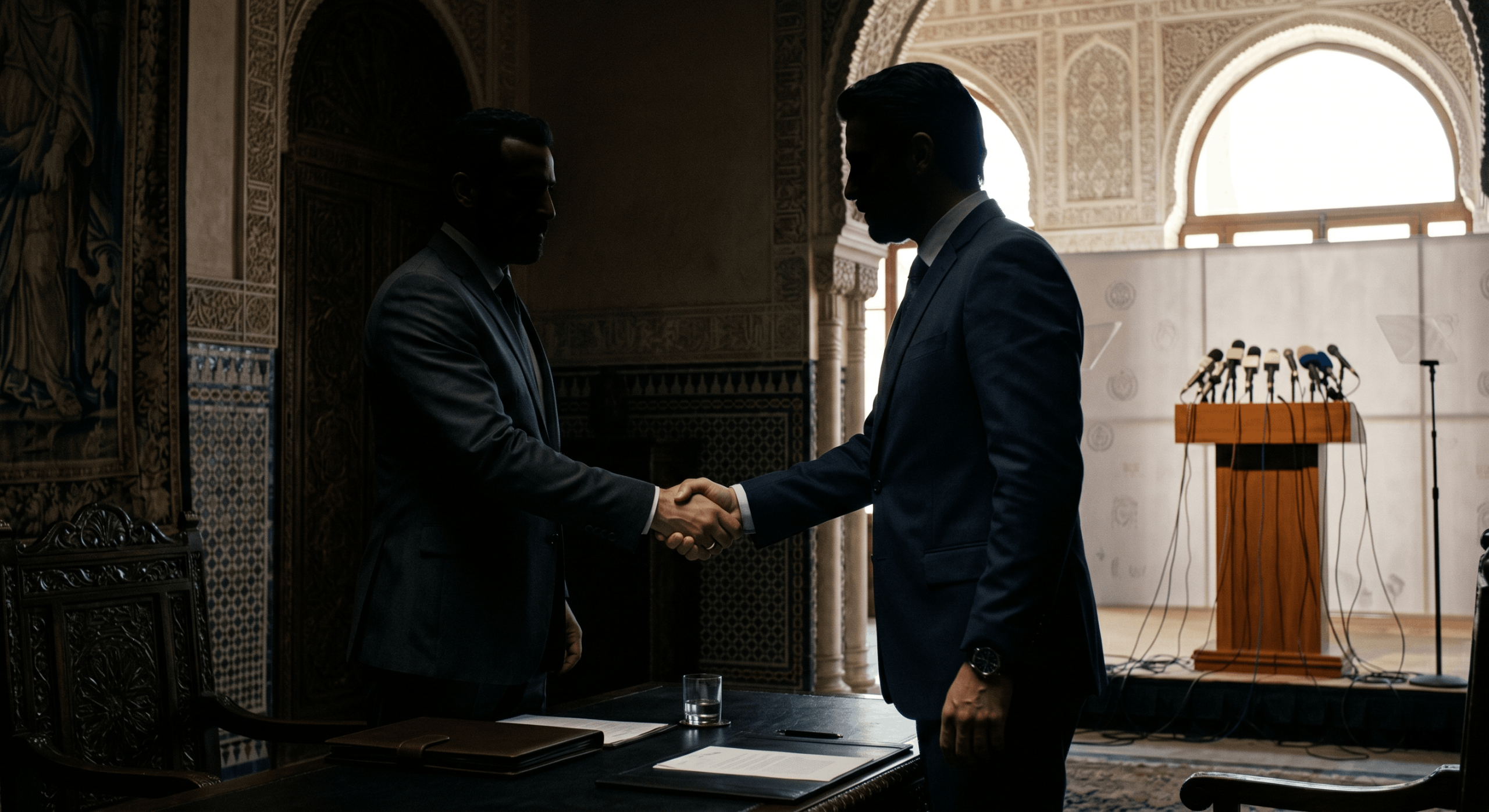
Conceptual illustration: Two figures engage in a discreet handshake within the dark shadows of an opulent palace antechamber, standing in stark contrast to the brightly lit, empty press podium behind them, symbolizing the hidden realities and quiet deals that drive high stakes geopolitical diplomacy away from the public eye. Image: AI generated (Google).
In August 2020, the United Arab Emirates announced it was normalizing relations with Israel. The world called it historic. American diplomats called it a breakthrough. Trump called it a miracle. The Abraham Accords, signed on the White House lawn on September 15, 2020, were presented as the dawn of a new Middle East: ancient enemies finally finding common ground, Arab states finally making peace with the Jewish state.
I read all the coverage at the time and kept thinking the same thing: What exactly are we celebrating the beginning of when most of this was already happening?
The handshake on the White House lawn did not build a new relationship. It put a name tag on one that already existed.
Start with Morocco, because Morocco’s story is the most extraordinary and the least told.
Morocco has kept secret relations mostly intact with Israel since the 1960s, when King Hassan II established clandestine links with Tel Aviv. In September 1965, Arab leaders gathered in Casablanca for a summit to discuss Israel. King Hassan II, who did not trust his guests from the Arab League, secretly recorded the discussions and gave the recordings to the Israeli Mossad. A joint Shin Bet and Mossad team known as “The Birds,” co-led by Peter Zvi Malkin and Rafi Eitan, was initially stationed on an entire floor of the Casablanca hotel. Hassan asked them to leave a day before the conference began, fearing discovery, but immediately after it ended, the Moroccans gave Israeli intelligence everything they had recorded.
The recordings revealed that the Arab states were preparing for war but were deeply divided and ill-prepared. Mossad chief Meir Amit described the Casablanca operation as “one of the greatest moments of Israeli intelligence” in a memo to then-Prime Minister Levi Eshkol. The Six-Day War of June 1967, the conflict that reshaped the entire Middle East and whose consequences are still playing out today, was made more decisive in part because a Moroccan king secretly fed intelligence to Israel while publicly sending Moroccan troops to fight alongside Egypt against those same Israeli forces.
Read that again. Morocco helped Israel prepare to win the Six-Day War. Morocco also sent soldiers to fight against Israel. Both things happened simultaneously, with neither side officially acknowledging the other. Calling it hypocrisy undersells how structurally embedded the double reality was. A country maintained two entirely separate foreign policies, each completely sincere in its own arena, across the same period of history.
In 1976, Rabin came to Morocco for secret talks with King Hassan, disguised in a shaggy wig, mustache, and fake glasses. A year later, in 1977, Rabat hosted clandestine talks between Israeli Foreign Minister Moshe Dayan and Egyptian Deputy Prime Minister Hassan Tuhami, setting the stage for President Anwar Sadat’s landmark visit to Israel. Dayan made his secret trip to Morocco, donning a fedora and removing his signature eyepatch. The meetings Dayan held in Morocco in September 1977, facilitated by Hassan II, directly preceded Sadat’s November 1977 visit to Jerusalem, which led to the Egyptian-Israeli Peace Treaty of 1979.
Two Israeli prime ministers and a foreign minister visited a country that officially had no relationship with Israel. Each one arrived in disguise. The most important peace agreement in Middle Eastern history was brokered in secret inside an Arab country that officially rejected Israel’s legitimacy.
Morocco established the regional standard.
Saudi Arabia has a long history of clandestine cooperation with Israel against mutual enemies. In November 2020, Netanyahu and Mossad chief Yossi Cohen reportedly flew to Neom, a city on the Saudi Red Sea coast, for a secret meeting with Crown Prince Mohammed bin Salman and US Secretary of State Mike Pompeo. Saudi Arabia’s official position at the time was that it would never normalize with Israel without a Palestinian state. Nobody in Neom seemed particularly concerned about that.
The UAE was operating the same way, at a level of institutional depth that only became visible after 2020. Mossad chief Yossi Cohen highlighted his personal involvement in restructuring the Emirati security apparatus to institutionalize and facilitate cooperation between the two parties years before the Abraham Accords formalized anything. The Mossad was helping to build the UAE’s security infrastructure while the UAE’s official position held that it had no relationship with Israel. Both of these things were simultaneously true for years.
When Israel bombed the Iranian Embassy in Damascus in April 2024, the UAE and Saudi Arabia provided Israel with intelligence and active radar-tracking during Iran’s retaliatory response. That cooperation required trust, integrated systems, and shared threat assessments that take decades to build. You do not provide real-time radar tracking for a country you met last year.
The question worth asking is why all these countries maintained such elaborate official fictions for so long.
The answer has two parts, and they are both uncomfortable.
The first is Iran. Shared cybersecurity threats and shared concerns about Tehran aligned the Gulf states and Israel around common threat perceptions long before any public relationship existed. When you face the same enemy, the ideology separating you from a potential ally starts to feel less important than the practical question of survival. The Gulf monarchies and Israel disagreed about Palestine. They agreed, completely and urgently, about Iran. That shared threat drove covert cooperation for decades. The Palestinian issue gave each party the cover of public hostility it needed for domestic and regional audiences.
The second part is harder to say plainly. Palestinian leadership was not consulted, and its interests were not the priority. The relationships formalised in 2020 were built on decades of Arab governments privately deciding that their own security mattered more than their public commitments to Palestinian statehood. The Accords formalized a bargain that had already been struck, quietly and repeatedly, in hotel rooms and palace antechambers across the region.
Morocco signed the first-ever defense cooperation agreement between Israel and an Arab state in November 2021 and has since purchased Israeli military equipment worth approximately $2 billion. That speed, moving from formal normalization to a two-billion-dollar arms deal in two years, only makes sense if you understand that the relationship had been running in the background for sixty years.
The four states that signed the Abraham Accords were the first Arab states to establish public ties with Israel since Egypt in 1979 and Jordan in 1994. Egypt’s peace treaty is now 47 years old. Jordan’s is 32. Both countries maintained cold, functional, deeply unpopular official relationships with Israel throughout that period. Both also maintained warmer, more substantive back-channel cooperation that their publics never fully knew about.
The pattern across seventy years is consistent. Hostility in the speeches. Cooperation in the shadows. Official rejection of Israel’s legitimacy combined with a quiet, practical acceptance that Israel was not going anywhere and might as well be useful.
What September 15, 2020, did was bring some of that shadow work into daylight for four countries willing to accept the political cost of doing so. The wig came off. The eyepatch went back on. Israeli prime ministers no longer had to arrive in disguise. The press conference could happen in the open.
The relationship itself was exactly where it had always been, just no longer required to pretend otherwise.
Related Topics
Related Posts