
Russian-American-Israeli Palestinian. Palestine is Israel.
You Cannot Terror-List Half a State
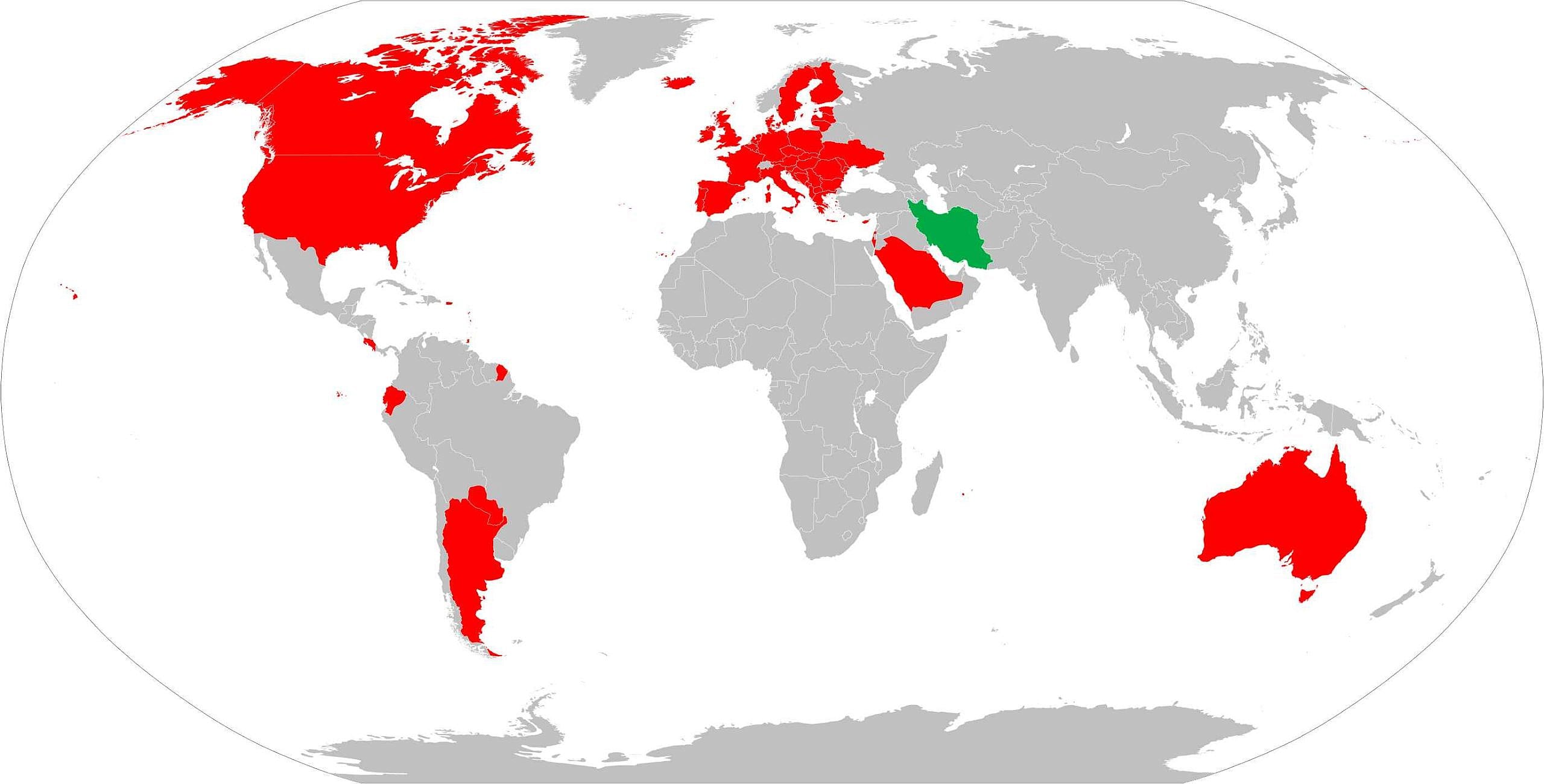
Countries and international bodies that have designated the IRGC as a terrorist organization or entity are shown in red; Iran is highlighted in green. Image © The Account 2, 2026. Licensed under CC BY 4.0. Source: Wikimedia Commons.
If the IRGC Is Iran, Then Say Iran. If It Isn’t, Where Does Iran End and the IRGC Begin?
The United Kingdom recently designated Iran’s Islamic Revolutionary Guard Corps (IRGC) as a threat to national security under the National Security Act, making support for the organization a criminal offense punishable by up to fourteen years in prison.
This decision follows a broader international pattern. The IRGC has been designated as a terrorist organization or entity by numerous countries and international bodies, including the European Union, the United States, Canada, Australia, Israel, and others.
In my previous article, Sovereignty Is Not a Privilege. It Is a Liability., I discussed the relationship between Lebanon and Hezbollah and argued that sovereignty and responsibility are inseparable. A sovereign state bears responsibility not only for the actions of its official institutions, but also for hostile acts originating from territory under its sovereignty.
That principle led me to a simple question.
Why should Israel care?
Why should Israel care whether the rockets were launched by Hezbollah, a militia, a political movement, a revolutionary guard, a tribal army, or some other armed organization?
The only reason Israel should care about Hezbollah’s identity is the same reason every nation studies its adversaries: to know its enemy, understand its capabilities, and defend itself more effectively.
Beyond that, Hezbollah’s internal relationship with Lebanon is fundamentally Lebanon’s problem.
Iran presents almost the opposite situation.
Lebanon often argues that Hezbollah is an independent force beyond the government’s effective control. Iran makes the opposite argument. It insists that the IRGC is an integral part of the Islamic Republic and condemned the UK’s designation as “irresponsible” precisely because it treats the IRGC as separate from the Iranian state.
That position has an important consequence. The ordinary principles of state responsibility apply: the actions of the IRGC are the actions of Iran.
Ironically, I anticipated this very example in my previous article:
Imagine Iran claiming that attacks against Israel are not the responsibility of Iran but only of the Islamic Revolutionary Guard Corps. Few would accept such an argument.
I would go one step further. Even if the IRGC were a nominally independent force like Hezbollah in Lebanon, Iran would still bear responsibility for actions carried out from its territory or by forces acting on its behalf. The issue is not limited to rockets fired across a border. It includes proxy warfare, covert operations, cyberattacks, and other forms of state-directed activity.
A sovereign state cannot escape responsibility simply by arguing that a different organization carried out the action. Sovereignty entails responsibility regardless of how a state organizes its internal affairs.
This is what makes attempts to separate the IRGC from the Iranian state conceptually puzzling.
The IRGC is not a private organization that merely happens to operate inside Iran. It is a constitutional branch of Iran’s armed forces, financed by the Iranian state and exercising powers granted by Iranian law. It is one of the institutions through which Iran acts.
States do not act in the abstract. They act through institutions.
Imagine another country announcing that the British Army or MI5 has been designated a terrorist organization while assuring London that the decision is not directed against the United Kingdom itself.
The distinction would sound absurd. Neither the British Army nor MI5 is merely associated with the British state; they are institutions through which the British state exercises its sovereign authority. The Army defends the country, while MI5 protects its internal security. Both exist because the British state created them, funds them, and directs them.
Separating these institutions from the state that created and controls them would be an artificial distinction.
The point becomes even clearer outside the military and security sphere.
Imagine a foreign government announcing that the UK’s Green Party has been designated a terrorist organization because it opposes fossil fuels, while emphasizing that the Labour and Conservative parties remain perfectly acceptable.
The example is not intended to compare the Green Party with the IRGC. The conduct alleged against the IRGC is of an entirely different character. Rather, the analogy illustrates the oddity of selectively singling out one component of another country’s political landscape while insisting that the designation says nothing about the state as a whole.
The same principle applies to international organizations, such as the United Nations.
Israel has banned UNRWA because of its ties to terrorist organizations and the involvement of its personnel in the October 7, 2023, terrorist attacks. The United States government has also taken action against UNRWA over these allegations. Yet neither country treats the United Nations itself as the direct target of these measures.
Structurally, however, UNRWA is not an independent international organization. It is an agency created by the United Nations and operating under a mandate granted by the UN General Assembly.
The issue is not limited to UNRWA. Israel’s disputes with the United Nations have also involved other UN bodies, including UNESCO, where tensions have centered on accusations of political bias, disputes over cultural heritage designations, and the treatment of sites connected to Jewish heritage.
Israel has long argued that multiple UN institutions demonstrate systemic anti-Israel bias.
Yet even in these cases, the debate is usually directed at specific institutions or agencies within the UN system rather than at the United Nations as a whole.
This raises an important question:
When does an institution become sufficiently separate from the body that created, funds, empowers, and oversees it?
The boundary between an institution and its parent organization cannot be ignored whenever responsibility becomes inconvenient. If an institution exists because a larger body created it, empowered it, and gave it a mandate, that relationship must be taken seriously.
Returning to the IRGC, the logic is straightforward.
Either the IRGC is an official organ of Iran, or it is not.
If it is, then Iran bears responsibility for its actions under the ordinary principles of state responsibility. If it is not, Iran as a sovereign state still cannot avoid responsibility simply by redefining its relationship with an armed organization operating from its territory or acting on its behalf.
In the case of the IRGC, however, the situation is even clearer. Iran itself proudly insists that the IRGC is an official branch of the Iranian state and an integral part of its system of government.
If the IRGC is an arm of Iran, why pretend it is separate from Iran?
One cannot have it both ways.
State sovereignty is indivisible.
And responsibility follows sovereignty.
—
See Also
Related Topics
Related Posts