You Want to Light Up the Dark Side of the Moon, or What?
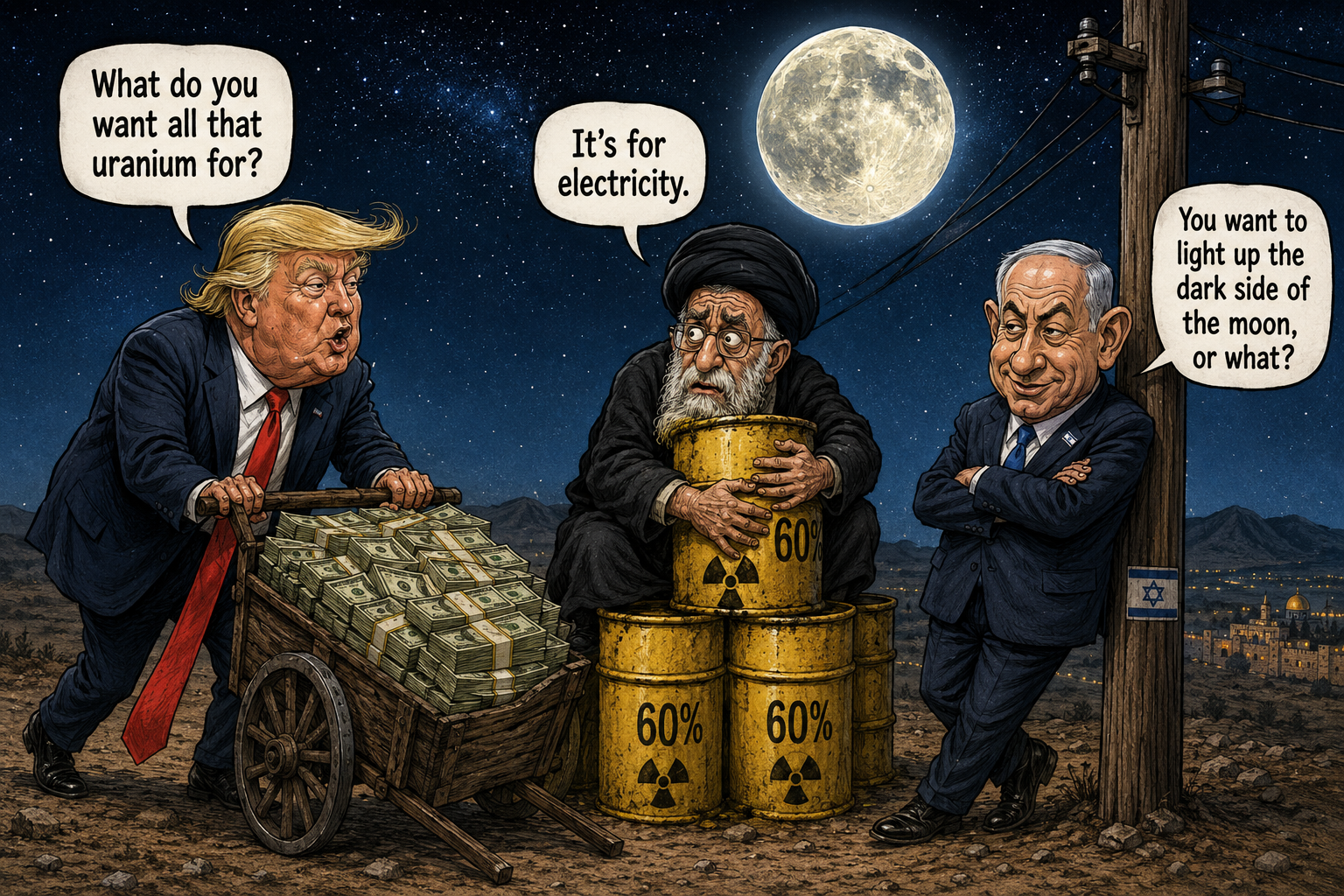
Tehran has said it for more than twenty years. The uranium is peaceful. The program is civilian. The enrichment is for energy. The line has survived presidents, wars, and two supreme leaders, repeated so often it has become the regime’s reflex.
It is worth taking the claim seriously for a moment. Seriously enough to follow the material from the ground to the centrifuge, and ask what each step is actually for.
The rock anyone can hold
Uranium is not exotic. It sits in the earth’s crust like any ore, mined underground, in open pits, or dissolved in place and pumped to the surface. The rock is crushed, milled, and concentrated into a yellow powder called uranium oxide, the form in which uranium is bought and sold. Nothing here threatens anyone. The raw material was never the problem. Possessing uranium is not the dangerous part. What you do to it is.
The needle inside the haystack
Natural uranium is almost entirely the wrong kind. About 99.3 percent of it is uranium-238. Only 0.7 percent is uranium-235, the isotope that splits easily and releases energy in a reactor. The two are nearly identical twins. Same element, same chemistry. They differ only by three neutrons of mass.
That tiny difference is the whole story. You cannot separate them with a chemical reaction, because chemically they are the same substance. You have to sort them by weight, atom by atom. This is why enrichment is hard, and why so few nations can do it.
Spinning the gas
The trick is to turn the uranium into a gas, uranium hexafluoride, and spin it at enormous speed inside a centrifuge. The slightly heavier U-238 drifts toward the wall. The lighter U-235 concentrates toward the center. One machine moves the needle a sliver. So you chain thousands of them into cascades, feeding the output of one into the next, again and again.
The ladder
Now the part that matters. Enrichment is a ladder, and each rung has a known purpose.
Three to five percent is low-enriched uranium. This is what fuels the world’s power reactors. Twenty percent is the formal threshold of highly enriched uranium, the realm of research reactors and medical isotopes. Sixty percent serves no power reactor and no ordinary civilian purpose. The one exception anyone can raise for enrichment this high is naval propulsion. Yet the world’s nuclear fleets run on low-enriched fuel, on roughly forty percent, or on weapons-grade, rarely if ever on sixty. And Iran does not operate a single nuclear-powered vessel to fuel, only conventional diesel-electric submarines. Ninety percent is weapons-grade, the level from which a bomb is built.
There is no power plant that asks for 60 percent. None. It is a rung that exists for one reason only, and it is not the one Tehran names.
The climb is front-loaded
Here is the cruelty hidden in the physics. The effort is not spread evenly across the ladder. The overwhelming majority of the separative work is spent climbing the very first stretch, from natural 0.7 percent up to a few percent. By the time a state reaches 60 percent, it has already done the hardest, longest part of the journey.
The last stretch, from 60 to 90, is comparatively short. The IAEA has said as much in its own language: higher enrichment levels and larger stockpiles shorten the technical time needed to reach weapons-grade material. Sixty percent is not a little extra electricity. It is a state standing on the second-to-last rung, looking up at the only step that remains.
A reactor that runs on someone else’s fuel
Set the physics beside Iran’s actual grid and the energy story collapses entirely.
Iran has exactly one operating nuclear power reactor, at Bushehr. In 2023 it supplied around 1.7 percent of the country’s electricity. Less than one part in fifty. And it does not even run on Iranian enriched uranium. Bushehr was built by Russia and is fueled by Russia, its spent fuel sent back to Russia.
Iran’s grid, meanwhile, holds roughly 90 gigawatts of capacity, with demand growing about 4 percent a year, met overwhelmingly by natural gas. The enrichment program powers nothing the country actually plugs into. It never has. The single reactor that justifies a civilian fuel cycle is fed from Moscow, while the home-grown stockpile climbs to a purity no reactor will accept.
So the uranium enriched on Iranian soil lights no Iranian home. The question writes itself. If not for the grid, then for what?
What Tehran guards, and what it gives away
Watch what the regime protects, and the answer arrives without anyone having to say it.
For nearly two decades the program has been shielded from scrutiny. Iran stopped honoring the Additional Protocol in 2006. Inspectors found uranium traces at undeclared sites the regime had never reported, places like Turquzabad and Varamin, and the explanations were judged not credible. After the 2025 war, Tehran suspended cooperation with the agency, and inspectors lost continuity of knowledge over much of the material.
Now, in the 2026 negotiations, look at the trade on the table. Iran will reopen the Strait of Hormuz. It will clear the mines it laid there. It will release its grip on the waterway that carries roughly a fifth of the world’s oil and gas, the single most powerful economic lever it holds, in exchange for the unfreezing of its assets and the freedom to sell oil again.
It will give back the throat of the global energy supply. But it will not give back 440 kilograms of uranium enriched to 60 percent. Mojtaba Khamenei, now supreme leader after his father’s death, directed that the stockpile stay inside the country, and Iranian officials deny any agreement to hand it over.
So what is it for?
A regime willing to release a fifth of the planet’s oil, but not a few hundred kilograms of metal it insists is meant for electricity. A stockpile that lights nothing it owns, refined past every level a power plant could use, guarded more fiercely than the chokepoint of the world economy.
If the uranium is truly for energy, and Iran’s lights already burn on Russian fuel and its own abundant gas, then one has to wonder where exactly that 60 percent is meant to shine. Somewhere remote, surely. Somewhere with no grid, no homes, nothing at all to power… maybe the dark side of the moon.