London based entrepreneur, cybersecurity analyst doing a PhD in AI
Your Daily Pill
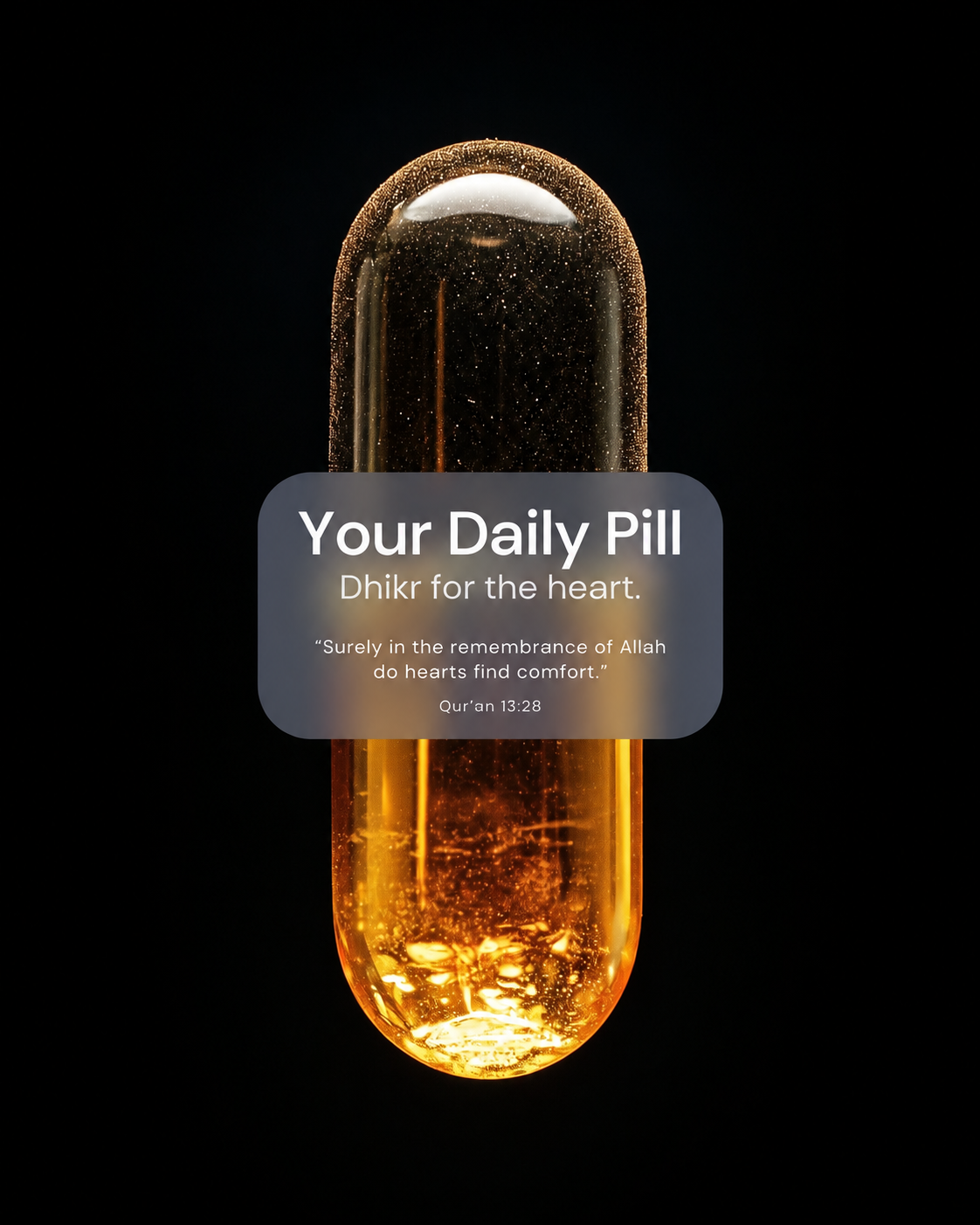
The Spiritual Wellness Product.
We Optimise Everything Except the Heart.
We are living through an extraordinary wellness boom.
We measure sleep.
We track glucose.
We count steps.
We monitor heart-rate variability.
We take magnesium for sleep, creatine for performance, omega-3 for health and vitamin D when our levels are low.
We stretch.
We meditate.
We practise yoga.
We sit in saunas and climb into cold water.
The biohacking movement takes this even further: measure the body, identify what is deteriorating, intervene early, repeat.
There is something sensible underneath all of this.
Maintenance is easier than repair.
Look after the body before disease appears.
Protect the joints before they hurt.
Protect sleep before exhaustion becomes normal.
Protect metabolic health before the blood test becomes frightening.
Islam introduces another form of preventative maintenance.
Not for the skin.
Not for the muscles.
Not even primarily for the brain.
For the heart.
And perhaps the most important wellness product we have forgotten is completely free.
Dhikr.
The remembrance of Allah.
The Organ We Do Not Measure
The Prophet Muhammad ﷺ gave an extraordinary description of the human being.
He said that within the body there is a piece of flesh:
“If it is sound, the whole body is sound; and if it is corrupt, the whole body is corrupt. Indeed, it is the heart.”
— Sahih al-Bukhari 52
Read Sahih al-Bukhari 52 (Sunnah)
We have developed sophisticated ways of measuring the physical heart.
Blood pressure.
ECG.
Resting heart rate.
Cholesterol.
VO₂ max.
But the Qur’an and Sunnah repeatedly ask us to examine another condition:
What is happening inside the heart itself?
Is it becoming softer?
Or harder?
More grateful?
Or more entitled?
More conscious of Allah?
Or progressively less conscious of Him?
More sensitive to wrongdoing?
Or increasingly comfortable with it?
Because according to revelation, hearts do not remain spiritually static.
Something is always happening to them.
The Qur’an Describes Spiritual Build-Up
Allah says:
“No! Rather, their hearts have been stained by what they used to earn.”
— Qur’an 83:14
The Arabic is:
كَلَّا بَلْ رَانَ عَلَىٰ قُلُوبِهِم مَّا كَانُوا يَكْسِبُونَ
Kallā bal rāna ʿalā qulūbihim mā kānū yaksibūn.
Read Qur’an 83:14 and Ibn Kathīr
The important word is:
رَانَ — rāna.
From it comes the idea of rān upon the heart.
It is often expressed in English as a stain, covering or even rust upon the heart.
The image is powerful.
Metal does not usually become completely rusted in a second.
A little oxidation appears.
Then more.
Then more.
Until something once bright is covered.
Ibn Kathīr explains the verse similarly: repeated sins and wrong actions form a covering over the heart until they obstruct it. (Quran.com)
The Qur’an is describing something deeply recognisable.
The first lie feels terrible.
The fiftieth becomes easier.
The first cruel act troubles the conscience.
Eventually cruelty can become personality.
The first forbidden thing produces discomfort.
Repeated often enough, the discomfort begins to disappear.
The behaviour has not become better.
The heart has become less sensitive to it.
That is the danger of rān.
The Black Spot
The Prophet ﷺ explained Qur’an 83:14 himself.
Abu Hurayrah رضي الله عنه reported that when a servant commits a sin, a black spot appears on the heart.
If the person stops, seeks Allah’s forgiveness and repents, something beautiful happens:
the heart is polished.
But if the person returns to the sin, the blackness increases until it covers the heart.
The Prophet ﷺ then identified this accumulated covering as the very rān mentioned in the Qur’an.
— Jāmiʿ al-Tirmidhī 3334, which al-Tirmidhī described as ḥasan ṣaḥīḥ.
Read Jāmiʿ al-Tirmidhī 3334 (Sunnah)
This may be one of the most elegant models of spiritual health in the Sunnah.
Sin leaves residue.
But residue can be removed.
The heart can become stained.
But the heart can also be polished.
Islam therefore does not give us only a diagnosis.
It gives us a cleaning mechanism:
Stop.
Seek forgiveness.
Repent.
Return.
Rust Does Not Mean the Heart Is Finished
This is where the metaphor becomes beautiful.
If something precious develops rust, you do not necessarily throw it away.
You restore it.
You remove the corrosion.
You polish the surface.
You protect it from what damaged it.
The Sunnah describes repentance almost exactly this way.
The Prophet ﷺ does not say that once the black spot appears the heart is ruined forever.
He says:
the servant stops,
seeks forgiveness,
repents,
and the heart is polished again. (Sunnah)
That changes the whole psychology of repentance.
You are not being told:
You are filthy. Give up.
You are being told:
Clean the heart.
And then keep cleaning it.
Because human beings repeatedly accumulate spiritual residue.
That is why Astaghfirullāh—“I seek Allah’s forgiveness”—belongs in an ordinary day.
Not merely after catastrophe.
But There Is Another Mark on the Heart
There is another authentic hadith that develops this image even further.
Hudhayfah رضي الله عنه reported that the Prophet ﷺ described fitan—temptations and trials—as being presented repeatedly to human hearts.
One after another.
Like reeds being woven into a mat.
When a heart absorbs a temptation, a black mark is placed upon it.
When a heart rejects it, a white mark is placed upon it.
Eventually the hearts become two kinds.
One becomes bright and resilient.
The other becomes darkened and overturned—no longer properly recognising good or rejecting evil except according to its desires.
— Sahih Muslim 144a
Read Sahih Muslim 144a (Sunnah)
This is slightly different from the hadith of the black spot after sin.
And the distinction is beautiful.
One hadith describes what happens when we sin and repent.
The other describes what happens when temptation arrives and we accept or reject it.
Together they give us almost a complete model of spiritual maintenance.
Temptation arrives.
Reject it: the heart is strengthened.
Accept it: darkness enters.
Fall into sin: repent.
Repent sincerely: the heart is polished.
Repeat the sin without repentance: the covering grows.
Eventually there can be rān.
The Real Heart Score
Imagine that tomorrow a wellness company released a new device.
It measured:
Sleep: 92
Recovery: 87
Heart-rate variability: Excellent
Glucose stability: Excellent
Fitness: Excellent
Then underneath appeared another metric:
HEART
Truthfulness: declining.
Gratitude: declining.
Envy: increasing.
Arrogance: increasing.
Prayer: neglected.
Repentance: low.
Remembrance of Allah: almost absent.
Suddenly all the other numbers would seem less impressive.
Of course, no smartwatch can measure these things.
But revelation asks us to. There are spiritual guidelines from the Hadith and Quran I encourage the reader to research. [qaswat al-qalb].
Allah says:
“Has the time not yet come for believers’ hearts to be humbled at the remembrance of Allah and what has been revealed of the truth?”
— Qur’an 57:16
Read Qur’an 57:16 and Ibn Kathīr
Ibn Kathīr explains this as a call for believing hearts to soften when Allah is remembered and revelation is heard—to understand, submit and obey. (Quran.com)
Notice again who is being addressed.
Believers.
Faith does not make heart maintenance unnecessary.
Faith makes heart maintenance part of life.
Dhikr Is Not Just Relaxation
This is where dhikr differs subtly from many modern wellness practices.
Meditation may teach you to observe the mind.
Breathing exercises may help slow the body.
Yoga may combine controlled movement, breathing and attention.
Dhikr can certainly involve stillness and calm.
But its purpose is not merely:
Be present.
It is:
Remember Allah.
Allah says:
“Surely in the remembrance of Allah do hearts find comfort.”
— Qur’an 13:28
Read Qur’an 13:28 and Ibn Kathīr
Ibn Kathīr explains that these hearts become tranquil through Allah, find comfort when He is remembered and are content with Him as their Protector and Supporter. (Quran.com)
Dhikr therefore has a destination.
When you say:
Subḥān Allāh
you are glorifying Allah.
When you say:
Alḥamdulillāh
you are thanking Allah.
When you say:
Allāhu Akbar
you are declaring that Allah is greater.
When you say:
Astaghfirullāh
you are asking Allah to forgive you.
And when you say:
Lā ilāha illa Allāh
you are returning to the central truth around which everything else is supposed to orbit:
There is no deity worthy of worship except Allah.
The Polish
If sin produces residue, dhikr and repentance belong to the polishing process.
But this must never be reduced to moving prayer beads while refusing to change.
Allah describes believers who fall into wrongdoing:
“Those who, when they commit an indecency or wrong themselves, remember Allah and seek forgiveness for their sins … and do not knowingly persist in what they have done.”
— Qur’an 3:135
Read Qur’an 3:135 and its tafsīr
Look at the order.
They sin.
Then:
they remember Allah.
That remembrance produces awareness.
Awareness produces repentance.
Repentance produces change.
They do not knowingly persist.
So sometimes Astaghfirullāh must be followed by:
I need to apologise.
I need to stop.
I need to return what does not belong to me.
I need to delete this.
I need to leave this situation.
I need to repair what I damaged.
Otherwise we risk trying to polish the heart while continuing to pour corrosion onto it.
The Simplest Wellness Routine
Perhaps the spiritual wellness routine is therefore much simpler than we imagine.
Morning
Before the noise begins:
Remember Allah.
During the day
When temptation appears:
Reject what you know is wrong.
Protect the white mark.
When you fall
Do not rationalise it.
Say:
Astaghfirullāh.
Stop.
Repent.
Repair what needs repairing.
Let the heart be polished.
Throughout the day
Say:
Subḥān Allāh.
Alḥamdulillāh.
Allāhu Akbar.
Lā ilāha illa Allāh.
Not merely with the tongue.
Know what you are saying.
At night
Instead of checking only your steps, calories and sleep score, ask:
What did I do to my heart today?
Did I polish it?
Or rust it?
The Most Important Notification
There is another reason dhikr is extraordinary.
Modern life has trained us to want to be noticed.
A message.
A like.
A reply.
A mention.
A follower.
Someone noticed me.
But Allah says:
“Remember Me; I will remember you.”
— Qur’an 2:152
Read Qur’an 2:152 and its tafsīr
Perhaps there is no greater notification than that.
You can be completely alone.
Nobody knows you are making dhikr.
Nobody applauds.
Nobody clicks anything.
But you remember Allah.
And Allah promises:
“I will remember you.”
The New Wellness Product
So take the supplements you genuinely need.
Exercise.
Sleep properly.
Eat well.
Look after the remarkable body Allah has given you.
Stretch.
Walk.
Rest.
Use medicine when medicine is needed.
There is nothing spiritual about deliberately neglecting your physical health.
But add one more item to the wellness stack.
Perhaps place it at the top.
Heart maintenance.
Because the Qur’an describes something no blood test detects.
Rān upon the heart.
Rust.
Accumulation.
A covering produced by what we repeatedly earn.
And the Sunnah tells us that the process can begin with something as small as a black spot.
But revelation also gives us something wonderfully hopeful.
The blackness is not necessarily permanent.
The heart can be polished.
Temptation can be rejected.
White marks can accumulate.
The heart can soften again.
The heart can remember again.
The heart can live again.
And perhaps this is the forgotten principle behind all genuine wellness:
Do not wait until something precious is badly damaged before you begin looking after it.
Allah asks:
“Has the time not yet come for believers’ hearts to be humbled at the remembrance of Allah?”
— Qur’an 57:16
Perhaps the answer should simply be:
Yes.
Related Topics