


You’re Fighting the Wrong Fight
The fight was over before it even began.
A head taller than the man he had spent the previous hours arguing with, the anti-Israel loudmouth grabbed the advocate from behind, wrapping an arm around his neck as he unsuccessfully tried to force him into a headlock. The Israeli, on his part, fought back. Drawing on his experience fighting actual terrorists rather than those who serve as their Western mouthpieces, he broke free, landing punch after punch as others tried to pull the two men apart. Having been attacked first, he had every right to defend himself. Standing in the parking lot making a video for his social media followers, he had been attacked through no fault of his own. Yet the moment he fought back, he had already lost the fight. Through no fault of his own, he had been set up to fail.
He was set up to fail because the people watching hadn’t heard the podcast he had just recorded arguing with this man and several other extremists like him. He was set up to fail because they hadn’t seen the confrontation unfold. He was set up to fail because they hadn’t seen the aggressor follow his target into the parking lot, shout obscenities at him, and attack him from behind. Above all, he was set up to fail because he was fighting the wrong target.
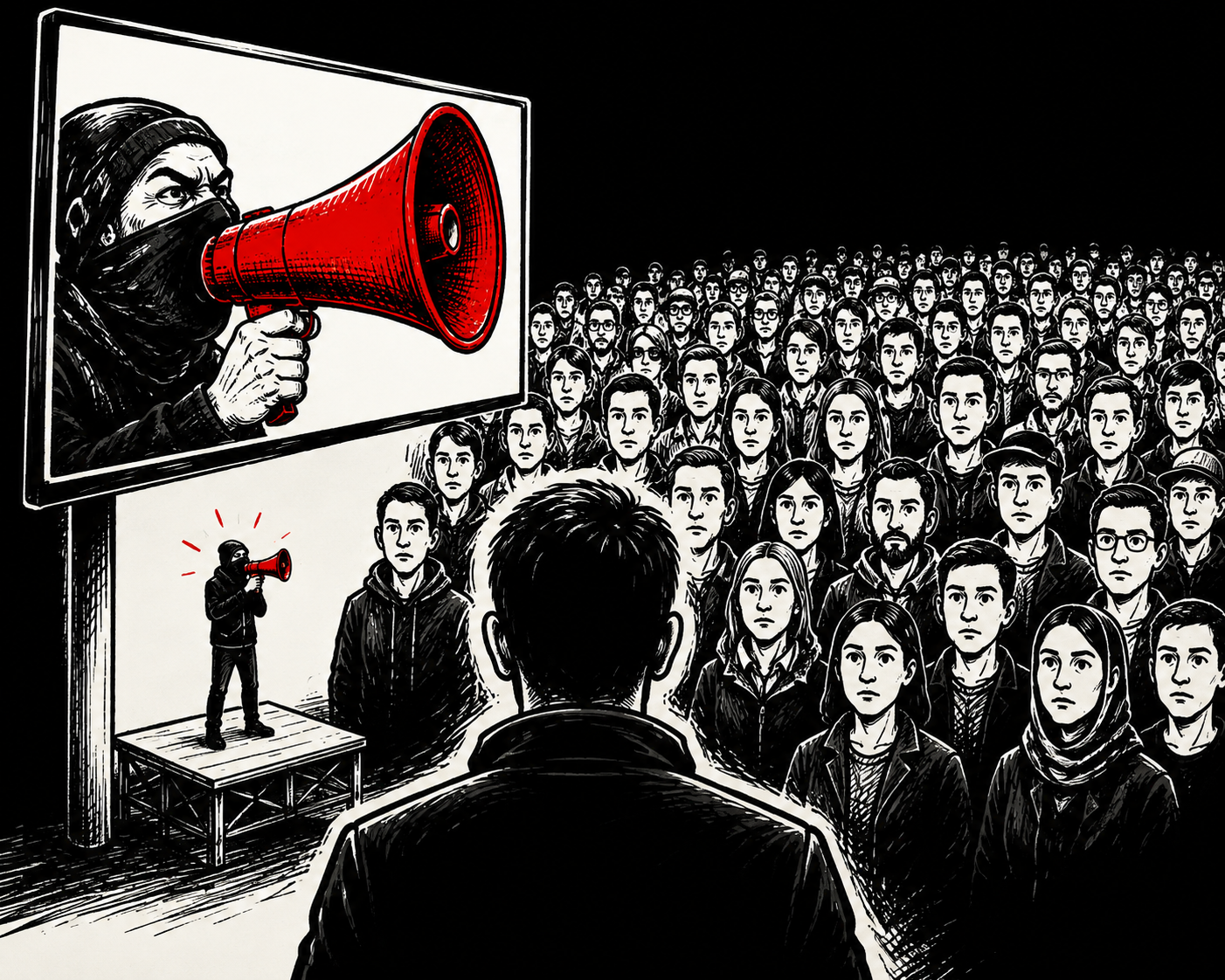
Ideological wars—like the one we are currently fighting against American Intellectual Antisemitism—are won not by fighting extremists, but by fighting for the middle. Having spent years fusing their identities with their ideology, hardened extremists are among the least likely people to question what they have come to believe. By the time hatred has become part of their identity, changing their minds becomes extraordinarily difficult. As a result, every minute spent trying to convert an extremist is a minute not spent persuading someone who can still be persuaded. Ideological wars are therefore not fought for extremists’ closed minds, but for the minds of the much larger population whose views have not yet hardened, whose identities are not organized around the ideological fight, and whose minds therefore remain open to persuasion.
Recognizing that requires changing how we fight. Rather than focusing on whether you humiliated the other side, exposed their hypocrisy, went viral, or got the last word, ask whether you moved someone—anyone—toward your side. Though the person across the table, on the other side of the screen, or behind the protest barricade may never change their mind, the millions of people watching from the sidelines still might. Winning, then, does not necessarily mean persuading the person fighting you. It means persuading the people watching you fight. The extremist across from you may be unreachable. The person watching you engage with them is not.
Yet the moment fists—whether physical or rhetorical—start flying, persuading the unpersuaded becomes far more difficult. Once both sides start screaming, people in the middle simply hear two sides screaming. Once both sides start trading insults and obscenities, they simply hear insults and obscenities. Once both sides start throwing punches, they simply see a brawl. Unaware of who started what or what led to the heated clash, the undecided, uninvolved, and uncommitted middle may see just two combatants, one defending Israel and the other vehemently opposed to its existence, trading punches between parked cars. Whatever moral asymmetry existed before the fight can quickly become obscured by the fight itself.
That is why extremists benefit when we stoop to their level. Though fighting back may feel righteous and provide the deep catharsis of refusing to be pushed around, if the people whose minds remain open walk away unable to distinguish between the person who initiated the attack and the person who responded to it, what feels like a victory may accomplish remarkably little. The easiest way to make an extremist look reasonable is to start behaving like one.
Making that danger even greater, the middle rarely arrives at these encounters with a blank slate. Even people who saw the aggressor throw the first punch might not understand what they were seeing. Having been exposed to distortions and lies of American Intellectual Antisemitism—an ideology that recasts Jews as White oppressors, Jewish self-determination as uniquely illegitimate, and Israel as the embodiment of everything wrong and evil in the world—many have come to see Israeli self-defense as violence and attacks against Israelis as justified resistance. For some, the parking lot brawl is just another piece of a story they have long been telling themselves. But for many others—people who have never embraced the ideology themselves but have absorbed its omnipresent assumptions through the media and across college campuses—it simply reinforces a story they have long been taught. You do not have to embrace an ideology to begin seeing the world through its assumptions.
Extremists understand this vulnerability far better than moderates do. They want the parking lot brawl because the parking lot is their terrain. They want the furious quote-post on social media because outrage amplifies their message far beyond the audience they could ever reach themselves. They want the shouting match across the barricades because chaos transforms footage of their radical protests into footage of two angry mobs screaming at each other. Unable or unwilling to conduct themselves on the higher ground of evidence, nuance, and genuine dialogue, extremists try to pull everyone else down to theirs. Armed with cheap taunts and vicious insults, their goal is not to persuade you, but to provoke you into responding in kind. Once they succeed, they gain something enormously valuable: false moral symmetry.
None of this means that extremists should be ignored or given free rein. By recruiting followers, radicalizing sympathizers, intimidating dissenters, and capturing the institutions that shape public conversation, extremists pose a serious threat to any democracy. By repeatedly and relentlessly making false claims and radical arguments, they stretch the boundaries of what feels sayable, acceptable, or politically imaginable. Their success depends less on winning any particular argument than on changing what everyone else considers worth arguing about. Extremists, therefore, need not persuade the majority to shape the ideological landscape. All they need to do is move the line separating the fringe from the mainstream until yesterday’s radicalism begins to look reasonable, respectable, routine, or even unremarkable.
The question, then, is not whether to confront extremists, but how to do so. Exposing an extremist’s lies or inconsistencies—for example, by confronting their claim that Jews are colonial interlopers in the Levant with the historical, archaeological, and cultural evidence of continuous Jewish connection to the land—may matter not because the extremist will acknowledge being wrong, but because those watching may recognize the weakness of the libelous claim. Challenging increasingly radical arguments—for example, by forcing adherents of American Intellectual Antisemitism to confront the immense bloodshed that their desire to dismantle Israel would almost certainly entail—may matter not because their most committed advocates will abandon them, but because doing so can inoculate onlookers against the argument before they accept its premises. The value of confronting extremists lies not in changing their minds, but in preventing them from capturing the minds of others. The extremist may be the person you confront. The middle must remain the person you are trying to reach.
The real fight is not over the extremists we have already lost, but the people we can still reach. Whether by inoculating them against misinformation, giving them a more truthful frame of reference before hostile labels become their default vocabulary, or helping them understand what is at stake before indifference hardens into complacency, fighting for the middle means reaching contested minds before the opposing ideology does. With the much larger population that has yet to be absorbed into either camp still up for grabs, every person moved toward one side is also one fewer person available for recruitment by the other.
Sometimes the best way to reach those people is to do something deeply uncomfortable: give extremists enough rope to hang themselves with. Ask them questions that allow them to reveal their bigotry. Let them explain what they mean when they call the October 7 Massacre “resistance.” Let them tie themselves into knots when pushed on what should happen to millions of Israeli Jews after the Jewish state is dismantled. Let them explain why dialogue with Israelis is supposedly immoral, or why Jewish self-determination alone among national movements must disappear. Sometimes the most persuasive argument against extremism is simply letting extremists expose the moral and logical bankruptcy of their own beliefs. Sometimes wrestling an extremist to the ground is far less useful than letting the middle watch them fall on their own.
Used strategically, extremists can become evidence. Give them enough room and they may show the people watching exactly where the aggression, intolerance, and hatred are coming from. That does not mean refusing to defend yourself when attacked or allowing hatred to go unanswered. It means remembering why you are engaging in the first place. Because what an extremist deserves and what helps us win are not always the same thing, the fights worth having are those that leave the middle seeing the extremist more clearly—not those that leave them struggling to tell the two sides apart.
Back in that Los Angeles parking lot, the Israeli advocate had every right to defend himself. When faced with imminent danger, we have every right to protect ourselves. Yet winning the brawl and winning minds are two very different things. The moment your punches start landing, your arguments may stop doing so.
The same is true in an ideological war. Confront lies when they must be confronted. Challenge extremists when doing so exposes what they believe. Defend yourself when defense is required. But remember whom the confrontation is for.
Never confuse the person you are fighting with the person you are trying to persuade.
Extremists are the people we fight. The middle is the people we fight for.
*
American Intellectual Antisemitism: The Anti-Jewish Movement Tearing Through Our Universities (Wicked Son/Post Hill Press) is now available for pre-order.