
Antisemitism Is an Ideology. We Must Fight It Like One.
Werner Krauss, one of the most celebrated actors in the German-speaking world, waited just beyond the heavy red velvet curtains of Vienna’s Burgtheater. Years earlier, he had portrayed the mysterious carnival showman in The Cabinet of Dr. Caligari. Now a leading figure in the Reich Theatre Chamber, he adjusted his bright red wig, his grotesquely exaggerated hooked nose, and his unkempt, fraying false beard as he prepared to step onto one of Europe’s grandest stages.
The moment he stepped onto the stage, the audience erupted in jeers, curses, and heckles.
At once grotesquely buffoonish and profoundly dangerous, Krauss’s portrayal of Shylock in The Merchant of Venice became the embodiment of everything Nazi ideology claimed Jews to be. No longer one Jew, he became every Jew, the imagined force supposedly corrupting Germany from within. Every gesture, every inflection, every exaggerated facial expression reinforced an image the audience already recognized. They were not watching Shakespeare. They were watching centuries of antisemitic mythology brought to life.
The remarkable thing is that none of this required actual Jews. It required only an idea.
Indeed, by the time Shakespeare wrote The Merchant of Venice in the late sixteenth century, England had officially been without Jews for more than three centuries. Having expelled its Jewish population in 1290, Shakespeare most likely never knowingly met a Jew. Most members of his audience had probably never knowingly met one either. Yet they recognized Shylock immediately.
The explanation, however, has remarkably little to do with Jews themselves. Long before people encountered an actual Jew, they had encountered the idea of “the Jew.” Not a person, but a character. Not a reflection of Jewish life, but a story onto which societies projected their deepest fears, frustrations, and aspirations.
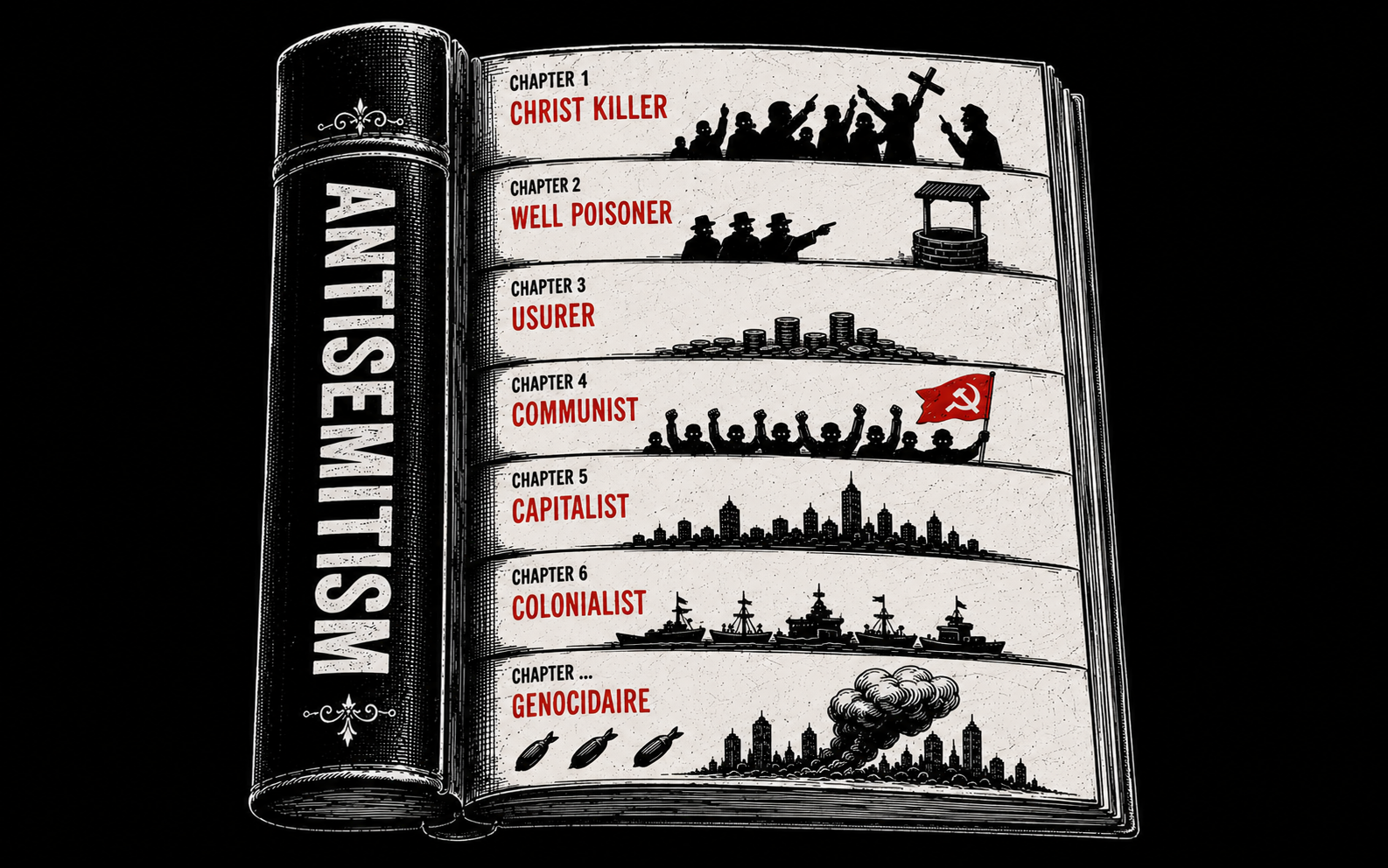
That story changed from age to age. Early Christendom imagined the Jew as the Christ killer. Medieval Europe imagined the Jew as the well poisoner and ritual murderer. Later generations imagined the Jew as the usurer, the revolutionary, the capitalist, the communist, the racial contaminant, or the cosmopolitan. Each society rewrote the story to match its own anxieties. The symbolic Jew became the hidden force behind society’s failures and the obstacle standing between the present and the better world people believed they were trying to create.
Antisemitism survives not because Jews stay the same, but because the story keeps changing around them. The accusations changed because cultures changed. The moral vocabulary changed because societies changed. Even when Jews themselves changed—converting to Christianity, assimilating into European society, demonstrating extraordinary patriotism, fighting in their countries’ armies, and helping shape their nations’ scientific, cultural, and economic achievements—the story simply adapted. Whatever actual Jews became, the imagined Jew survived.
That persistence reveals the defining feature of the world’s oldest hatred. Antisemitism does not simply distort how people see Jews. It offers them an entire way of seeing the world.
Seen this way, antisemitism looks less like prejudice than an ideology. Like every enduring ideology, it offers its adherents a story about how the world works. It explains why society is broken, who is responsible for its failures, and what must be done to fix them. Once Jews become the explanation for what is wrong with society, opposing Jews ceases to be merely an expression of hatred. It becomes part of the solution. Whether framed as a civic duty, revolutionary necessity, religious obligation, or moral imperative, opposing Jews becomes the way adherents demonstrate that they stand on the right side of history. Hostility can remain private. An ideology demands action.
Today, that ideology has learned a new language. Recasting “the Jew” as “the Zionist,” it translates centuries-old accusations into the moral language of a new generation, transforming the symbolic Jew into a genocidal White oppressor, a settler colonialist, and the architect of a global system of injustice. The cast changes. The plot rarely does.
I call this latest iteration of the world’s oldest hatred American Intellectual Antisemitism. Recasting the symbolic Jew as an all-powerful Zionist, it once again portrays Jews as wielding disproportionate influence over governments, financial institutions, universities, and the media. According to this story, Israel, the national homeland of the Jewish people, becomes the most visible expression of that alleged conspiracy. Within this narrative, Jewish peoplehood becomes morally suspect, Jewish self-determination becomes uniquely illegitimate, and the world’s only Jewish state becomes uniquely unworthy of existing. Far from inventing a new story, American Intellectual Antisemitism is not a new ideology. It is an old one translated into the moral language of the present.
Like every enduring ideology, American Intellectual Antisemitism does not stop at identifying Jewish collective existence as the source of society’s injustices. Go beyond mere accusation, it also tells people what must be done about it. By portraying Jewish self-determination as a colonial enterprise, it launders violence into the language of decolonization. By presenting Israel as the embodiment of systemic evil, it transforms the country’s elimination into a moral imperative. Violence against those who support Israel is recast not as aggression, but as resistance, liberation, or social justice.
Treating antisemitism as an ideology changes more than how we understand it. It changes how we fight it. It explains why antisemitism repeatedly survives the disappearance of the very characteristics it claims to oppose, flourishes where Jews barely exist, continues to recruit new believers, and keeps returning in unfamiliar forms. It also changes how we must confront it.
To defeat antisemitism, we must challenge false narratives before—not after— they harden into unquestioned truths. We must identify the gateway beliefs that draw people into antisemitism before—not after—they have already been radicalized. We must recognize the psychological needs antisemitism exploits—certainty, belonging, purpose, agency, and moral clarity—and offer people healthier ways of satisfying them. Above all, we must become just as serious about understanding how ideas spread as we are about condemning the damage they cause.
Seeing antisemitism as an ideology does not replace protecting Jewish communities, prosecuting hate crimes, teaching Jewish history, or exposing antisemitic stereotypes. It complements those efforts by giving us a new set of tools. Rather than asking only how to respond once antisemitism appears, it encourages us to ask how people become susceptible to it in the first place—and how we might interrupt that process before hatred hardens into conviction.
The fight against antisemitism has never been only about protecting Jews. It has always been about confronting the ideas that make hatred appear righteous. To confront those ideas, we must first understand them. The first step toward defeating an ideology is recognizing that it is one. Whether the next generation inherits the same story—or a different one—depends on what we do now.
–
American Intellectual Antisemitism: The Anti-Jewish Movement Tearing Through Our Universities (Wicked Son/Post Hill Press) is now available for pre-order.