Zissels on Ukraine: Sacrifice before aid
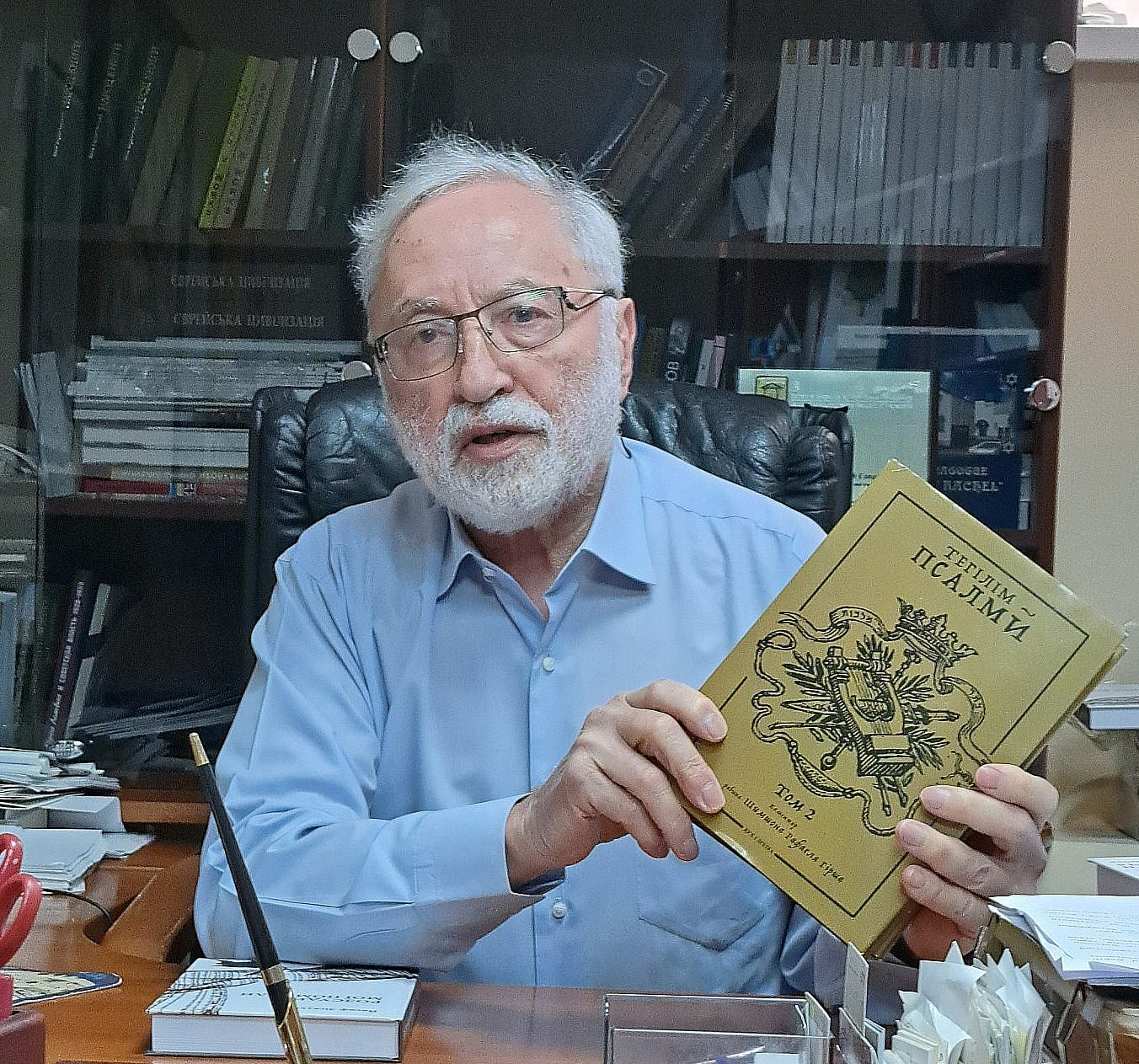
Two and a half months ago, Yosef Zissels sent me a letter. Zissels is a veteran figure of Ukrainian Jewry, a former Soviet dissident, and I met him personally in Kyiv during my trip to Ukraine last year. I chose not to write about it immediately, preferring to let the text settle, reread it and verify its strongest points. What emerged is a document that deserves attention because it does not only call Russia into question, it also challenges part of Ukrainian society itself. The letter, written in October 2025 and titled “Self-denial and self-sacrifice,” is a harsh, almost ruthless statement.
Its central point is this: before asking more of the West, Ukrainians should ask themselves whether they are truly doing everything they can. Zissels defines the conflict as an “existential” war, part of a broader confrontation between the authoritarian and democratic worlds. From this premise he draws a radical conclusion: a war of this kind cannot be sustained only by those fighting at the front or by a particularly motivated minority. It must transform the whole of society. For this reason, he writes that, in his view, only about 30 percent of adults are truly orienting their lives toward Ukraine’s victory, and he goes so far as to ask whether the country is preparing its children and grandchildren, boys and girls, for possible military service.
When I interviewed him in Kyiv on May 7, 2025, Zissels had already told me that Ukraine, in order to survive, would have to become “a militarized country, like Israel,” and that boys and girls alike would have to grow up with that awareness. In the same interview, he added that many Ukrainians had not yet fully understood the nature of the conflict and were still hoping for a miracle. The letter he sent me develops that same idea in an even sharper form.
Zissels touches a real nerve in the Ukrainian war: mobilization. As early as April 2024, Reuters reported that about 4.3 million Ukrainian citizens were living in European Union countries under temporary protection, including about 860,000 adult men. This means that, while the front needs men, outside the country there is a very large pool of males of potentially relevant age for the war effort. The difficulty, however, does not concern only those abroad. Reuters also covered, in July 2024, a mobilization campaign marked by declining enthusiasm, distrust of recruitment offices and widespread tension around military service. To this must be added another element, less discussed but not irrelevant: in March 2024, domestic tourism in Ukraine had almost returned to 2021 levels, and only 20 percent of Ukrainians were avoiding travel for security reasons. These data help explain the target of Zissels’ polemic. A long war wears down the relationship between state, society and sacrifice, and makes the distance more visible between the existential nature of the conflict and the degree of mobilization that, in his view, Ukrainian society has expressed so far.
The problem remains wide open. Recently, Volodymyr Zelensky spoke of the need for much broader changes to the mobilization system: between April and May, Ukraine introduced new rules on troop rotation and launched a reform of the army designed to address infantry shortages, low morale and personnel exhaustion.
There is also an important point concerning the involvement of women. In the letter, Zissels explicitly speaks of “boys and girls,” meaning a preparation that should involve both sexes. Today, however, the Ukrainian picture is not symmetrical. According to the Ministry of Defense, as of January 1, 2025, more than 70,000 women were serving in the Ukrainian Armed Forces, and more than 5,500 were on the front line. This is a significant involvement, but it remains far from male mobilization. Women are not automatically conscripted like men, except for specific registration obligations applying to certain professional categories, especially in the medical field. In this sense, Zissels is calling for a further leap in responsibility.
His reference to Israel can be better understood from this angle as well. In Israel, the female role is an organic part of the military system. In Ukraine, it is not: the contribution of women has grown, but it still does not have a fully symmetrical character compared with that of men. This was precisely the difference that struck me in Kyiv. A year ago, entering some bars and evening venues in the capital, the feeling was very clear. I was struck by the sight of so many young women taking part in the nightlife of a city that, to someone who often visits Israel, appeared much less marked by total mobilization. This is a direct impression, not supported by specific data. I therefore take it for what it is. Yet it still helps explain the meaning of Zissels’ call for a more militarized society.
Zissels is not right about everything. His “30 percent” is not, based on public sources, a verified figure. Other indicators suggest a society more resilient than his invective would imply, although today that picture appears less clear-cut than it seemed at the beginning of 2026. A KIIS poll, the Kyiv International Institute of Sociology, published on February 2, 2026, showed that 65 percent of Ukrainians said they were ready to endure the war “for as long as necessary,” but subsequent surveys recorded a decline to 52 percent in mid-February, 54 percent in early March and 48 percent at the end of April. This figure does not confirm the “30 percent” evoked by Zissels. It shows a society in which the willingness to resist remains broad, within a context of growing fatigue. Zissels’ 30 percent should therefore be read as a moral and polemical formula.
Even more debatable is the passage in which Zissels seems to suggest that the war has had a relatively limited impact on the well-being of the majority of Ukrainians. Here the data point in the opposite direction. According to the World Bank, poverty in Ukraine remained at very high levels in 2025, with an estimate of 36.9 percent, essentially in line with 37.0 percent in 2024 and far above pre-2022 levels. Over the same period, inequality increased significantly, with the Gini coefficient rising from 0.41 in 2023 to 0.50 in 2025. Material hardship exists, it weighs heavily and it remains structurally much higher than before the war.
The decisive point of the letter is moral: Zissels is telling Ukrainians that an existential war cannot be delegated to those fighting at the front, nor can it be compensated for solely by external aid. Before even addressing the relationship with the West, he calls into question Ukraine’s relationship with itself.
In this framework, the reference to Israel, which had already emerged in my May interview, carries a precise weight. After October 7, 2023, Israel called up about 360,000 reservists, the largest mobilization since 1973. Reuters reported on the almost immediate return of Israelis from abroad, with people leaving jobs, studies and holidays to come back in uniform. Alongside them, thousands of foreign volunteers reached the country to work in agricultural fields, help affected communities and fill part of the logistical gaps opened by the war. Among them were also many non-Israeli Jewish volunteers, as shown by the civilian mobilization programs that emerged after October 7. The point is clear: in the face of the initial trauma, the dominant reflex was mobilization, not withdrawal.
This is the yardstick by which Zissels looks at Ukraine. Can an existential war be won by a society that resists, yes, but without truly transforming itself?