A Correspondent in Tel Aviv
Zohran Mamdani: The Clown’s Sinister Darkness
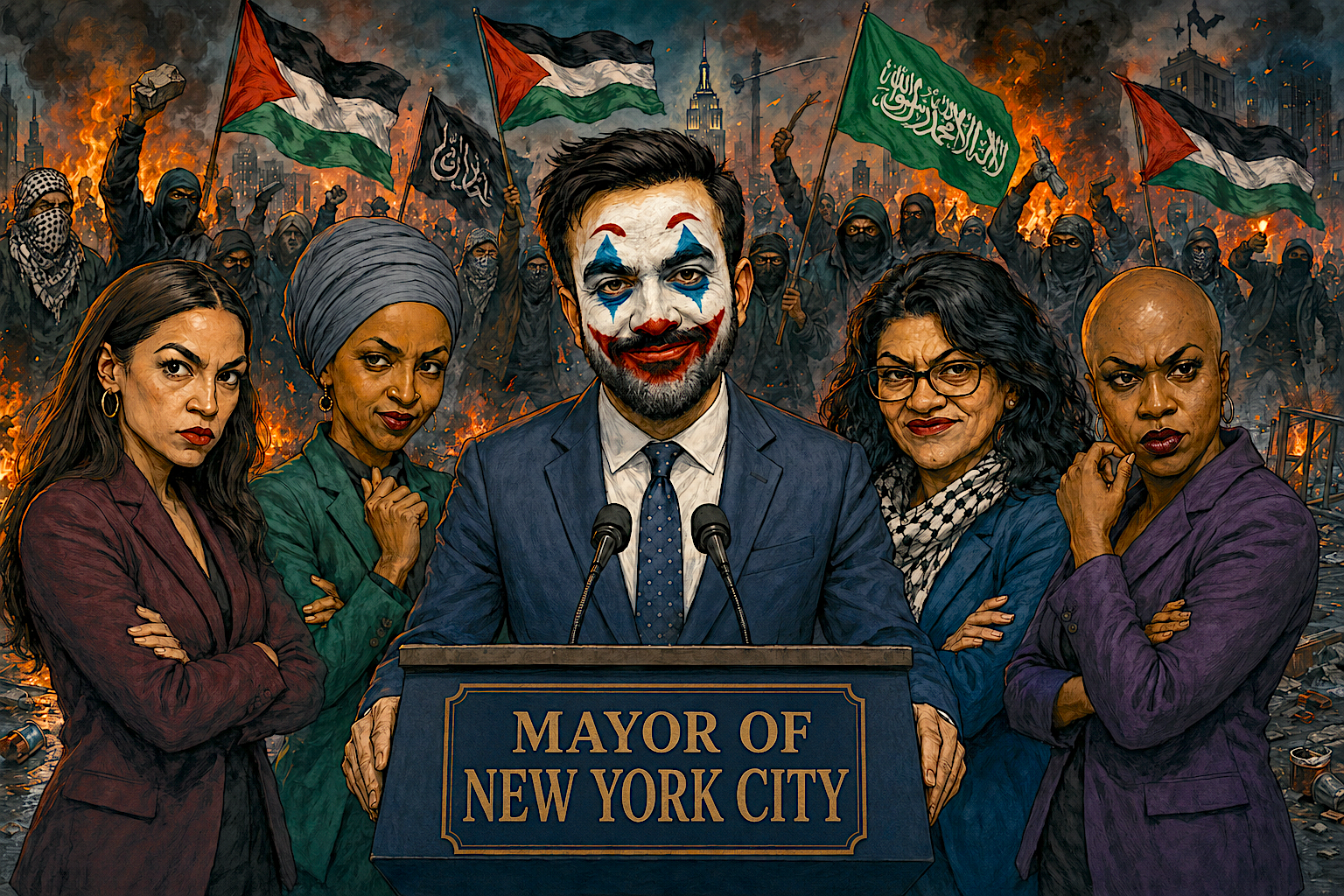
Zohran Mamdani was elected mayor of New York City on promises that anyone familiar with government recognized as crude populism in attractive packaging, designed to seduce residents of a city where living costs had spiraled, and corruption under previous administrations had become intolerable.
That also persuaded many Jewish New Yorkers to vote for him.
Today, they may be the unhappiest of all.
They swallowed promises Mamdani knew he could not keep while making a far more consequential concession—one that will remain a dark chapter in the history of a Jewish community woven into New York’s cultural identity.
Mamdani is using the mayoralty of the city with the largest Jewish population outside Israel as a means to promote a systematic “anti-Israel” campaign. The quotation marks matter: this is not legitimate criticism of a particular Israeli government, but a challenge to the legitimacy of Jewish statehood itself.
Alongside it comes a more insidious cultivation of antisemitism. Jews are relabeled “Zionists,” while self-described progressives march with Islamists and apologists for Palestinian terrorism. Synagogues and Jewish-owned businesses are blockaded; visibly Jewish people are assaulted.
Mamdani’s agenda is hardly hidden. He has described the debate on Palestine as “central to my identity.” At Bowdoin College, he co-founded a chapter of Students for Justice in Palestine, whose national organization later hailed October 7 as a “historic victory for the Palestinian resistance.”
He supports BDS and refuses to affirm Israel’s right to exist as a Jewish state.
And that is not even the worst of it.
The day after the October 7 massacre, Mamdani broadly mourned those killed “in Israel and Palestine,” without naming Hamas, before pivoting almost immediately to “occupation” and “apartheid.”
Under pressure, he later called the Hamas assault a “horrific war crime.”
Yet there was no war on October 7, nor was Hamas an army representing any legitimate state structure. It was what it remains: a brutal jihadist terrorist organization. Even Mamdani’s carefully chosen language faintly suggested contextualization, if not excuse.
In October 2025, he initially refused to say whether Hamas should disarm, conceding one day later, on a debate stage, that it should. The pattern is familiar. He refused to condemn “Globalize the Intifada”—a call for violence aimed primarily at Jews—arguing that a mayor should not police language.
Only after the backlash did he promise to “discourage” its use.
When Hezbollah flags appeared during disturbances outside a synagogue, his condemnation was so vague that a spokesperson had to clarify that “terrorist organizations” did include Hezbollah.
By contrast, words such as “genocide” and “war criminal” roll effortlessly off his tongue when discussing Israel, although neither allegation has been judicially established.
No secret Islamist conspiracy need be proved. Nor is it necessary to re-examine his relations with Islamist figures in New York or the funding networks behind his rise.
The reality is simpler—and perhaps more dangerous. Mamdani is a bridge through which Islamist propaganda is laundered into the language of America’s radical left.
Terrorism becomes “resistance.” Self-defense becomes “genocide.”
Slogans from the suicide-bombing era are repackaged as the vocabulary of civil rights.
And the company he keeps completes the picture.
His wife, Rama Duwaji, reposted material glorifying PFLP terrorists Leila Khaled and Shadia Abu Ghazaleh. She shared a post declaring “F*ck Tel Aviv” and arguing that the city should not exist. She liked posts celebrating the October 7 terrorist attacks as “resistance,” along with one dismissing the now-substantiated allegations of mass rape against Israeli women as a “hoax.”
When pressure eventually came, she apologized for offensive language in other old posts—but never for these.
One could argue that a wife’s actions cannot automatically be attributed to her husband. That much is true. They do, however, reveal much about the ideological world surrounding the “charismatic” mayor—and the man who recently managed, in effect, to erase both New York’s Italian and Greek communities from the map.
This is a political method in which massacre is s stripped of its horror and Israelis are portrayed as monsters, while terrorist organizations, the inhuman Iranian regime and every other subject on which Mamdani remains silent recede into the background.
Given what he says when he speaks, perhaps that silence is indeed a blessing.
His latest fiasco—the threatened “arrest” of Benjamin Netanyahu—was the crudest populist theater of his mayoralty. Mamdani knew he had no such authority and that the United States is not a member of the International Criminal Court.
The ICC’s chief prosecutor, Karim Khan, who sought the warrant, was dismissed on Friday, July 24, over allegations of sexual misconduct. American cooperation with the court is also heavily restricted by legislation enacted in 2002.
Before that, Mamdani became the first New York mayor since 1965 to boycott the city’s annual Israel parade. Yet Bezalel Smotrich, Netanyahu’s far-right finance minister, marched alongside some 50,000 New Yorkers—protected by Mamdani’s own police department.
For that is what Mamdani ultimately is: a ruthless populist posing as a global prosecutor.
A toxic antisemite and, above all, a grotesque political product—but a dangerous one. His performance has handed Islamists and the extreme left something far more valuable than another hate-filled street demonstration: New York City Hall.
Related Topics
Related Posts