121 Witnesses Lithuania Cannot Prosecute
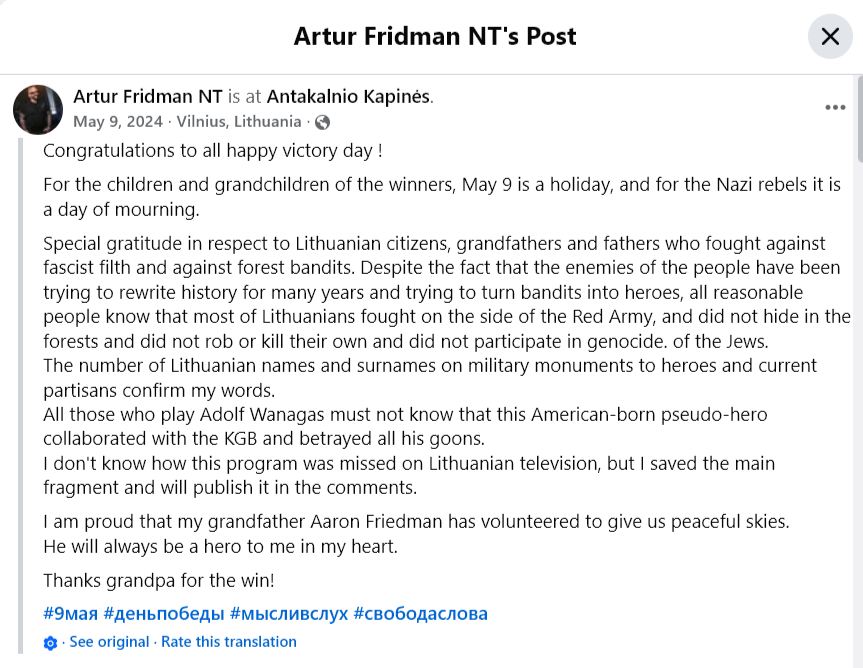
Lithuania has chosen to criminally prosecute Artur Fridman for a Facebook post.
Lithuania cannot prosecute the dead. That is the problem now confronting the Lithuanian state. Long before Fridman wrote a word, long before the Genocide Center elevated its preferred narratives into administrative doctrine, and long before prosecutors turned Holocaust-related speech into a criminal matter, Jewish survivors had already recorded what happened in Lithuania, town by town, witness by witness, perpetrator by perpetrator.
Leyb Koniuchowsky did not collect rumors. He collected first-hand survivor testimonies in Displaced Persons’ camps between 1946 and 1948, when memory was still close to the events, when names were still sharp, and when the destroyed social world remained visible in the minds of those who survived it. The result is not a stray anecdotal archive. It is one of the most concentrated testimonial records of Lithuanian participation in the destruction of Lithuanian Jewry. The title says exactly what the Lithuanian state most fears: The Lithuanian Slaughter of its Jews.
And the 121 testimonies are not the whole archive. They are a published selection from a much wider body of Jewish witness evidence. My own aunt, Sheyne Beder of Biržai, gave a detailed testimony that belongs to that broader world of record but is not included in this published volume. Lithuania’s problem is therefore not one book. It is the existence of a far larger Jewish evidentiary record than the state has ever seriously centered.
Joseph Melamed spent decades compiling what he described as an estimated 30,000 names of Lithuanians implicated in the persecution and murder of Jews, yet Lithuania resisted investigation and never punished anyone through its own courts. The pattern is now unmistakable: evidence arrives, the state stalls, and the bearer of the evidence becomes the problem.
The importance of the Koniuchowsky collection is not just emotional. It is forensic. The testimonies preserve the local mechanics of destruction in a way official state narratives cannot survive. They name towns. They name police. They name partisans. They name commandants. They name local thieves, tormentors, rapists, guards, collaborators, and beneficiaries. They record not only how Jews were murdered, but how Lithuanian society behaved while Jews were being marked, isolated, humiliated, dispossessed, exploited, marched out, shot, and buried. That is why the collection matters so much for the Fridman case. Lithuania may be able to drag one living Jew into court. It cannot indict the dead witnesses.
And those witnesses do not describe a society caught by surprise. They describe preparation, local initiative, opportunism, spectatorship, theft, and terror. Koniuchowsky’s archive records not rescue as norm, but rescue as exception against a background of mass participation, pervasive acquiescence, pervasive thievery and plunder of Jewish property, and the thrill of instilling terror and distress in Jewish neighbors. In Telzh, armed Lithuanian bands were already calling themselves “partisans” and ruling the town before German power had fully stabilized. The testimony records local officials, guards, extortion, the false promise that valuables would be stored at the Lithuanian state bank, looting by local youths, theft of wallets, shoes, umbrellas, and even baby carriages, and the spectacle of townspeople coming to watch and applaud the “Demon’s Dance.” This is not a story of remote German abstraction. It is a story of Lithuanian social participation.
My aunt’s testimony makes the same point in another register. She describes Lithuanian civilians, students, and local officials participating in humiliation, forced labor, robbery, sexual coercion, and murder. She names individuals. She describes girls being degraded, threatened, and exploited, not in some abstract universe of “gendered violence,” but inside the ordinary provincial world of Biržai and its surroundings. Her testimony makes one thing impossible to deny: Lithuanian participation in anti-Jewish violence was not confined to shooting pits alone. It extended into humiliation, domination, plunder, and the destruction of dignity before death.
That matters for another reason too. Lithuania likes to foreground rescuers as though rescue were a national norm and a moral solvent. The testimony record says otherwise. Even where survival depended in part on Lithuanian assistance, that assistance could be coercive, unequal, contingent, and exploitative. My aunt survived in part because of her relationship with a Lithuanian engineer, Antanas Ratziukaitis, who helped her at times. But the relationship itself was marked by pressure, dependence, conversion demands, sexual exploitation, and abandonment. Rescue under those conditions carried moral weight. It did not carry moral absolution. A state that turns all rescue into national self-redemption is falsifying the record.
The foreword to the Koniuchowsky volume states plainly that the slaughter of the Jews was widely known. That point is devastating because it destroys the state’s preferred fiction of ignorance. The record is not one of hidden crimes invisible to society. It is one of public destruction, visible disappearance, heard gunfire, watched humiliation, transferred property, and moral choice. When later Lithuania asks the world to treat its anti-Soviet hero canon as morally insulated from the destruction of Jews, the Koniuchowsky collection answers with a town-by-town rebuttal.
That is why this archive matters more than rhetoric. It shifts the argument from emotion to proof. Lithuania has tried for years to reduce the Holocaust question to a dispute about interpretation, emphasis, proportion, or national dignity. Koniuchowsky denies that escape. His witnesses do not ask the reader to infer what happened from political theory. They say what happened. They say who did it. They say who watched. They say who profited. They say who remained silent.
The effect on the current prosecution is devastating. Fridman is being treated as though he created an offense by raising questions about revered Lithuanian figures and the Holocaust-era environment in which they operated. But the questions were already there in the record. The contradiction was already there in the archive. The unresolved conflict between Lithuania’s pantheon and Jewish testimony did not begin with Fridman. He merely forced the state to confront a problem it has spent decades trying to manage.
That is why the title of this article matters. These are 121 witnesses Lithuania cannot prosecute. It cannot impose a travel restriction on them. It cannot indict them under Article 170-2. It cannot accuse them of insulting a national hero. It cannot neutralize them through legal process. All it can do is what it has done for years: omit them, minimize them, subordinate them to official memory institutions, and hope that political ceremony outlives documentary truth.
But that strategy is getting harder to sustain because the state’s own credibility has collapsed under repeated disclosures of historical fraud. The Brazaitis case proved that Lithuanian institutions were willing to convert an American administrative closure into a false public claim of “complete exoneration” and then persist in that claim after notice from lawyers, historians, complainants, and members of Congress. Silvia Foti’s work then destroyed from within the family itself the state-protected legend around Jonas Noreika. In this field, Lithuania no longer has a presumption of honesty. It has a record of persistence in falsehood after notice.
The issue is not whether testimony is infallible. Serious history does not treat survivor recollection as beyond criticism. Dates can blur. Sequence can compress. Fear can sharpen some details and flatten others. But that methodological caution does not save Lithuania. First, Koniuchowsky’s collection is large enough that patterns recur across places and witnesses. Second, it is early enough to preserve local detail that later political memory often erases. Third, the broad structure it describes is strongly supported by serious scholarship: local participation, social breadth, material benefit, choice, and the rapid integration of Lithuanian actors into the destruction process. Testimony here does not sit alone. It stands inside a wider and convergent historical record.
So what exactly is the state prosecuting when it prosecutes Fridman? Not a lie. Not a fantasy. Not an invented insult to the nation. It is prosecuting a challenge grounded in the very kind of record Lithuania has spent decades refusing to center: Jewish testimony about what Lithuanians did to Jews in Lithuania.
Lithuania should be required to do what it has systematically avoided. Instead of one Jew being placed on trial, the conduct of the Lithuanian state, the nation, and the historical culture it has imposed on its own people should be placed on trial against the archive. Not in the theatrical sense of slogans, but in the strictest evidentiary sense: produce the files, identify the reviewers, state the standards applied, disclose the dissent, explain the omissions, and account for the falsehoods. The question is no longer whether one Facebook post offended the national myth. The question is whether Lithuania, its institutions, and the social memory system it built can survive honest confrontation with the Jewish evidentiary record they have spent decades trying to subordinate, sanitize, or silence.
Fridman’s case shows where Lithuania’s courage ends. It can prosecute the living. It can isolate the vulnerable. It can impose restrictions, file charges, and make examples of Jews who force contradiction into view. What it cannot do is prosecute the dead witnesses who already said what happened. The real defendant is no longer Artur Fridman. It is the Lithuanian state’s regime of managed memory — and the deception by which it taught a nation to honor the unresolved, commemorate the exceptional, and look away from the overwhelming record in front of it.