French-Israeli Visual Artist and Writer
25 Minutes of Applause
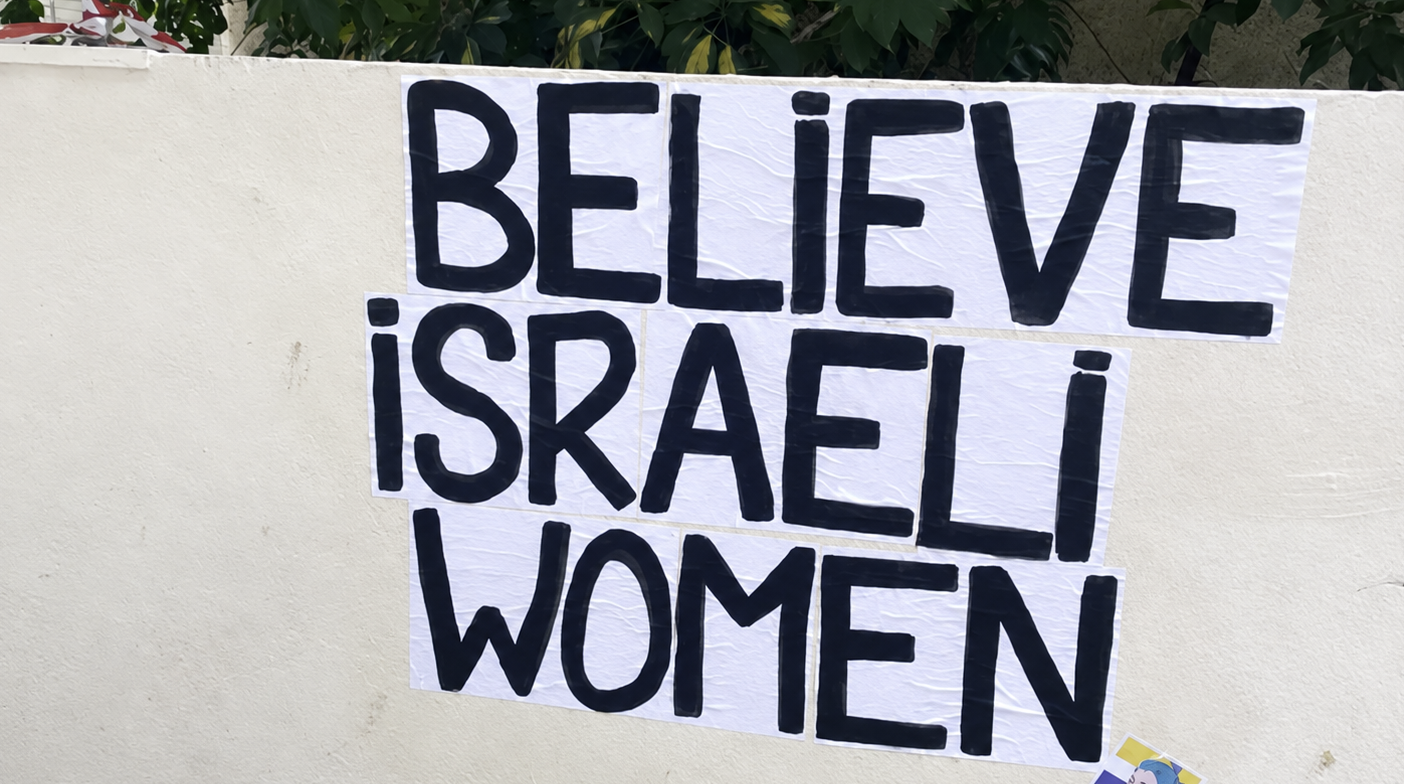
Credit photo : @YiddishFeminist / Morgane Koresh
Twenty-five minutes.
That is how long the audience at the Venice Film Festival reportedly stood applauding NAZA, the new documentary by Israeli filmmakers Yuval Abraham and Rachel Szor. Days later, the film received the festival’s Special Jury Prize.
Twenty-five minutes is a very long time to stand and clap.
And perhaps that is why, when I first read about the film, I found myself thinking less about NAZA than about another set of testimonies, ones that were met not with standing ovations, but with suspicion, demands for more proof, accusations of fabrication and an apparently ever-moving threshold for what would finally be enough.
Disclaimer: I have not seen NAZA. This is not a review of it.
The documentary is built around testimony from 24 Israeli military and intelligence insiders whose identities are concealed from the audience. It grew out of investigative work connected to +972 Magazine, Local Call and The Guardian, which produced the film and says the confidential testimonies were verified.
I am not questioning whether those people are telling the truth. That is not the question I am interested in asking today.
There is also a separate argument taking place in Israel over the filmmakers themselves. They have been called traitors, and there have been calls to strip them of their citizenship. I do not want to turn this article into that debate either.
Freedom of speech and freedom of artistic and journalistic creation are easy democratic principles to defend when we like what is being said. Their real test comes when the work angers us, embarrasses us, implicates our own society or feels profoundly damaging.
What interests me is not whether NAZA should have been allowed to exist.
What interests me is those twenty-five minutes, and what happened around them.
Because Venice did not remain in Venice.
The ovation travelled. The prize travelled. Headlines travelled. Clips travelled. Online, people reacted not only to the film, but to the idea of the film, to descriptions of it, to excerpts, and to the fact that Israeli military insiders had apparently said these things.
Many of the people discussing NAZA had not seen it.
Most could not have seen it. It had only just premiered.
Yet its testimonies were already circulating as confirmation of a much larger argument.
That reaction reminded me of what happened when survivors and witnesses of October 7 tried to tell the world what had happened to them.
Nova survivors described people being hunted and murdered around them. Survivors from the kibbutzim described what they had seen in their homes and communities. Children described what they had witnessed. Released hostages described captivity. First responders described the scenes they encountered.
And those accounts did not emerge into an evidentiary vacuum.
There was testimonial evidence. Documentary and digital evidence. Physical and forensic material. Attack sites and bodies. Footage recorded by the attackers themselves. Survivors and hostages who returned from Gaza. Later came investigations examining thousands of images, hours of footage, physical locations and witness accounts.
And still, in substantial parts of international discourse, there was disbelief.
Not simply investigation.
Disbelief.
It is fake.
It is Israeli propaganda.
They are lying.
It was exaggerated.
Where is the proof?
How much more evidence?
The denial around sexual violence became perhaps the clearest illustration of this, but it was never the whole story.
For years, much of international culture had absorbed the language of #MeToo. We had discussed why victims of sexual violence may struggle to speak, why trauma does not always produce neat testimony, and why delayed disclosure does not automatically invalidate an account.
Then the victims were Israeli women, and something visibly changed.
The slogan “Believe Israeli Women” became necessary not because women were the only people whose testimony was questioned, and not because every allegation should automatically be accepted. It became necessary because their treatment exposed something broader about whose testimony is instinctively granted credibility and whose testimony seems to require an endlessly replenished supply of proof.
The United Nations matters here because its findings carry considerable weight with many of the same international audiences involved in these conversations.
Its mission on conflict-related sexual violence interviewed 34 people, including survivors, witnesses, released hostages and first responders. It visited attack sites and a morgue, reviewed more than 5,000 photographs and around 50 hours of footage, and found reasonable grounds to believe that rape and gang rape occurred in several locations, as well as convincing information that hostages had been subjected to sexual violence. It also rejected or could not substantiate some reported allegations.
That distinction matters.
Evidence can be weighed. Some claims can be corroborated and others rejected.
But there is a difference between investigation and a culture of disbelief.
The same UN mission noted that intense national and international media scrutiny of people who made their accounts public had hindered access to survivors.
These were traumatized people being repeatedly asked to demonstrate that what had happened to them was real.
And then comes NAZA.
The people speaking in the documentary are anonymous to the audience. Their faces are obscured and their voices altered. There may be entirely legitimate reasons for that. Whistleblowers often require protection.
Anonymity does not make testimony false.
But it does limit what an audience can independently assess.
The public cannot identify these witnesses, independently establish their roles or assess the information to which they personally had access. Nor can it inspect much of the confidential material behind their accounts.
That does not mean the material is unreliable.
It means that anyone watching the film, reading about it or reacting to it online is placing a degree of trust in the filmmakers and journalists who verified those sources.
And yet the language surrounding the film quickly becomes expansive.
The film presents its testimony not merely as allegations about individual incidents, but as evidence of systems governing civilian deaths in Gaza. The Guardian describes the documentary as focusing on systemic targeting and mass killing, while the filmmakers themselves have framed it around systems rather than isolated events.
I have not seen the film, I have not interviewed its sources, and I am not pretending I can determine whether its claims ultimately stand up to scrutiny.
But I can look at the difference in reception.
The twenty-five minutes in Venice are simply the most visible image of it.
There is the prize.
There are the headlines.
There is the commentary.
There are the posts and shares from people for whom the existence of these testimonies already appears to settle a much larger argument.
And I cannot help comparing that willingness to receive testimony with what happened when the survivors and witnesses of October 7 spoke.
The point is not that anonymous testimony should be dismissed.
The point is the extraordinary difference in instinct.
In one case, testimony arrived alongside a substantial body of visual, physical, testimonial and investigative evidence and still encountered people determined to find another reason not to believe.
In the other, testimony that necessarily remains inaccessible in important ways to the public can be received with extraordinary cultural affirmation, and its implications repeated by people who have not even seen the documentary.
The nationality of the speaker cannot explain the difference. Much of the testimony in both cases comes from within Israeli society.
The difference may be what that testimony allows the listener to believe.
When testimony confirms an existing conviction about Israel, does the threshold for acceptance fall?
When testimony requires someone to acknowledge Israelis as victims, particularly victims of people or movements they understand primarily through the language of oppression, does the threshold rise?
That is where confirmation bias becomes more than an abstract psychological concept.
It is not simply believing something false because we want it to be true.
It can also mean changing the amount of proof we require according to how comfortably a claim fits the world we have already constructed.
This is not an argument for believing one side automatically.
It is an argument against deciding how much evidence is enough only after we know who the evidence will condemn.
I keep returning to those twenty-five minutes.
Not because they are the whole story.
They are simply one particularly stark image of something we have witnessed for years.
An audience standing.
A prize being awarded.
Headlines spreading.
Posts being shared.
A story being absorbed.
A willingness to receive.
And I remember how desperately people who survived October 7 tried to explain what had happened to them, and how often even an extraordinary accumulation of testimony and evidence seemed unable to purchase that same willingness.
Venice did not reveal a double standard. It was simply another stark example in an already vast accumulation of them.
Because the difference was never only about the quality or quantity of the testimony.
What changes is the story the testimony is being asked to support.
When Israelis speak as victims, the threshold for belief can become extraordinarily high.
When testimony presents Israel as perpetrator, that threshold can suddenly become much easier to cross.
NAZA did not create that asymmetry. But those twenty-five minutes in Venice gave it an astounding stage.
Related Topics
Related Posts