
Author l Columnist | Public Policy | Life Management Coach
36 Years On, Kashmir’s Hindus Still Await Justice
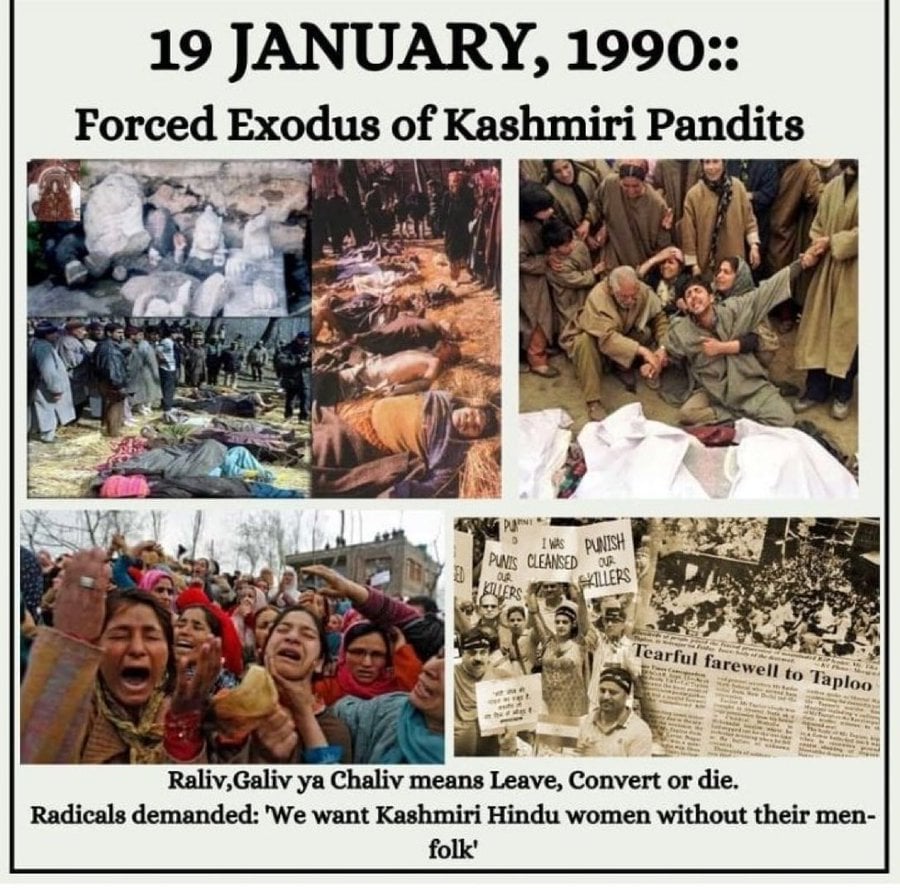
Forced exodus of kashmiri Hindus in 1990, Photo credits :- https://x.com/OfficialPreetiM/status/1990317188008616299/photo/1
Whenever Kashmir state of India is discussed, the debate often revolves around cross-border terrorism, security, the rights of the majority Kashmiri Muslims and international politics. But this time the topic of discussion is none of these. This time at the center is the minority Kashmiri Hindus of this state, whose tragedy remained on the margins of national and global discourse for decades. The echo of whose human rights does not reach the forums of the United Nations, nor the international courts, and unfortunately the human rights discourse of the country also seems to be silent towards their suffering. Have Kashmiri Hindus, who are a minority in Jammu and Kashmir despite being a majority in India, been victims of politics for decades? Are their human rights, justice and right to dignified and safe resettlement different from those of other citizens? If not, then why did their displacement, their suffering and their demand for justice not find the place in the national discourse that is expected of a democratic republic?
Justice delayed is justice denied. This statement seems equally relevant even today on the suffering of Kashmiri Hindus displaced from Jammu and Kashmir in India, especially the Kashmiri Pandit community. On June 29, after almost 36 years, Jammu and Kashmir Police has filed a 737-page charge sheet in the Anti-Terrorism Court in the case of murder of Kashmiri Pandit nurse Sarla Bhatt in 1989. According to the charge sheet, Sarla Bhatt was abducted by militants of the banned organization Jammu Kashmir Liberation Front, subjected to inhuman torture and later murdered.
The chargesheet names other accused including then JKLF (a terrorist organization) chief Yasin Malik. According to police, Khurshid Ahmed Chalaku fired at Sarla Bhatt and fled to Pakistan-administered Kashmir after the incident. The other three accused named in the case, Abdul Hameed Shaikh, Mohammad Yusuf Sufi and Ghulam Mohammad Taplu, are no longer alive. The investigating agency alleges that this was not an ordinary criminal incident, but was part of a targeted terrorist campaign launched against the Kashmiri Pandit community, the aim of which was to create an environment of fear and force them to flee the valley.
Sarla Bhatt, 27, was working as a staff nurse at the Sher-e-Kashmir Institute of Medical Sciences in Srinagar. It is alleged that she was kidnapped, subjected to severe physical torture, sexually assaulted and later brutally murdered. Jammu and Kashmir Police says that due to years of terror and fear of witnesses, effective investigation of the case could not proceed. The investigation restarted in 2024 and now the charge sheet has been presented in the court. But the question is not only that the charge sheet has been filed. The question is, can a wait of 36 years be called justice? With the rise of militancy in Jammu and Kashmir in 1989–90, many Kashmiri Hindu government employees, teachers, judges, intellectuals and ordinary citizens became victims of targeted violence. According to government records, more than 44,000 Kashmiri Pandit families were registered for relief and rehabilitation, while various independent studies and community organizations estimated the actual number of displaced people to be between 3 to 5 lakh people, as not all displaced families were registered with the government relief system. This is considered to be one of the largest internal displacements in the history of independent India.
Sarla Bhatt was not the only victim of this tragedy. The assassination of senior lawyer and political leader Tika Lal Taplu in September 1989 signaled the beginning of this period. After this, in November 1989, terrorists murdered Justice Neelkanth Ganju in broad daylight, who had sentenced terrorist Maqbool Bhat to death. In 1990, Engineer B.K. Ganju was shot dead in his house, while Doordarshan Srinagar director Lassa Kaul was targeted outside his office. In the same year, the brutal murder of Girija Tikku after her kidnapping shocked the entire country. These incidents were not just isolated killings, but were a means of creating an environment of fear and insecurity that forced thousands of Kashmiri Hindu families to leave their ancestral lands. That is why many security experts and investigative agencies believe that the purpose of the targeted violence at that time was not only to kill individuals, but also to change the social and demographic structure of the valley.
The barbarity of Kashmiri Hindus did not stop here. This was the final and decisive blow to the process of ethnic cleansing and genocide of Kashmiri Pandits. After this, mass massacres like Sangrampora massacre (1997), Udhampur massacre (1997), Prankot massacre (1998), Wandhama massacre (1998) and Nadimarg massacre (2003) became the sequels of this ethnic cleansing. The population of Kashmiri Pandits in Kashmir was about 10 percent in 1947, which declined to less than 5 percent by 1989 and today has come down to less than 0.2 percent. This dance of death continues even today in some form or the other. While the governments of the day seem eager to provide a “healing touch” to terrorists, militants and self-proclaimed separatist leaders, the indigenous Hindus of Kashmir, who were almost wiped out from their homeland and forced to live as internally displaced persons in their own country, are still waiting for justice and dignified rehabilitation.
The Central Government, from time to time, launched special rehabilitation packages to provide thousands of government jobs, safe houses and financial assistance, but even after more than three decades, a large number of families continue to live displaced lives in Jammu, Delhi and other parts of the country without any guarantee of security. Kashmiri Hindus, who were once an integral part of the valley’s cultural, intellectual and administrative identity, have today a very limited presence. This is not only a change in population, but also a symbol of deep damage to India’s ancient civilization, cultural heritage and social diversity. Over the years the government has taken several steps like rehabilitation, employment packages, safe housing and conservation of temples. After the removal of Article 370, the expectation also increased that cases related to decades old terrorism would increase. The charge sheet in the Sarla Bhatt case is an important step in this direction, but justice will be meaningful only when all such pending cases are disposed of in a timely manner and the victim families get the real experience of justice.
Meanwhile, during the years of displacement, many disputes related to land and property also came to the fore. In 2001, the Jammu and Kashmir State Vesting of Ownership to Occupants Act, popularly known as Roshni Act, was introduced by the then Chief Minister Farooq Abdullah. In other words, this Act was to raise resources for power projects by giving ownership of the state’s land to the occupiers, but its purpose was to give legal recognition to the occupation of the majority Muslim population on the land, buildings and property of the displaced Hindu population. But a 2014 report by the Comptroller and Auditor General of India pointed to serious irregularities in its implementation. Later, in 2020, the Jammu and Kashmir High Court declared the Act unconstitutional and void, ordered the cancellation of all allocations and directed a Central Bureau of Investigation probed into the matter. Due to many such reasons, there are still deep apprehensions in the minds of displaced Kashmiri Hindus regarding the security and ownership of their ancestral lands, houses and properties. If the judicial process in the case of Sarla Bhatt, a Kashmiri Hindu woman victim, takes 36 years to move forward, can it be expected that millions of displaced Kashmiri Hindu families will be able to muster the courage to return to their birthplace without fear? Confidence to return is not built by rehabilitation packages alone; It is created when the state can establish in practice the assurance of security, justice, property rights and dignified rehabilitation.
Related Topics
Related Posts