
From Kibbutz to the global stage
3I/ATLAS, Humanity — and the MAVEN Anomaly: A Challenge for NASA and ESA
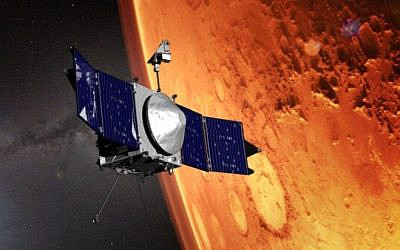
MAVEN (Mars Atmosphere and Volatile EvolutioN) has served as the primary atmospheric science and communications relay mission at Mars since 2014.
Credit: NASA/GSFC
3I/ATLAS, Humanity — and the MAVEN Anomaly: A Challenge for NASA and ESA.
On Friday, December 19, the interstellar object 3I/ATLAS will reach its closest point to Earth — at a distance of approximately 168 million miles (about 270 million kilometers).
The unusual object, estimated to be roughly the size of Manhattan, arrived in our vicinity nearly six months after its discovery, and even longer after entering the solar system.
Scientists, NASA, the European Space Agency (ESA), other space agencies, and a large global audience — observers who are curious, skeptical, and even emotionally invested — have been following with fascination the ancient visitor, more than seven billion years old, now passing through our neighborhood.
If this were an intelligent object, one might doubt it would be pleased with what it encounters on the young planet — only 4.5 billion years old — called Earth, given the instability, wars, and ongoing neglect of sustainability and environmental protection.
The strange visitor arrived on a trajectory opposite to the direction of planetary rotation, traveling at approximately 60 kilometers per second. It passed near Mars, Jupiter, and Venus, emitting jets of dust and gas, glowing and changing colors. Scientists have identified at least 15 anomalies in observations of the object — phenomena for which no full explanation yet exists. As far as we know, it is now on its way out of the solar system.
Barring surprises, it will begin moving farther away from Earth in the coming days. There are purely theoretical speculations that even at a distance of 53 million kilometers, it could leave behind a probe or research instrument, but the likelihood of this is considered very low.
It arrived peacefully, and it will likely depart peacefully. Yet the impact of 3I/ATLAS on humanity — and on our values and priorities — is already being felt, and much of it has yet to be fully processed.
We were reminded how young we are, how vast and infinite the universe is, and how small our place within it truly is.
We were confronted with our vulnerability when an object entered our cosmic neighborhood at 60 kilometers per second, ejecting gas jets extending hundreds of thousands of kilometers — on the scale of the distance between Earth and the Moon.
We learned, once again, that only global cooperation can allow humanity to better understand the universe and develop systems capable of responding, in the future, to unusual phenomena — events that will almost certainly recur in the years ahead.
The MAVEN Anomaly
While we are still absorbing the lessons left behind by this interstellar neighbor, a new and troubling development emerged:
Contact has been lost with the Mars orbiter MAVEN.
The loss of communication occurred just two months after observational encounters with 3I/ATLAS, when MAVEN and other spacecraft were only 29 million kilometers from the object.
On December 6, as MAVEN transitioned from the dark side of Mars to the sunlit side in the course of its routine orbit, NASA’s operations team failed to re-establish contact with the spacecraft.
Three major media outlets in the United States and the United Kingdom — US Herald, Daily Mail, and IBT UK — have reported on a possible connection between 3I/ATLAS and the loss of communication with MAVEN. All three, and especially the Herald, highlighted growing public distrust of NASA, as well as the blurred images presented at a November 19 press conference, following a prolonged period of silence attributed to the US government shutdown.
The images, taken around Mars on October 2, were released in low quality. NASA promised to provide clearer images later — a promise that has not yet been fulfilled.
NASA has provided few details regarding the communication failure, describing it only as an “anomaly.” This is a broad term that can encompass a wide range of scenarios — from a technical malfunction to an external, unidentified factor. More specific explanations, such as a collision or system failure, were not offered, and the choice of wording raised additional questions.
NASA also acknowledged that MAVEN changed its orbit, a fact that further fueled curiosity and speculation across social media.
Following the press conference, some scientists suggested that the blurring in the images might be related to the presence of anomalous objects in the field of view, and claimed that NASA was withholding information — claims that are most likely unfounded. Nonetheless, the prolonged silence and the partial disclosures amplified conspiracy theories already circulating online.
What Could Have Gone Wrong?
Several possible causes have been suggested for MAVEN’s failure:
- A collision or impact with an external object
- A cyber operation
- Failure of physical systems
- Failure of onboard computing systems
- Human operational error
A senior space industry scientist told The Register that switching a spacecraft’s computers into Safe Mode alters its orbit, as it involves firing thrusters. Recovery, he explained, requires a maneuver to correct the orbital deviation caused by entering Safe Mode.
It is important to note that such recovery operations can take months — and in some cases even years. Moreover, there is no no guarantee that sufficient fuel remains for corrective maneuvers.
Other experts told SpaceNews that in January, Mars will enter a solar conjunction period, when it lies behind the Sun relative to Earth — a condition that could delay recovery efforts and diagnostics.
NASA has stated that it will rely more heavily, for now, on Mars Odyssey, Mars Reconnaissance Orbiter, and ESA’s ExoMars Trace Gas Orbiter to provide relay services while MAVEN remains unavailable.
The Broader Context: Planetary Defense
MAVEN is not merely a scientific probe.
It is a core component of the Mars Relay Network, serving as a communications hub for other NASA missions, and until recently was considered one of the most advanced relay nodes operating around Mars.
At the same time:
- An unusual interstellar object passed near Mars only two months ago
- NASA has issued an official statement regarding a communication anomaly in MAVEN
- There has been a sudden reliance on older-generation relay systems, requiring assistance from ESA and potentially coordination with other space agencies operating around Mars, including China, India, and the United Arab Emirates
The potential implication is a reduced ability for NASA to manage Mars as a continuous operational environment, with possible consequences for future plans — including crewed missions and preparatory launches.
All of this is unfolding while the world is in the midst of a large-scale United Nations planetary defense exercise —
UN/IAWN — centered on 3I/ATLAS. The exercise involves approximately 80 observation sites worldwide, along with a global fleet of satellites and spacecraft.
From a theoretical risk-management perspective, the loss of contact with MAVEN is not evidence of anything, but rather an edge-case scenario that systems are expected to handle.
Programs such as IAWN / SMPAG are designed to address not only what is likely, but also scenarios with high impact, even if their probability is extremely low.
In risk-management terms, this is defined as:
Low probability – high consequence
The MAVEN anomaly, occurring just two months after spacecraft near Mars “observed” the interstellar visitor, and only days before 3I/ATLAS reached its closest point to Earth, fits precisely the type of scenario that planetary defense exercises are meant to examine.
Exercise managers are expected to ask:
- Are new objects appearing in Mars’ orbital environment?
- Is there an unexplained change in the object population?
- Is there an object that does not match known signatures (debris or natural bodies)?
- Could an external body — natural or otherwise — disrupt orbits, affect spacecraft, or cause communication anomalies?
Any serious safety system must also ask:
- What happens when an anomaly cannot be immediately explained?
- Who reports it?
- Who classifies it?
- Who is responsible for public communication?
This applies even if the final explanation turns out to be:
- A technical fault
- Instrument noise
- Or a rare natural phenomenon
Had NASA — the largest participant in the planetary defense exercise and one of its five governing authorities — initiated a formal activation of the exercise mechanisms following the MAVEN incident, there is a strong likelihood that the case would have been examined in depth, that conclusions would have been shared with scientists worldwide, and that the event would have been handled in a scientifically, technologically, and communicatively transparent manner — meeting the level of clarity the public reasonably expects.
Related Topics