A Camera In Dachau: Burden of the Jewish Liberator
The questions began when we named our fourth child after my grandfather.
Like many Jewish families, naming a child after a loved one felt deeply meaningful a way of honoring someone and carrying their memory forward. But after my son’s birth, I found myself thinking about my grandfather with a new, urgent curiosity. For the first time, I wanted to understand not just the family narrative, but the man himself.
As I held my newborn son, I realized I knew far more about what my grandfather had accomplished than what he had carried.
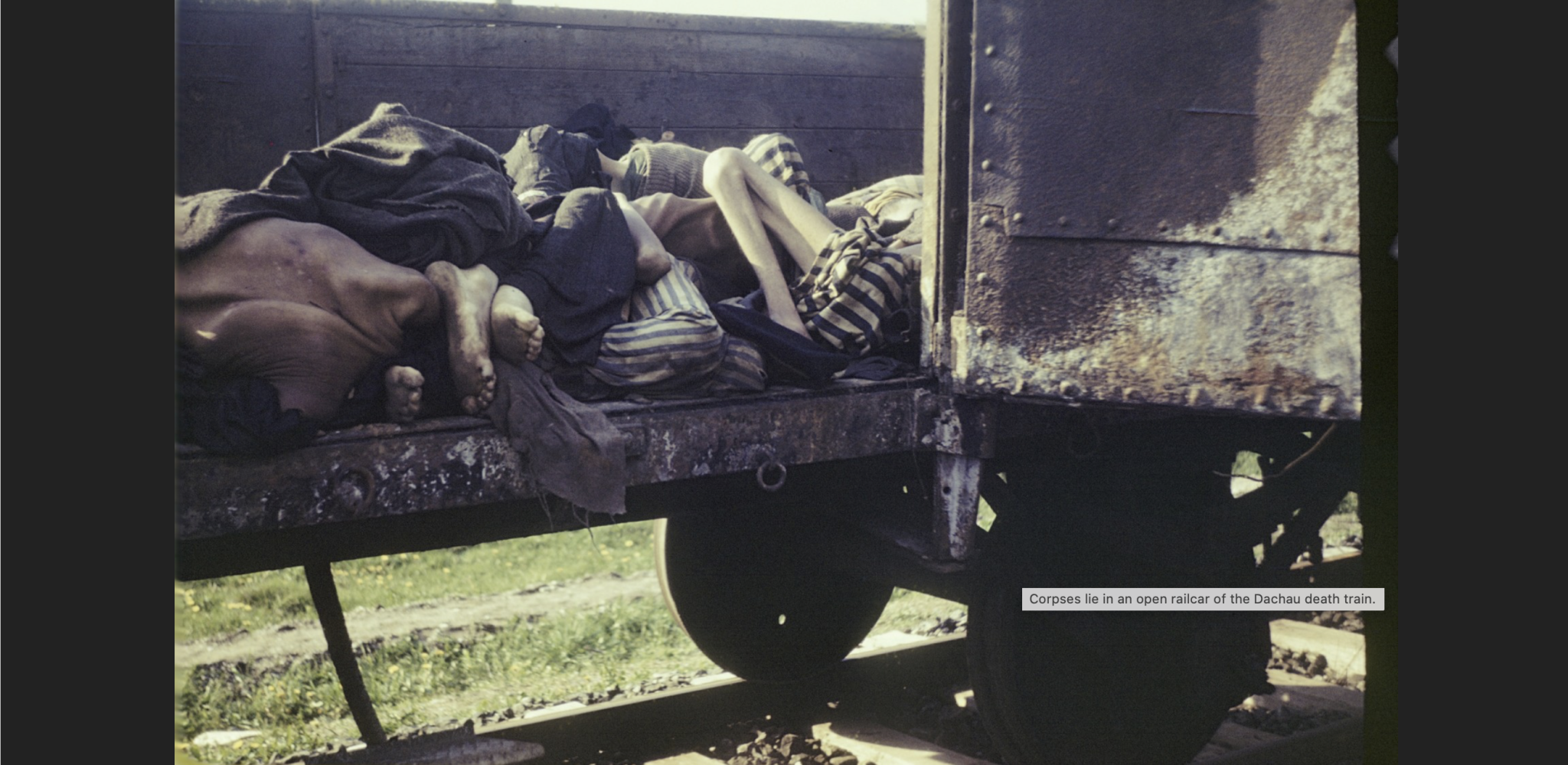
What I didn’t fully appreciate as a child was that before he became a husband, a father, and eventually my grandfather, he had walked through Dachau. He did so as a Jewish soldier in General Patton’s Third Army, carrying a camera.
My grandfather was older than many of the soldiers around him; he wasn’t an eighteen-year-old boy swept up in history. He was already trained as a surgeon, and by the time he crossed the Atlantic, reports of Nazi atrocities had begun to emerge. The full scale of the Holocaust was not yet known, but he understood enough to know that he might encounter evidence of extraordinary human suffering.
So he packed a camera.
The older I become, the more I think that decision reveals something essential about who he was. The camera reflected a desire to observe, document, and preserve what he witnessed.
‘A Nightmare I Can Never Hope to Forget’
Years after his death, I discovered a quote preserved alongside his photographs and testimony at the United States Holocaust Memorial Museum:
It is all a horrible memory, a nightmare I can never hope to forget. I wish that all the people back home could walk through this place. Then they would realize that any sacrifice they have made—even the loss of their loved ones—was not made in vain. To liberate this camp alone was sufficient reason for our war with Germany.
I have returned to those words again and again.
The young man who wrote them understood, in real time, that what he was witnessing would stay with him forever. Reading that sentence today, I find myself wondering not whether Dachau stayed with him, but how.
The grandfather I knew was bright, charismatic, larger-than-life, and deeply proud of being Jewish. He was also complicated. Depending on whom you asked, he was inspiring or intimidating, generous or demanding, warm or emotionally distant. Like many grandchildren, I inherited fragments of him: stories told while passing the stuffed cabbage across the table at a holiday meal, and contradictions that never fully settled into a coherent picture.
One thing everyone seemed to agree on, however, was his vitality. My grandfather was an avid athlete and outdoorsman who skied well into his eighties.
Looking back, I am struck by the sharp contrast between the man I knew—the surgeon and athlete who embraced life with remarkable energy—and the young Jewish soldier who described Dachau as “a nightmare I can never hope to forget.”
The Burden of the Witness
For most of my life, I thought of my grandfather’s military service as one chapter in a larger story. He fought in the war. He came home. He became a successful surgeon. He built a family and a life that eventually made mine possible. Only recently have I begun to wonder whether that story is too simple.
We have devoted decades to understanding the trauma carried by Holocaust survivors and their descendants. Their stories deserve that sacred attention. Far less attention, however, has been paid to another group: the liberators, and particularly the Jewish liberators.
Any soldier entering Dachau would have confronted the depths of human cruelty. But what was it like to enter as a Jew? To witness the destruction of your own people while knowing that, through mere geography, timing, and circumstance, you had escaped their fate?
My grandfather was not a survivor. He arrived wearing an American uniform. Yet he was not entirely an outsider either. The people behind the barbed wire were his people. The persecution he witnessed was not abstract; it was personal.
I suspect there is a unique burden in witnessing a catastrophe directed at your own people while standing just outside it. There is no language for being both connected to a tragedy and spared from it.
Human beings do not walk through places like Dachau unchanged.
The Distance in Simple Delight
One story in particular has stayed with me. My aunt once told me about the elaborate shows my sister, cousins, and I used to put on in my grandparents’ living room. We would dress up in our mothers’ old clothes, create skits, and perform for anyone willing to watch.
My grandmother delighted in it. She could sit for hours, fully present in the joy of the moment. My grandfather, she recalled, seemed unable to do the same.
He loved us, but there was often a distance between him and moments that required nothing more than delight. He was not a man who readily expressed emotion. In fact, one of the family stories repeated over the years was that he struggled to say the words “I love you,” even to the people closest to him.
For years, I accepted that as simply part of who he was. Today, I find myself wondering about it differently.
I cannot know exactly how those experiences shaped my grandfather. But I do wonder whether some of the qualities that defined him—his intensity, his vitality, his determination to keep moving forward—were connected in some way to what he witnessed there. I also wonder whether some of the distance my aunt observed, his difficulty fully entering moments of simple delight, or even his inability to say “I love you,” belonged to the same story.
Inheriting the Whole Person
What I do know is that naming my son after him sent me searching for answers.
When we chose the name, I remember telling my family that we were honoring the best parts of my grandfather’s story: the Jewish soldier who helped liberate Dachau, the respected surgeon, the athlete, and the larger-than-life figure whose accomplishments inspired admiration.
Implicitly, I wanted the rest left behind. The more complicated parts. The difficult parts. The contradictions.
But the longer I have spent trying to understand him, the more I have come to believe that this was unfair. Human beings are not divided neatly into the parts worth remembering and the parts we would rather forget. To tell only the triumphant version of someone’s story is, in some sense, to stop short of telling the truth.
One day, my son will ask about the man whose name he carries.
When he does, I will tell him about the surgeon who liberated Dachau, the athlete who skied into his eighties, and the grandfather who lived life with remarkable intensity. But I will also tell him that a person’s complexities are every bit as important as their strengths.
Because in the end, that is what I have come to understand about my grandfather. Not that I have solved the mystery of who he was, only that honoring someone means inheriting the whole person, not just the parts that fit neatly into the story we want to tell.