Teacher and activist in Jerusalem
A City of Saints
Jerusalem today is far from the vision of peace that the Prophets have promised us. Those of us who live here know that nothing erodes the sanctity of this place, but we also know that things are not as they should be. From the Temple Mount, inside the Walls, to the Knesset outside, competing with the holiness, there is an atmosphere of intimidation, fear and hatred, enforced and spread by threatening, ugly language. And while we cannot create peace internally, there is also the threat from Iran, whose leaders could be convinced that razing the holiest city on earth would bring about the yearned for end-of-days.
No wonder we cannot convince tourists to visit or students to enroll in short-term programs here.
In the nine days of deep mourning, filled with a sense of loss and yearning for the rebuilding of Jerusalem, I returned from abroad, bringing with me hope and holiness from outside. The Elijah Interfaith Institute, which has held an annual summer school in Jerusalem for years – or on Zoom when conditions prevented that – decided to take our students to a different holy city this year.
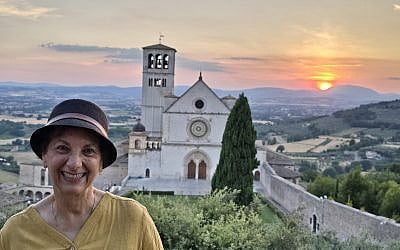
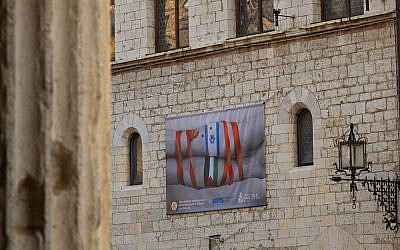
Assisi in Italy is the birthplace of St Francis, who loved all of creation and its Creator and demonstrated his love through kindness to people and animals alike. Assisi this year is marking 800 years since Francis’ death. His spirit and that of his follower and Saint in her own right, Claire, have imbued this city with a sense of holiness and peace. Whereas in Jerusalem it has proven impossible to create our dreamed of centre of HOPE – the House of Prayer and Education – in Assisi, with the support of the local authorities, we will soon open the Global House of Friendship and Hope. We held our summer school in Assisi.
Our students were Christian, Muslim, Jewish and Buddhist, all people of faith and all ready to learn with and from the religious other. While my role was as a facilitator and educator, my Jewish identity was not shed or weakened for a moment. Therefore, it should not be surprising that among my strongest impressions is the Jewish story of this very Catholic city.
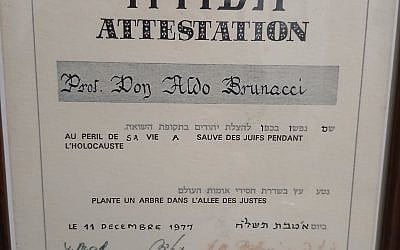
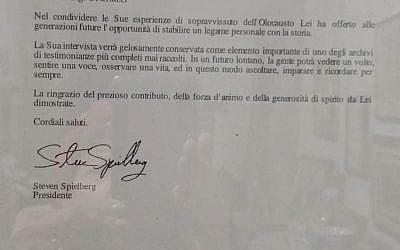
Our first inkling of the Jewish story of Assisi came as we set up our private dining-room for the shabbat meal in which all the students would participate. There, on the mantle-piece, was a certificate from Yad Vashem, bestowing the status of Righteous Among the Nations on Professor Aldo Brunacci. On another wall was a certificate from the Stephen Spielberg Foundation. Who was Brunacci and what was his connection to the guesthouse in which we were staying, Casa Papa Giovanni? That we were to learn after Shabbat.
 In 1943, there were no Jews living in Assisi, a town that in peace-time was a magnet for pilgrims but only had a population of about 5,000. That was the year of Italy’s sudden surrender to the Americans and the British. Already angered by the Italian government’s refusal to hand over Jews, Hitler turned on his former ally with a vengeance. The Nazis occupied the country. Thousands of refugees began thronging to Assisi, which had been declared a “hospital city” and therefore was unlikely to be bombed. Among the refugees were many Jews, whom the Nazis were determined to deport to death camps.
One of them was Emilio Viterbi, a professor of chemistry and dean of the University of Padua, which was founded while St. Francis was still alive. Emilio was an admirer of Francis and, according to his daughters, kept a copy of inspirational stories from the saint’s life by his bed. Perhaps, he thought, if they could reach Assisi, two hundred miles to the south, they could find shelter. When they arrived, they found the SS, the Gestapo, and the Italian Fascist police relaxing at the Café Excelsior. Unsure of where to turn, Emilio sought help from Bishop Nicolini of Assisi. This extraordinary man reportedly responded to the plea for help with, “There is no room left except my bedroom and my office. However, I can make do and sleep in the office. The bedroom is yours.”
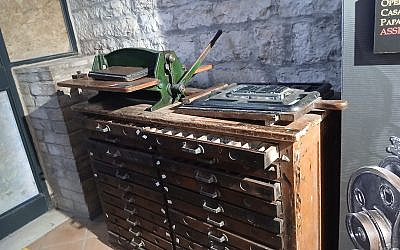
As hundreds of others arrived, they were given shelter in nunneries and monasteries. They were hidden in cellars throughout the day and occasionally able to emerge at night, when the church bells sounded vigorously to hide any sounds of their movements. An immediate problem was how to feed them. Whereas non-Jewish refugees often were able to bring ration cards with them, the Jews could not get them. Their documents would reveal that they were Jewish. Jews were supposed to report for deportation. A local printer began printing false documents and the work expanded.
Under the leadership of the Bishop and Father Aldo Brunacci, the city became the centre of the “Assisi Network,” a clandestine rescue operation operating under the noses of the Gestapo. At least three hundred Jews were saved thanks to the Franciscan spirit of hospitality in Assisi.
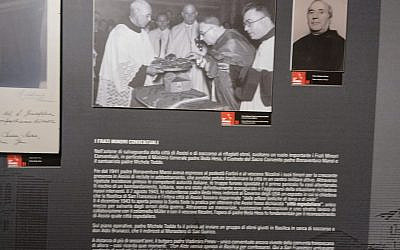
The “Museum of Memory: Assisi 1943-1944” takes you back in time to that terrible period. The exhibition was created by Opera Casa Papa Giovanni, a foundation of the Curia of Assisi. It consists of unpublished documents, photos, awards, essays and objects from that historic period and of the various people who personally saved the Jews. The exhibition speaks of Father Brunacci, founder of the Opera Casa Giovanni, which over the years kept the memories alive; of the Bishop Nicolini, who ran the clandestine organisation that was created spontaneously; of Father Rufino Niccacci, a Friar Minor, guardian father of the convent of St. Damiano; of the Podestà of Assisi, Arnaldo Fortini; of German Colonel Muller; of the religious orders; of the convent brother, Father Michele Todde and all the others who did their utmost to save the lives of so many people, who would otherwise have been deported. One important space is obviously dedicated to Luigi and Trento Brizi, the Assisi printers who printed the false documents for the Jews.
Altogether, a town with a population of just 5,000 has 10 people recognized by Yad Vashem as Righteous Among the Nations. I don’t think there is another place on earth that can compete!
At the summer school, we were studying saints from various traditions, including Rav Avraham Yitzchak Kook as an example of a Jewish “saint.” We learnt aphorisms, studied stories of their courageous deeds, asked historiographical questions, prayed and identified with their yearning for closeness to the Creator. We looked for role-models and ways to apply their legacy to our lives. We opened our minds and our hearts. We felt especially close to St Francis, whose principles and prayers cross religious lines, and to Claire, in whose city we learned.
Perhaps their saintliness is infectious and their impact was felt by residents of the City in 1943-4. The Righteous Among the Nations may not all have left their own religious teachings and their lives may not have been beyond reproach, however, they are, for me, modern-day saints. Assisi is a City of Saints in more ways than one.
Many things are unforgettable. On display in the museum, with the pictures, texts and awards, is the old printing press that produced the false documents, with its chest of drawers, cutter and stamps. It was not a portrait or a text that elicited my tears; it was that printing press, an ordinary object that became a tool for redemption in the hands of those with open hearts.
Related Topics
Related Posts