Director of Diplomacy, Representative to UN Geneva & UNESCO, World Jewish Congress
A Coalition Against Antisemitism at World’s Top Rights Body
Headlines in major media outlets would have you believe that good news is hard to come by. Indeed, positive developments rarely get wide coverage. So, when one does arrive, it’s important that we take notice.
For the sixth consecutive year, a broad coalition of United Nations members states took the floor during the Human Rights Council session to reaffirm their commitment to confronting antisemitism. Fifty-two states from all continents joined the annual initiative led by Austria, Czechia, and Slovakia, as part of their Slavkov or Austerlitz trilateral cooperation format, to reiterate their firm position that the fight against antisemitism constitutes an international priority. This year’s statement was read out by the Permanent Representative of Czechia to the UN in Geneva, Ambassador Karel Beran.
Each year, the joint statement focuses on a particular theme. Previous topics included combatting online antisemitism (2022); campaigning against antisemitism in and through sports (2023); and promoting interfaith dialogue and peer-to-peer learning (2025). This latest edition focuses attention on the effort to counter antisemitism through and on artificial intelligence platforms—quickly emerging battlegrounds in the fight against metastasizing hate and facts.
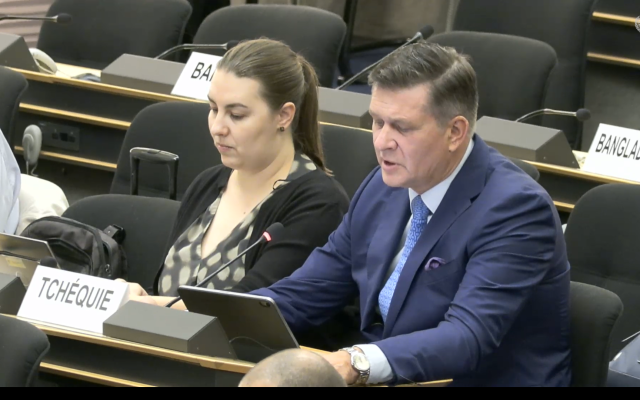
The statement affirmed that while artificial intelligence offers significant opportunities for innovation and development, it can simultaneously lead to the creation and spread of antisemitic content, hate speech, disinformation, and harmful stereotypes at an unprecedented scale and speed. Algorithmic systems can also reproduce and amplify hateful narratives and existing biases and undermine historical truth and public trust.
The coalition stressed that artificial intelligence must serve human dignity, equality and inclusion, and that it must be developed and leveraged in line with international human rights law. These nations also reaffirmed a specific commitment to tackle Holocaust denial and distortion in AI-enabled digital environments. And, crucially, they call on all governments, technology companies and other stakeholders to ensure effective safeguards, transparency, inclusivity, due diligence, human oversight and accountability throughout the AI lifecycle.
The statement also acknowledged the IHRA Working Definition of Antisemitism as a practical tool, among others, that can help identify and mitigate antisemitic bias. IHRA’s definition is the most widely-accepted tool to define antisemitism, allowing for the development of better measures and policies to mitigate it.
The UNHRC is often seen as a body that is hostile to Israel and to Jewish concerns. What this statement shows, however, is that consistent efforts based on concrete issues, coalition-building, and framing around international human rights practice can yield tangible results and help promote important priorities of Jewish communities worldwide even when and where we least expect it.
The World Jewish Congress has been strongly supporting this initiative, which is the only longstanding effort at an international forum to place the fight against antisemitism clearly on the agenda as a human rights priority. It is our hope that such efforts will continue to expand, create political will and galvanize more governments to take measures to limit this scourge.
To view the statement with the full list of signatories, click here.
Related Topics
Related Posts