
Environmental Peace Builder; Water & Energy Diplomacy
Featured Post
A cold peace with Jordan isn’t enough
The Iran war proved that cooperation with Jordan is key to Israel's security. The next government should deepen ties through water, infrastructure and shared regional interests
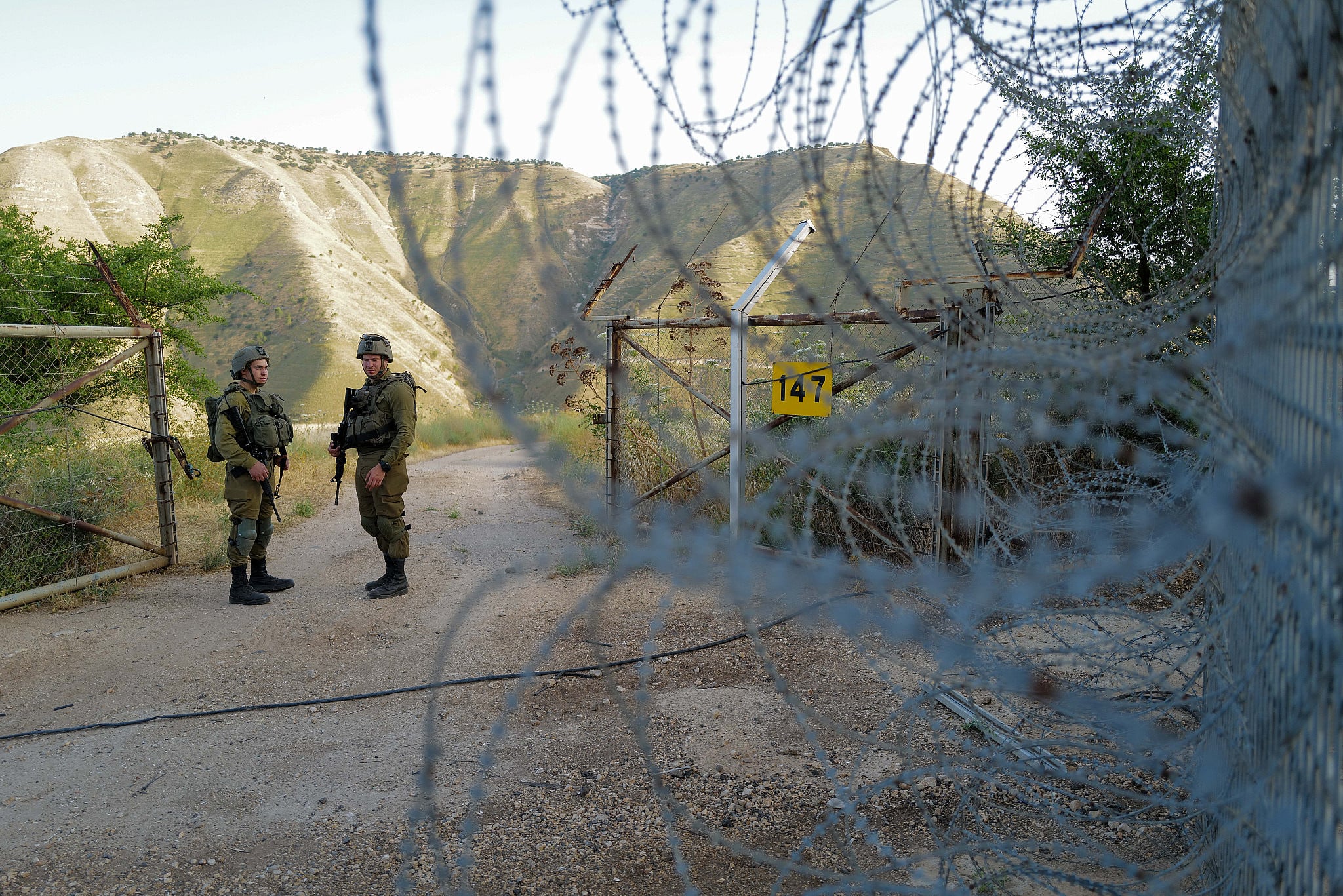
Israeli soldiers patrol in the tripoint border between Israel, Syria, and Jordan, northern Israel, on May 12, 2022. (Michael Giladi/Flash 90)
A few years ago, it had become commonplace to describe Israel’s relationship with Jordan as a “cold peace.” Today, that description is no longer adequate. In an era defined by Iranian aggression, regional instability, and climate insecurity, the relationship has become one of Israel’s most important strategic assets.
The direct confrontation with Iran demonstrated what security professionals have understood for years: Israel and Jordan share vital security interests. Quiet military coordination, intelligence sharing, and Jordan’s role in protecting its airspace against Iranian missiles and drones have underscored that the stability of the Hashemite Kingdom is inseparable from Israel’s own security. While much of this cooperation necessarily remains out of public view, its contribution to Israel’s national defense has been unmistakable. The next Israeli government, to be elected later this year, must therefore treat repairing and strengthening relations with Jordan not as a diplomatic luxury but as a national security imperative.
Importantly, the Israeli public already understands this. According to the 2026 Israeli Foreign Policy Index conducted by the Mitvim Institute in partnership with the Friedrich-Ebert-Stiftung and the Rafi Smith Institute, Israelis rated the importance of restoring and strengthening relations with Jordan at an average of 7.42 out of 10. Fifty-eight percent described the task as “important,” while an additional 24 percent considered it “quite important.” In other words, more than four out of five Israelis recognize that rebuilding ties with Jordan should be a national priority.
Fortunately, the foundations already exist. Rather than beginning from scratch, a new Israeli government can build on a series of ambitious regional initiatives that together form a coherent vision for shared prosperity and mutual security.
The first pillar is renewing the water sale agreement between Israel and Jordan. First signed in 2021, the agreement provided for Israel to sell Jordan additional water beyond its obligations under the peace treaty. After a series of short-term extensions through 2024 and 2025, the agreement expired without renewal in November 2025. While Israel’s desire to link renewed water sales to progress on the water-energy exchange known as Project Prosperity is legitimate, allowing the agreement to lapse serves neither side’s interests.
Project Prosperity, agreed in 2022, would see Jordan develop large-scale solar energy exports to Israel while Israel supplies Jordan with up to 200 million cubic meters of desalinated water annually. It is an elegant example of comparative advantage: Jordan has abundant land and sunshine; Israel has world-leading desalination technology. Each country provides what the other lacks, creating interdependence that strengthens security for both.
The second pillar is the 2022 Jordan River Memorandum of Understanding, recognizing that restoring the Jordan River is not simply an environmental objective but a regional economic and strategic investment. Rehabilitation of the Israeli-Jordanian stretch of the river would improve biodiversity, expand tourism, protect shared ecosystems and create green jobs while establishing the precedent needed to extend rehabilitation to the Palestinian stretch of the river.
The third pillar is the India-Middle East-Europe Economic Corridor (IMEC). More than a transport corridor, IMEC represents an opportunity to reshape regional economics through infrastructure, trade, digital connectivity and energy cooperation linking India, the Gulf, the Middle East, and Europe. Its success, however, depends on Jordan serving as the indispensable land bridge connecting the Gulf with the Mediterranean. Without a strong Israeli-Jordanian partnership, IMEC cannot fulfill its promise.
These initiatives are mutually reinforcing. IMEC requires regional stability. Project Prosperity creates economic interdependence. Jordan River rehabilitation delivers visible environmental benefits that citizens on both sides of the border can experience directly. Economic feasibility will also be critical to implementation. Much depends on how desalinated water is delivered to Jordan.
Rather than constructing expensive new pipelines from Mediterranean desalination plants directly into Jordan, the additional water could be conveyed through to the Sea of Galilee using Israel’s existing National Water Carrier. This proposal aligns closely with the Israeli Water Authority’s long-term strategy. Having reversed the historic flow of the National Water Carrier, Israel now pumps surplus Mediterranean desalinated water north into the Sea of Galilee through the Reverse Carrier system. Managed by the Water Authority and Mekorot, this strategic innovation stabilizes lake levels, protects the ecosystem from crossing ecological “red lines” during drought, and creates a climate-resilient freshwater reserve by delivering thousands of cubic meters per hour when needed. Using this system to include the sale of water to Jordan would avoid costly new infrastructure while advancing Israel’s own national water strategy.
The benefits would be substantial. Routing the full 200 million cubic meters annually through the Sea of Galilee would help maintain higher lake levels despite climate change, strengthening Israel’s strategic freshwater reserve while allowing greater environmental flows into the Lower Jordan River. This would accelerate river rehabilitation, improve biodiversity and water quality, reduce salinity, and revive one of the world’s most important cultural and religious landscapes. Higher water levels would also enhance tourism around the Sea of Galilee and the Jordan Valley, benefiting local communities, pilgrimage sites and nature-based businesses on both sides of the border. These benefits to Israel should be reflected in a discounted water price for Jordan, resulting in cheaper water for Jordanian consumers and contributing to Jordan’s economic stability.
Just as importantly, using existing infrastructure substantially reduces delivery costs for Jordan. Those savings could be passed on to Jordanian consumers through even more affordable water prices. For one of the world’s most water-scarce countries, reliable and affordable water strengthens economic resilience, reduces social pressures, supports agriculture and reinforces national stability. That stability directly serves Israel’s interests. Jordanian water security is both Jordanian and Israeli national security.
The next Israeli government will face no shortage of urgent challenges. But repairing relations with Jordan should rank near the top of its agenda. Security cooperation has already demonstrated its value. Public opinion supports renewed engagement. Regional economic initiatives are waiting to be implemented. Climate cooperation offers tangible benefits to both societies.
Investing in Jordan is not an act of generosity. It is an investment in Israel’s own security, prosperity and resilience. At a moment when the Middle East is being reshaped by new alliances and shared threats, few investments could yield greater strategic returns.
Related Topics
Related Posts