The Institute for Safety in the Criminal Justice System
Featured Post
A conditional pardon could be just what Israel needs
Protecting the rule of law and safeguarding the nation would entail not just an end to Bibi’s trial, but an exit from his role as prime minister
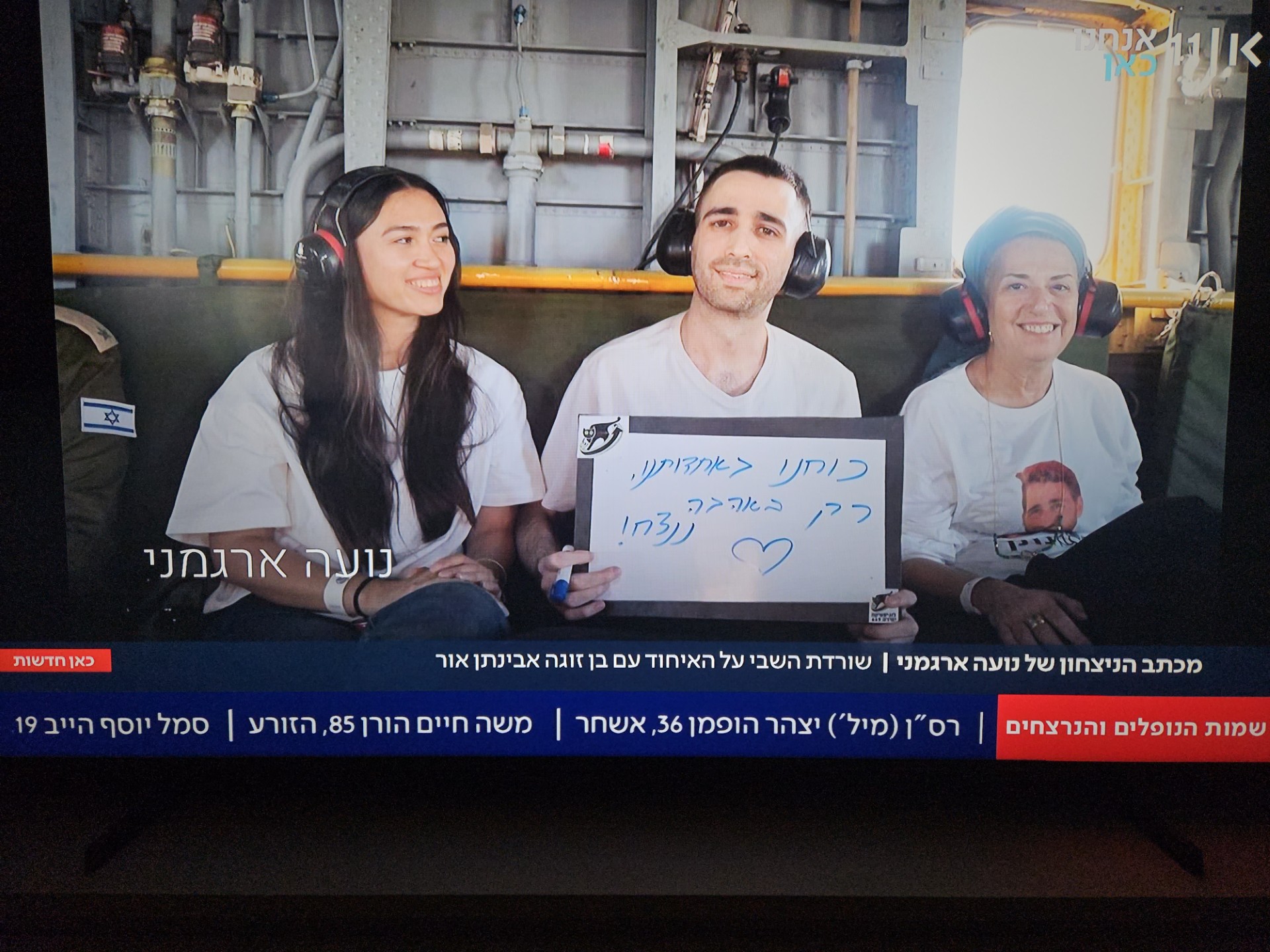
'Our strength lies in our unity. Only through love will we prevail.' Noa Argamani with Avinatan Or, aboard the rescue helicopter, October 13, 2025. (screenshot)
A dignified, conditional pardon in exchange for full retirement from politics could restore public trust, national stability, and a sense of shared responsibility.
Israel is entering what may become one of the most divisive elections in its history. The social rifts that preceded the war have resurfaced, and public trust has worn dangerously thin. In this climate, the ongoing criminal trial of the prime minister is no longer merely a legal proceeding — it has become a national paralysis. It prevents the state from focusing on existential priorities and deepens the polarization. Unless a responsible and nationally accepted way is found to close this chapter with dignity, Israel risks sinking deeper into political and moral exhaustion.
US President Donald Trump recently called on President Isaac Herzog to consider granting a pardon to Prime Minister Netanyahu — a call that, regardless of one’s opinion of Trump, has revived the same crucial question: can Israel find a constitutional and honorable way out of its prolonged political paralysis?
A pardon, when exercised responsibly, is not an act of leniency or retreat from the rule of law. It is a legitimate constitutional tool intended to safeguard the life of the nation. President Chaim Herzog once used it in the aftermath of the “Bus 300 Affair,” granting pardons to prevent institutional collapse. The Knesset later legislated the “Termination of Proceedings” law following the Gaza disengagement, invoking the principle of national healing, even at the cost of deviating from the strict letter of the law. The question is not whether the law matters — it certainly does — but whether it serves the preservation of the state itself.
The proposal presented here is not a political favor but a balanced, legal mechanism: a conditional pardon tied to Prime Minister Netanyahu’s immediate and complete retirement from political life. It would be accompanied by a binding legal commitment and subject to public oversight. This is not about erasing justice, but about applying the law wisely – to preserve the moral and institutional strength of the state, rather than perpetuate division.
Such a measure would not establish a dangerous precedent, but would instead create a narrowly defined, time-limited framework to be invoked only in exceptional national circumstances and under full transparency. The state would terminate the trial, while the leader would forfeit all political authority. This reciprocal arrangement – law for stability, power for unity – would mark an honorable closure to a destructive chapter in Israel’s public life.
Upon resignation, a caretaker government of national responsibility should be formed from within the existing coalition, in coordination with the president. Its mandate would be limited: to bring home the remaining hostages, rehabilitate Israel’s northern and southern regions, and ensure fair and calm elections. This disciplined transition would restore a sense of restraint, transparency, and national purpose – signaling to Israelis and to the world that Israel is returning to a mature and accountable mode of governance.
Term limits
Since October 7, many senior officials in Israel’s security establishment have taken personal responsibility and stepped down, from the IDF chief of staff and the head of the Shin Bet to field commanders. They did not wait for judicial processes to determine accountability. It is difficult to justify that the nation’s highest leader should be exempt from this standard. A negotiated, conditional pardon linked to an honorable retirement would allow him to do so with dignity, aligning with a national ethic of responsibility, rather than defiance.
Yet closing the legal case alone will not suffice. The problem is not only personal but structural. A healthy democracy limits power to preserve trust. A two-term limit for prime ministers has become an essential safeguard. Without it, the temptation toward permanent rule grows too strong; power concentrates in every branch of government, and the public loses its sense of partnership. Now, approaching another election, Israel has a chance to form a broad consensus: there is no eternal rule — only temporary public service.
Such reform could also unlock new diplomatic and economic opportunities. If Israel regains internal stability and returns to a language of restraint and unity, the Abraham Accords could be revitalized and expanded, potentially even with Saudi Arabia. Regional leaders are watching closely for signs that Israel can sustain responsible governance. A dignified retirement by Netanyahu could become a diplomatic asset — enabling him to serve as a regional envoy, using his experience and connections to promote normalization and long-term stability.
Meanwhile, a younger, unencumbered generation of leadership could focus on what truly sustains the nation: education that nurtures equality, community-based healthcare, affordable housing, and long-term infrastructure. These are not secondary issues but the foundation of Israel’s future. Without internal repair, diplomatic progress will erode; without regional vision, domestic growth will stagnate. The two must go hand in hand.
Some will argue that the rule of law must stand above all else — and they are right. But the rule of law exists to protect a free and functioning society, not to paralyze it. When legal processes themselves become a source of national paralysis, civic courage is needed to restore balance. Using the law wisely to prevent societal collapse is not a breach of justice, but an act of statesmanship. Israel’s history shows that, in moments of crisis, it has chosen unity over retribution, and healing over humiliation.
The conditional pardon proposed here, coupled with a two-term limit and a temporary government of national responsibility, is not meant to serve one person but an entire people. It is not a weakening of the law, but its prudent application to safeguard the collective. It is not the end of a story, but the beginning of a new chapter, one in which the current prime minister steps down with dignity and contributes from the outside, and the Israeli people reclaim a spirit of unity, humility, and purpose.
Between fracture and healing lies a single courageous decision. Trump’s call to President Herzog may have placed a mirror before Israel, but the reflection it reveals is ours to interpret. If we face this moment with courage, we can transform exhaustion into renewal and lay the cornerstone for a new dawn of shared hope.
Or Cohen, who served alongside Hadar Goldin in the Givati Brigade – Hadar as platoon commander and Or as sergeant – has fought for 11 years to bring his fallen friend home for burial.
He wrote:
More than 11 years have passed, and Israel’s governments have never missed an opportunity to miss an opportunity to bring Hadar back. What his family and we, his friends, have not done in trying to uphold the most basic values our government has repeatedly abandoned. We held vigils, demonstrations, and met with ministers, senior officials, and almost every member of Knesset. Eleven years — and he is still a captive fallen soldier. Nothing helped.
After the funeral, Cohen added in a radio interview: “The leadership will change, and the people will mend.”
Perhaps there is no truer expression of the Israeli hope — namely, that renewal will not come from the summit of power, but from the heart of the people…from the faith that the people themselves will rise, and will repair.
Related Topics
Related Posts