
A Cry or a Laugh on the Real Name of Rosh Hashanah
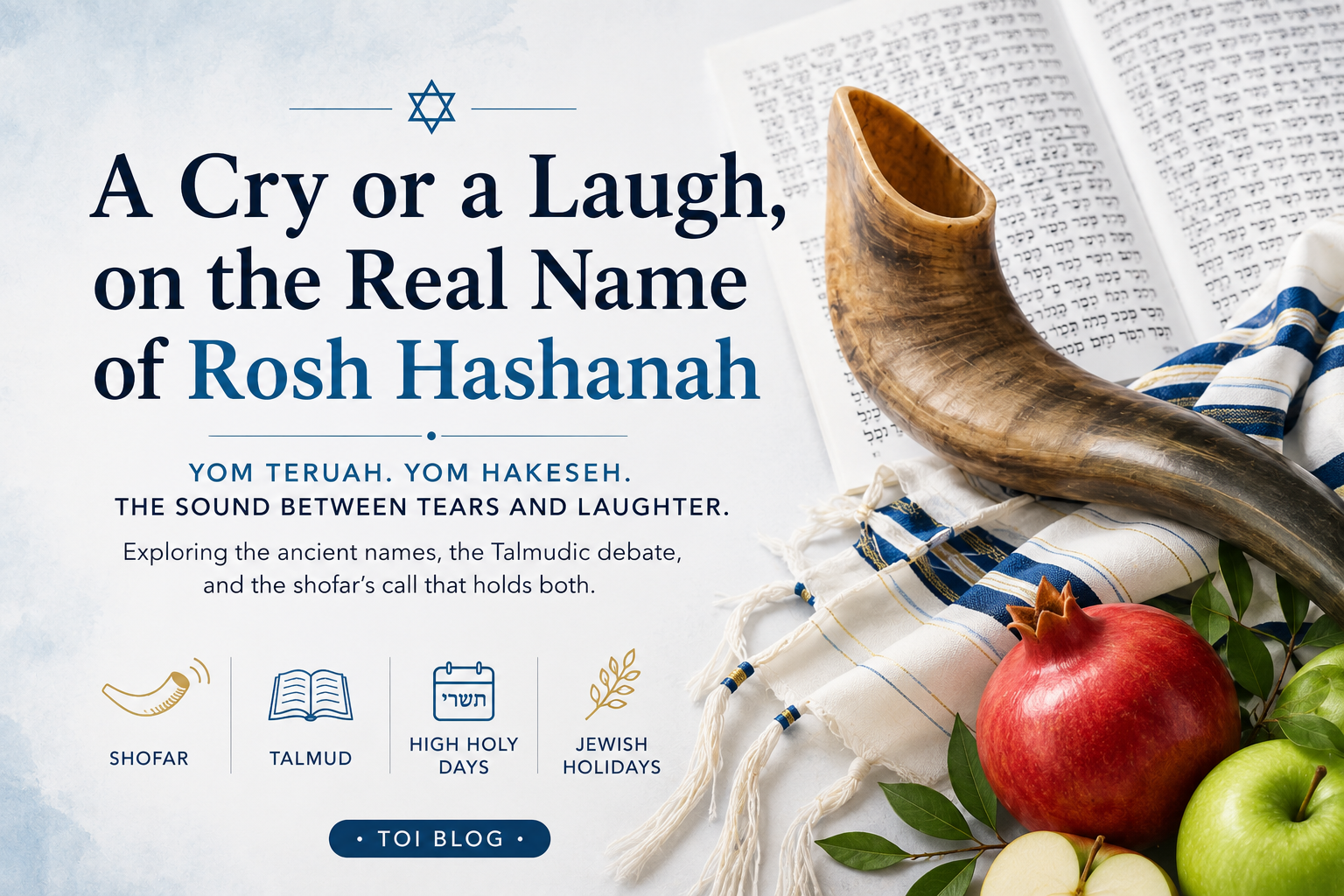
Preparing for Rosh Hashanah this year, I noticed something, the name I always use isn’t one the Torah ever uses. The Torah itself never once calls this day Rosh Hashanah. It only calls it Yom Teruah, the day of teruah, or Zichron Teruah, a remembrance of teruah. The name settled into use around the Mishnaic period, the second century, and the holiday’s own present form, according to some scholars, reaches back to after the Babylonian exile, to the sixth century, the same period Elul and Tishrei’s names came from.
This day carries another name too, one far less often mentioned, Yom HaKeseh, the day of concealment. Psalm 81 commands the shofar be sounded “on the concealment day of our festival.” Rosh Hashanah is the only festival that falls when the moon can’t be seen at all, on the first day of the month, when the new moon has only just been born and no light shows in the sky yet. Every other festival is celebrated at the full moon, on the brightest night. Rosh Hashanah begins in darkness instead, concealing itself.
What stopped me most, though, was the word teruah itself. Its root, resh-vav-ayin, carries two entirely opposite emotions at once. In the eighth chapter of the Book of Job, the same word appears in a context of laughter and joy, he will yet fill your mouth with laughter, your lips with teruah. But Targum Onkelos, translating the Torah’s teruah into Aramaic, uses the word yevava, weeping, wailing. So the same root describes laughter in one place and weeping in another, and the Torah never tells us which one it means.
The ambiguity isn’t just my own observation, it’s a problem the Talmud itself never resolved. On the thirty-third and thirty-fourth pages of tractate Rosh Hashanah, the sages argue over exactly this, which sound we mean when we say teruah. Rabbi Abahu sees three possibilities, a long, heavy moaning sound, later called shevarim, or a short, sharp sobbing sound, teruah itself, or a combination of both. He couldn’t be certain. and because he couldn’t be certain, he settled not on one solution but on three, sounding all three interpretations in sequence, leaving none of them out.
The Talmud’s own definition of teruah as weeping comes from a striking source. In the Book of Judges, in the Song of Deborah, Sisera’s mother waits for her son to return from battle with plunder and captive women, and when he doesn’t return, she begins to cry. The Talmud derives the actual meaning of the word yevava directly from this mother’s weeping. But Sisera was Israel’s enemy general, and his mother was no sympathetic figure, a woman anticipating her share of captured women taken from Israel. Yet the sages took the defining sound of the year’s holiest day from the tears of an enemy’s mother, as though a parent’s grief sounds the same regardless of whose mother it is. Tradition holds that Sisera’s mother cried exactly a hundred times, which is why the shofar is sounded a hundred times today. The nineteenth-century commentator Eliyahu Kitov noticed that the Hebrew text describing her contains exactly a hundred and one letters, and read the Ashkenazi custom of blowing only a hundred as leaving that final letter, that final cry, uncounted, given over to a mother’s natural grief.
We still follow the trace of that uncertainty today. When the shofar is blown, nine base sounds are heard, tekiah, teruah, tekiah, then again tekiah, shevarim, tekiah, and finally tekiah, shevarim-teruah, tekiah. Each of these three sequences answers one of the three possibilities Rabbi Abahu couldn’t settle between. Some traditions extend this to a hundred blasts, some to a hundred and thirty. So the long sequence of sound we hear every Rosh Hashanah is, in fact, the direct result of a sage saying, two thousand years ago, I don’t know.
The shofar’s own name may carry a trace of exile too, just like Elul. Some linguists trace the word shofar to the Akkadian root shapparu, meaning wild sheep. If this holds, both the month’s name and the name of the instrument that opens that month and Rosh Hashanah come from the same Babylonian source.
But just as with Elul, the sages reclaimed this word into their own language too. According to Vayikra Rabbah, the word shofar is considered kin to the root shapar, meaning to beautify or improve, and the midrash reads a verse in Psalms on this basis, as though hidden inside the command to sound the shofar sits another command, improve your deeds. So the same word carries a wild animal on one side and a moral summons on the other, much the way Elul turned from a harvest field into a declaration of love.
Even which month deserves the honor of Rosh Hashanah was disputed among the sages. On the tenth and eleventh pages of tractate Rosh Hashanah, Rabbi Eliezer holds that the world was created in Tishrei, while Rabbi Yehoshua argues for Nisan. Both read the same text, and neither reaches the other’s conclusion. Two calendars still live side by side today because of it, the religious year beginning in Nisan, the civil year in Tishrei, as though the disagreement those two sages couldn’t resolve was never settled, only written into the calendar itself as two separate beginnings.
Which animal the shofar comes from isn’t arbitrary either. Rabbi Yehuda states in the Mishnah that the shofar of Rosh Hashanah must come from a ram, because of the curve of its horn, and that curve symbolizes submission. Tradition ties this directly to the Akedah, the binding of Isaac, to the ram Abraham saw at the last moment, caught by its horns in the thicket. But a cow’s horn can never be used, because the sages feared it would recall the sin of the golden calf, unwilling to let a symbol of redemption blend with a symbol of sin.
There’s one more tradition I’m fond of, though its exact source is contested, that one of the ram’s two horns was sounded at Sinai, and the other was set aside to herald the coming of the Messiah. True or not, the belief itself says something, that the same sound can carry a revelation from the past and a redemption still to come.
A parable told by the Baal Shem Tov, cited in Keter Shem Tov, may explain why this ambiguity was never resolved. A king’s only son is sent to a distant land, lives there for years, and finally returns to his father’s palace, penniless and exhausted. But he has forgotten the language of his own country, and can’t tell the guards who he is. In despair, he lets out a wordless cry. And the king recognizes his son’s voice in that very cry, needing no language at all. Maimonides, in the Mishneh Torah, compares the shofar itself to that cry, writing “awake, you sleepers, from your sleep, examine your ways and return.” Maybe this is why we’ve never known whether teruah is weeping or laughter, because the sound carries something words can’t separate, and the king who recognizes his son doesn’t stop to ask which emotion it was.
This year, knowing the shofar is sounding somewhere, I’ll think of it differently now. Maybe a cry, maybe a laugh, maybe both at once, just as Rabbi Abahu couldn’t be certain two thousand years ago. Maybe the real question was never which one it is, but finding a sound wide enough to carry both at the same time.