Miriam Frankel is a writer on religion, politics and culture.
A Funding Appeal for Holocaust Education on International Holocaust Remembrance Day
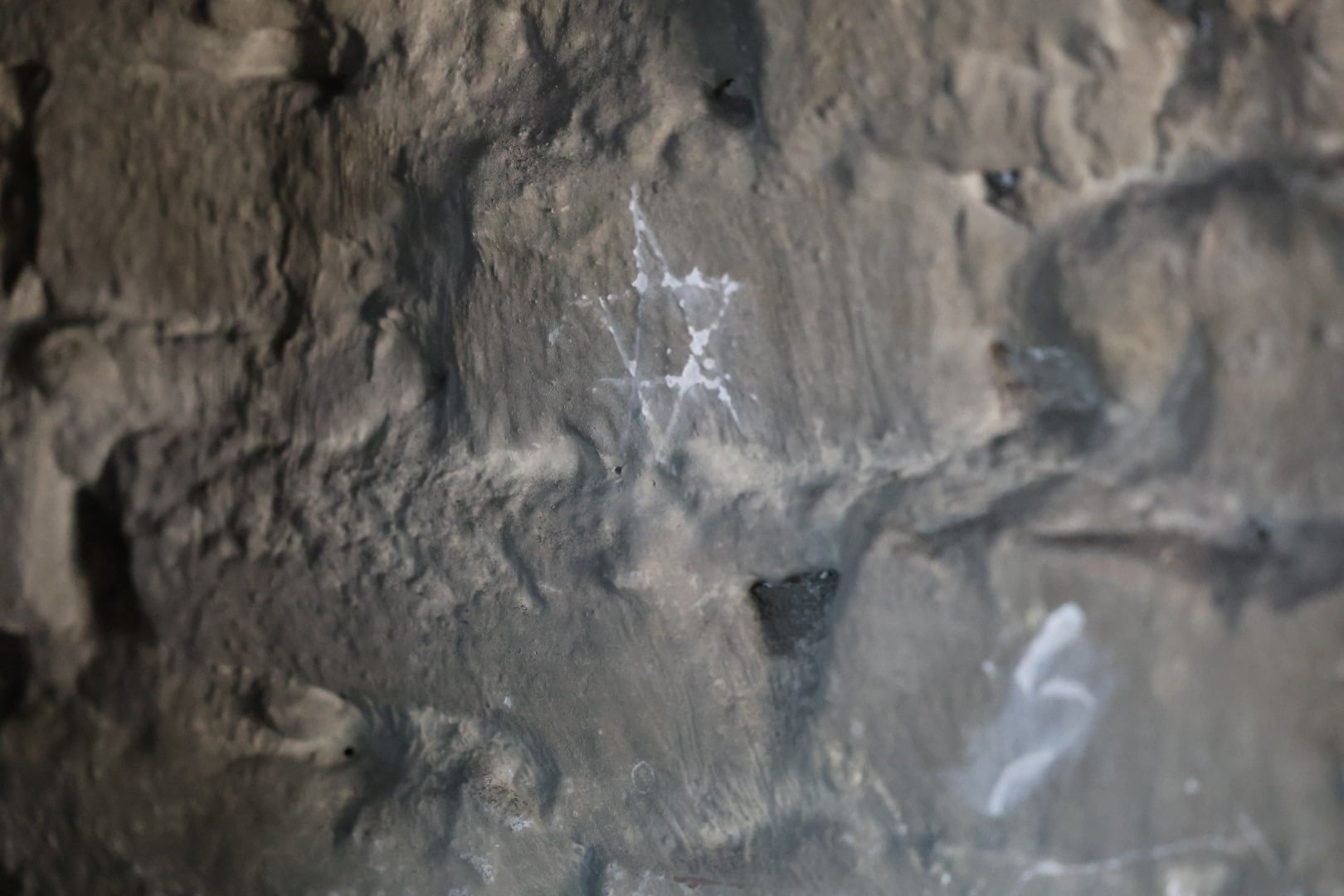
A Star of David etched into the gas chamber wall in Auschwitz-Birkenau (Photo Credit: Margaux Betesh)
In my middle school, extracurricular activities were assigned through a simple rating system. Students listed their top three preferences, and the administration chose the activity each kid would experience for the semester. I remember flipping through the pages of clubs and activities, my heart drawn to ceramics, cooking, and even Krav Maga. The options were wonderful and endless. I wanted to sign up for all of them. Yet in my final page flip of the catalog, there was one club that gave me pause, a club I hesitated to admit I didn’t want to join.
The club was Names Not Numbers, a largely known program where students could interview the last living survivors of the Holocaust and create a documentary to share their stories. Looking back, it was a remarkable opportunity, but at the time, something inside me shied away. I wasn’t ready to confront such raw, terrifying histories. Ceramics felt safe. It was light and uncomplicated, asking nothing of me but to create and enjoy myself. That comfort was much easier to choose.
Even then, I felt the tension of my choice, the pull between what was easy and what was a very important, albeit temporarily painful, good thing to do.
I made the choice that felt right at the time, but one I’d later be saddened by. It’s not regret, as every choice I’ve made has led me to where I am today, but I’m saddened to have missed the chance to meet these survivors and offer them my ear. Many have since passed, taking with them the last opportunity to learn directly from their testimony.
I have to admit that while I understood the importance of these stories, my mind hadn’t fully wrapped around their urgency and need to be focused on at the time. The war and Holocaust felt distant enough to not let them affect me too much.
After October 7th, that distance began to close. I watched antisemitism surface in ways that felt familiar and unsettling, echoing patterns I had encountered in books or classrooms. It made me wonder how much had been forgotten by the world, and whether listening more closely to the past might help us recognize the present.
I started to write about Jewish culture, partly as a way to learn and partly as a way to listen more. It gave me opportunities to speak to Jewish professionals and historians, learning details about my own identity that I never knew. Through a series of chance encounters, generous conversations, and more than a little persistence, I was eventually introduced to a member of the PR team for the Holocaust film Bardejov. That connection led me to survivor Emil Fish and to Rabbi Lynn, the film’s screenwriter and the executive director of Olami Manhattan.
Rabbi Lynn seemed to recognize my desire to learn more and understand history by hearing it directly from those who lived it. He offered me the opportunity to join Olami Manhattan on an eight-day trip to Poland. My reaction was immediate and conflicting: I felt tremendous excitement, followed quickly by a heavy sadness brought on by the realization that I couldn’t afford the trip. Even with the program’s large discount, the cost was at the time, far beyond my means.
What surprised me most was what came next. Olami Manhattan didn’t allow my limitations financially to stand in my way and instead focused on my willingness to learn. They made it possible for me to attend, covering the cost completely and asking only that I partner with them and write about what I experienced in my future articles.
In doing so, they removed a barrier I could have never navigated on my own. They made space for access where there otherwise would have been none, and in that choice, they allowed me to step closer to a history I had once been too hesitant to face and now was desperate to learn from.
To say the trip changed my life feels insufficient to capture its impact on me. Every aspect of my sense of self shifted. Standing in Auschwitz, I became aware of how much energy I had once spent worrying about small, temporary problems. In Mauthausen, while standing in a gas chamber, we sang Jewish songs together. In that moment, I felt connected to the victims in a way I never had before. Stepping out of that space shifted something fundamental in me. I had never been lazy, but I had allowed myself occasional days of waiting, of putting things off. After that moment, I no longer wanted to wait. I wanted to take every opportunity I had: to explore, to learn, to write, to make art, to sing, and to love deeply, because I have a chance that so many others were denied.
In Kałuszyn, once home to thousands of Jews and now home to none, the absence was overwhelming. No original Jewish buildings remained. Everything had been destroyed, including the mikvah, which was demolished just two years prior to my visit. There, my desire to protect and restore Jewish spaces grew even stronger. I felt an even deeper commitment, which I didn’t know was possible, to rebuilding Jewish communities and immersing myself in my own.
In every camp we visited and every town we walked through, we encountered desolation and, occasionally, signs of recovery, though often by the narrowest margin. The lessons were simple and devastating, and I was far from the only one to take them to heart. Many participants, including those who had little or no prior religious connection, left the trip more grounded in their Jewish identity and more committed to advocating for their people.
We all agreed that we must do everything we can to ensure this never happens again and that this trip would reshape how we live, what we value, and who we become.
We changed for the better and grew in our Yiddishkeit, and none of us would have had this opportunity if the trip had not been significantly discounted to make it accessible or, in my case, fully covered.
That is why, on International Holocaust Remembrance Day, I am urging donors and supporters to help fund educational trips to Poland for Jewish young adults, including visits to ghettos, cemeteries, and camps, and that we all recognize these experiences as deserving the same seriousness and level of investment as Birthright.
Birthright to date has brought over 800,000 Jews to Israel, completely removing financial barriers and helping a generation, who otherwise may not have had such an opportunity, build ties to their history and culture. A similar initiative for Holocaust education would address an equally urgent need: to prepare the last generation able to hear directly from survivors to proudly embrace their identity, carry those stories forward, and sustain our community’s memory while confronting the harsh realities of today.
Of course, learning our history alone is not a complete solution to stop antisemitism or hatred in the world. We cannot absolve society of its responsibility, and we also cannot pretend that education alone will prevent violence or prejudice. But it is an actionable step, one way we can equip young Jews like myself to carry on the fight, to confront denial, and act when they see injustice. It is one piece of a broader puzzle, and yet without it, the fight becomes far more difficult.
I again am urging you that if you have the means, the time to invest is now: fewer than 250,000 survivors remain, and antisemitic attacks continue to rise even as they seem to be reported less often, as does Holocaust revisionism and erasure.
Funding Holocaust trips on the scale of Birthright affirms a simple truth: Jewish continuity depends on both knowing where we are going and knowing where we come from. To honor , today and every day, the six million Jews killed in the Holocaust, today and every day, is to make their memory inseparable from our future. Bringing young Jews to Poland insists that the silence of the world, once broken there, will not be repeated in ours.
Birthright demonstrated what is possible when the Jewish people dedicate resources to identity-building and history preservation. Holocaust education requires the same conviction.
If we believe the past deserves a voice, we must give the next generation the ability to hear it.
Please consider donating, and please consider supporting this mission.
Learn more at Olami Manhattan’s website.
Related Topics