
Urban Sociologist and Global Affairs Commentator
A Handshake or a Chokehold? Two Visions of Political Solidarity
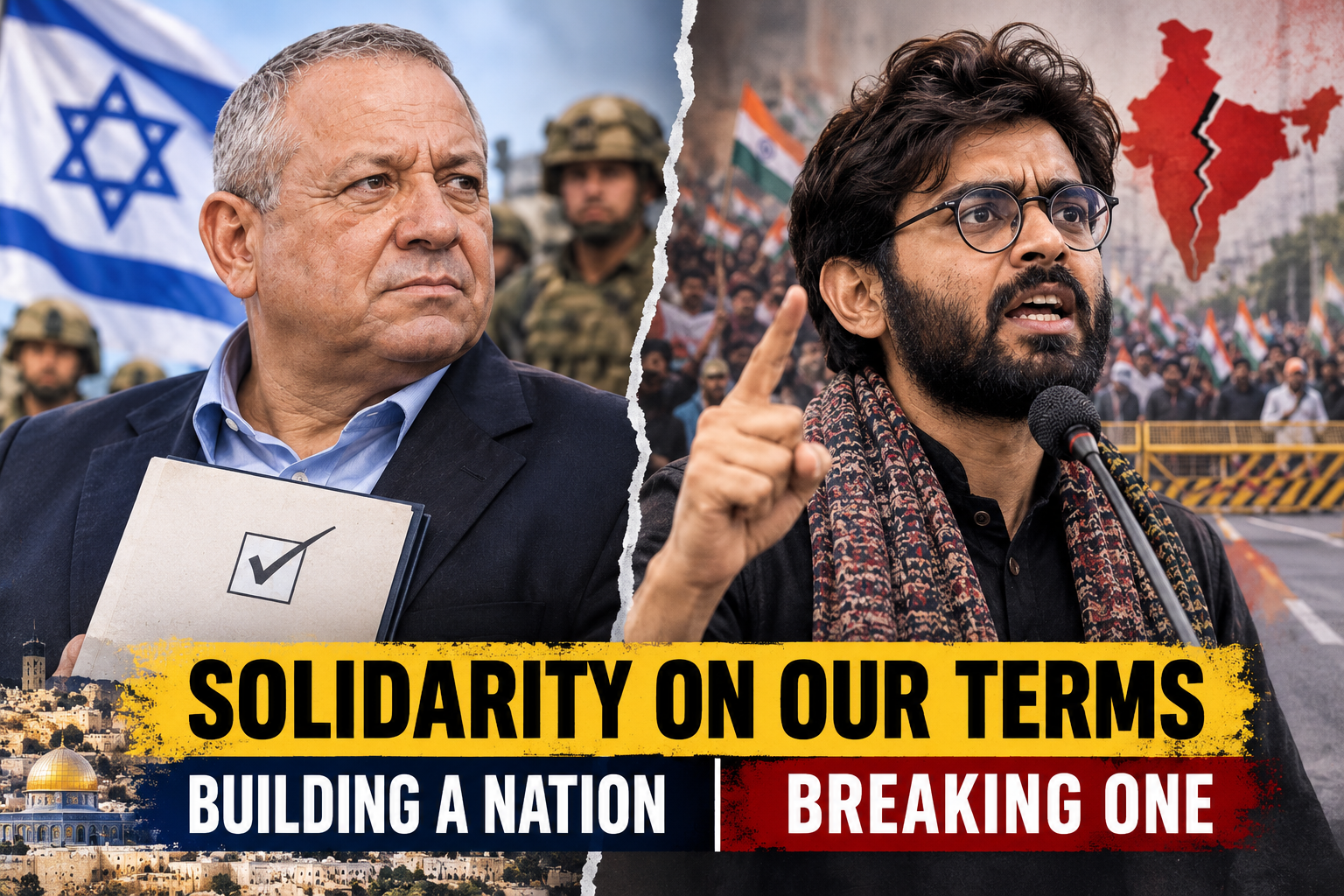
Solidarity on Our Terms: Building a Nation or Breaking One? An AI Illustration
Gadi Eisenkot and Sharjeel Imam represent two contrasting visions of political solidarity – one built on shared principles, mutual obligations and democratic participation, the other, on ultimatums, coercion and the suffering of those caught in the crossfire.
Some phrases sound like a handshake and work like a fist. “Solidarity on our terms” is one of them. It borrows the warmth of togetherness and uses it to deliver an ultimatum. The only honest way to judge it is to ask what the terms are, and who is made to pay for them.
Two men offer a useful lesson, from opposite ends of the world and opposite ends of the moral spectrum: Gadi Eisenkot in Israel and Sharjeel Imam in India. They are not twins, and nobody should pretend otherwise. Set side by side, they show what solidarity looks like when it builds something and when it only threatens.
The soldier who asks for a signature
Eisenkot has spent four decades in uniform and lost his son and two nephews in combat in Gaza. If any man in Israeli politics had earned the right to demand that the country simply fall in behind him, it would be this one. He asks for something quieter. Days after the 27 October election, he published four conditions for joining his government. Israel as a Jewish, democratic, liberal and egalitarian state comes first, followed by loyalty to the Declaration of Independence, universal military, national or civilian service, and the dismantling of Hamas’s rule in Gaza.
Then comes the sentence that matters most. Any Knesset member willing to sign these principles is a potential partner, and the door stays open to every elected official who accepts them.
The terms are hard, and his critics are right that they screen out parties that cannot or will not accept them. Eisenkot himself has said he sees no Arab party that currently accepts his principles. The demand is still posed as a test of principle rather than loyalty to a person: sign here, serve here, share the burden here, and you may govern with me. He has not named a price for the Haredi, the Arab or the secular voter that someone else must pay. The cost of refusal falls on the refuser, who stays in opposition. Nobody else’s lights go out.
Consider the posture. This is a man who won a mandate and chose to ask for a contract, not obedience. His power is a door, and he holds it open.
The speaker who reaches for the road
Now put him beside Imam at the podium in January 2020, as reported and as the circulated clips show. The anti-CAA protests were a legitimate constitutional drama: citizenship, detention and equal rights are exactly the questions a republic exists to argue about. Then Imam reached past the argument and toward the map.
His first move was to tell sympathisers that they must accept the movement’s terms or forfeit the right to call themselves friends. That is a purity test, a way of turning the persuadable into suspects. His second move was larger. He spoke of mobilising hundreds of thousands to cut Assam off from the rest of India through the Siliguri Corridor, the thin neck of land that carries the Northeast’s roads, rails and supplies, and to keep it cut for months.
Where Eisenkot reaches for a pen, Imam’s rhetoric reaches for a chokehold. Eisenkot says: accept these principles and come in. Imam, on this reading, says: accept these terms, or the lifeline goes (or worse still, accept these terms so that the project of breaking India can be dressed up as a just cause and a secular enterprise).
The lifeline is not his, and the people who would live on the wrong side of it never agreed to be anyone’s leverage. They are the Assamese farmer, the dialysis patient, the soldier, the shopkeeper, and, not least, Muslim families who live in Assam itself, the very people whose fear Imam invoked. A blockade would make them the besieged. It would also hand a hostile state (theoretically speaking) the one thing it most wants: a security pretext to treat a whole community as an enemy.
Terms versus ransom
The cleanest way to say it is this. Terms are what you ask of those who choose to join you. Ransom is what you demand of those who never did.
Run both men through four questions:
- Who pays? Eisenkot’s partners pay in policy concessions they accept freely. Imam’s plan is paid for by strangers.
- Can the other side say no? A coalition partner can walk away. The Northeast cannot opt out of a blockade.
- Can it be undone? A coalition dissolves with a vote. A severed region’s months of suffering cannot be refunded.
- What is the leverage made of? Eisenkot’s is votes, signatures and the willingness to serve. Imam’s is other people’s pain, which in this strategy is the working mechanism rather than a side effect.
A republic’s answer
None of this licenses the state to answer with indifference or abuse. Imam has been in Tihar since 2020, and the reports suggest the courts have not been of one mind about his speeches. A confident democracy meets a speech about strangling a region the way it meets any speech: it argues back, it prosecutes only what can be proved, and it does so promptly. A republic that would rather detain than rebut has quietly conceded half of Imam’s pessimism about it.
The Northeast, for its part, has paid enough. It has carried decades of insurgency, ethnic strife and neglect, and its people have every right to ask for dignity, development and a voice. Being cut off from the country in someone else’s name is not any of those things. Nobody gets to call that solidarity with them.
The same goes for minorities everywhere. Equal citizenship is not a favour a majority grants. It is the reason a majority is legitimate. It is also the reason no minority, however wronged, may claim a right to hold the rest of the country’s roads, rails and rations hostage to its demands.
The measure of a movement
Every political cause has red lines. The question is where it draws them, and who is standing on the far side when it does.
One man says: come in, on principles we can all read, and we will govern together. The other, in the words attributed to him, says: stand with us on our terms, or watch the road close (or worse still, stand with us on our terms, to watch the road close; that’s your solidarity test). The first is trying to build a house with room for opponents. The second would hold the neighbours’ door shut until the demand is met.
A country can survive disagreement, even fury. What it cannot survive is a politics in which every community learns that the way to be heard is to threaten everyone else. The only solidarity that holds is the kind that says, we may never agree, but I will never make you the price of my argument.
That is the line between building a nation and breaking one.
Related Topics
Related Posts