A Historic Mandate: UN Throws Its Weight Behind Gaza Peace Roadmap
The UN Security Council has now thrown its weight behind President Donald Trump’s Gaza peace plan, marking a rare and unusual moment in the often fractious world of Middle East diplomacy—a brief break in the relentless clouds of disagreement and deadlock. Thirteen countries voted in favor. None stood in opposition. Only China and Russia chose to abstain, silently signaling their reservations. For Washington, the vote represents a major diplomatic breakthrough; for the region, it opens a path — fragile but real — toward ending the two-year war that has devastated Gaza and destabilised the Middle East.
The resolution not only legitimises the first phase of last month’s ceasefire and hostage-release deal between Israel and Hamas, it also authorises an International Stabilisation Force (ISF) and a transitional Board of Peace charged with guiding reconstruction and governance. Whether this vision succeeds will depend not only on international commitment but on whether the political actors involved can rise to a moment that demands uncommon restraint and imagination.
President Trump hailed the Council’s decision as “one of the biggest approvals in the History of the United Nations,” writing on Truth Social that it “will lead to further Peace all over the World” and marks “a moment of true Historic proportion.”
U.S President celebrated the vote as “a moment of true Historic proportion” in a social media post, adding that “the members of the Board, and many more exciting announcements, will be made in the coming weeks.”
“Congratulations to the World on the incredible Vote of the United Nations Security Council, just moments ago, acknowledging and endorsing the BOARD OF PEACE, which will be chaired by me, and include the most powerful and respected Leaders throughout the World,”
“This will go down as one of the biggest approvals in the History of the United Nations, will lead to further Peace all over the World, and is a moment of true Historic proportion!” he wrote on his Truth Social platform.
The vote itself was notable for reasons that go beyond numbers. Russia had signalled for days that it might veto the US text, objecting to what it views as an American-dominated framework and a transitional authority outside the traditional two-state process. China, too, pushed for tighter controls on the ISF and a clearer governing role for the Palestinian Authority. Their abstentions, rather than outright opposition, reflect a broader recognition that the status quo in Gaza is untenable and that blocking an internationally backed stabilization mission now carries its own risks.
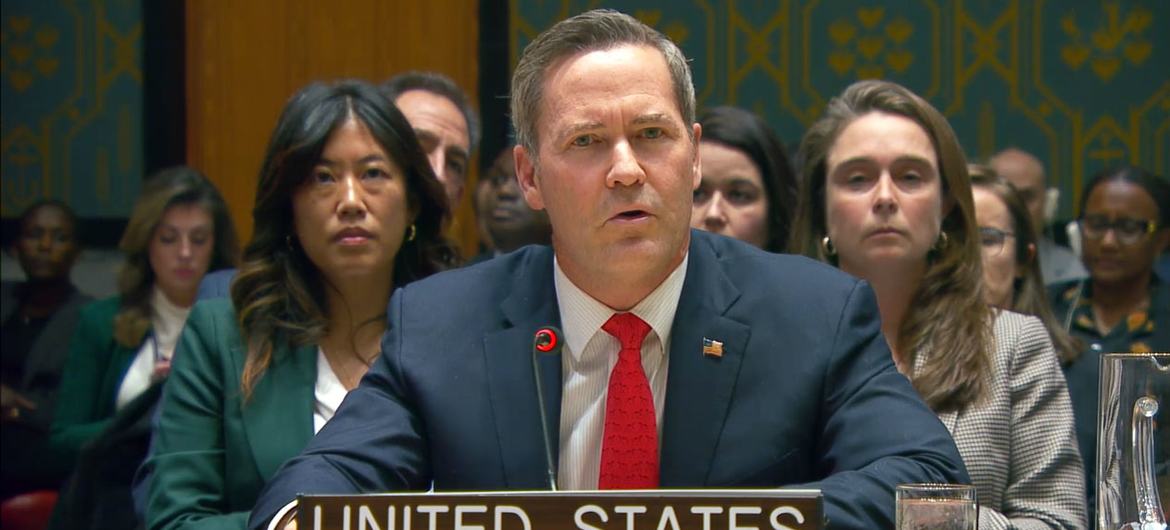
U.S. Ambassador Mike Waltz thanked ambassadors, hailing it as an “historic and constructive resolution” which charts a new course for the Middle East.
“We stand at a crossroads. Today, we have the power to douse the flames and light a path to peace,” said Mike Waltz before the vote. Calling the measure “historic and constructive,” Waltz said the resolution “represents another significant step toward a stable Gaza that will be able to prosper and an environment that will allow Israel to live in security.”
He, told the Council that the ISF would be “tasked with securing the area, supporting the demilitarization of Gaza, dismantling the terrorist infrastructure, removing weapons, and ensuring the safety of Palestinian civilians”.
The resolution authorizes “a strong coalition of peacekeepers — many from Muslim-majority nations like Indonesia, Azerbaijan, and others — to deploy under a unified command.”
Still, for all the celebratory messages in Washington, the political terrain remains difficult. As for the region itself, the situation is anything but straightforward. Hamas outright rejected the resolution, denouncing it as an attempt to place Gaza under international administration and refusing to relinquish its weapons. Israel, consistent with its long-standing positions, pushed back against any language that might be construed as paving the way for a Palestinian state. Caught between these irreconcilable positions is the proposed ISF mission, charged with dismantling armed groups but still lacking even a single confirmed troop deployment. The question of actual commitment from potential contributing countries is left hanging, especially if the situation on the ground deteriorates into violence.
Amid all the tension and clashing stories, the vote accomplished something both rare and deeply hopeful. For the first time in many months marked by heated debates and exhausted diplomatic efforts, Arab and Islamic states managed to unite and present a common front by fully endorsing the resolution. Pakistan’s approach stood out for its blend of principle and pragmatism. Ambassador Asim Iftikhar Ahmad articulated Islamabad’s position in clear terms: the killings must stop, humanitarian corridors must open, and this is only possible if there is a genuine ceasefire followed.
In his remarks, Ambassador Asim Ahmad, the Pakistani envoy, said that Pakistan’s position on the Palestinian question has always been in line with and in support of Palestine and the Arab countries as well as the Group of eight Arab-Islamic countries: Saudi Arabia, Qatar, the UAE, Egypt, Jordan, Indonesia, Turkiye and Pakistan, who came together in September, in support of President Trump’s commendable initiative to bring the war in Gaza to an end.
Pakistan, he said, reaffirms its full support and solidarity with the Palestinian people, and will continue to stand with them at every stage. “We hope that the momentum generated by the ongoing peace efforts will help achieve these objectives, and call on the international community to uphold its obligations in this regard.”
At this moment, the most important development is that the Council has finally acted—as well as, both Washington and leading Muslim nations are aligned. Though this does not solve everything, not by any means, but it is a starting point. After two years of unimaginable devastation, the people of Gaza deserve peace and prosperity. Still, for the first time in months, there is a genuine glimmer of hope. In a region long trapped between sorrow and political deadlock, even such a modest step carries great significance.