
A Jewish Kid From Michigan
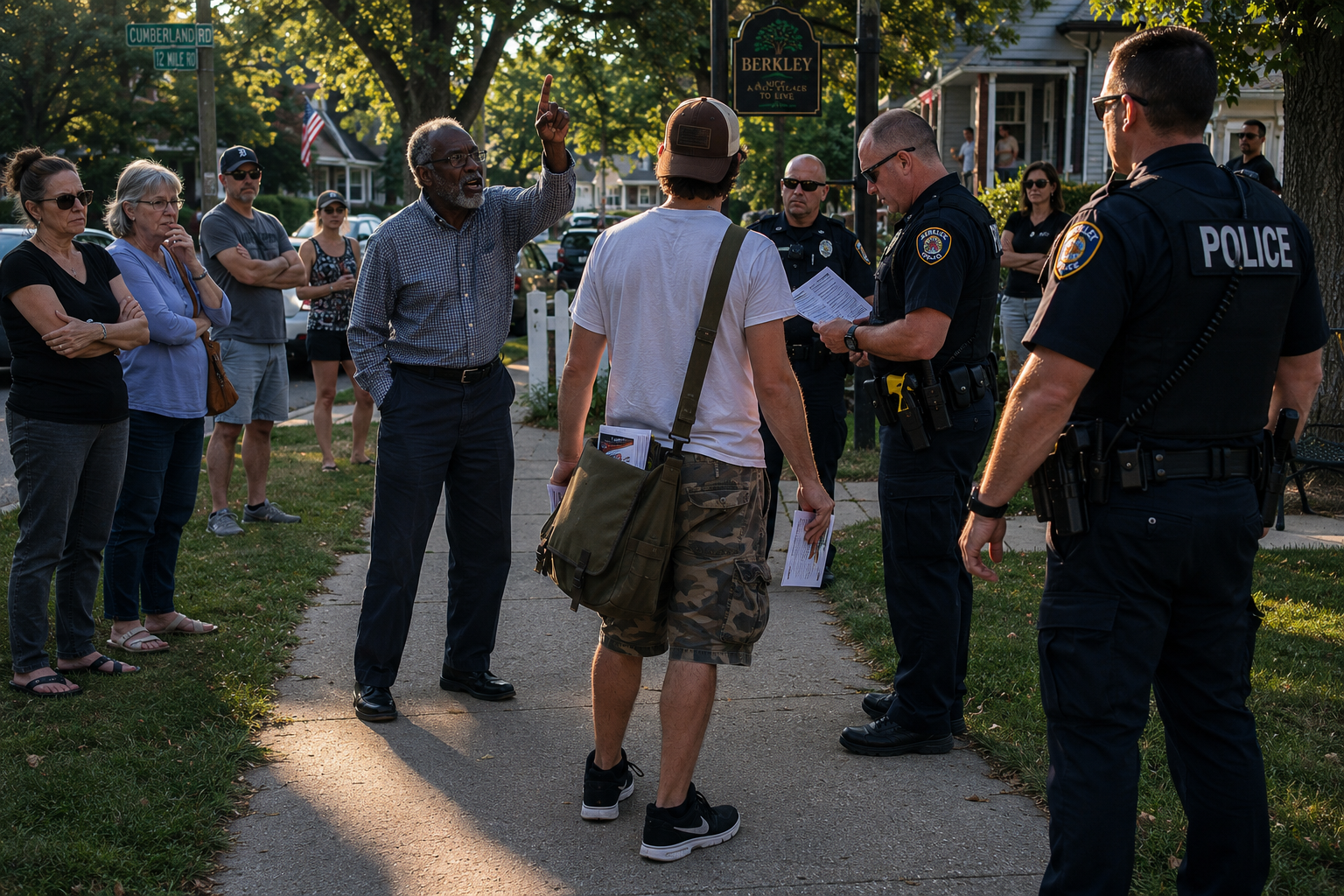
The police officer took the pamphlets from my hand and began flipping through them while another stepped away to call the station. I stood on the sidewalk waiting as they discussed city ordinances and whether what I was doing violated any of them. The pamphlets themselves were about antisemitism.
Even now, a few days later, that detail still strikes me as absurd.
A few weeks after Berkley residents woke up to find antisemitic propaganda distributed throughout the city overnight, I found myself standing in the same city explaining to police officers why I was handing out literature about antisemitism.
As I waited, I found myself looking around more than listening. My son’s soccer practice is held on that block. I’ve stood there countless times. Like most places that become part of the routine of family life, it had long ago faded into the background. It was simply one more familiar piece of the geography of home. Yet standing there that day, watching police officers review pamphlets and discuss complaints, I kept asking myself the same question:
How did we get here?
The obvious answer is antisemitism, but that answer feels incomplete. Jews do not have the luxury of being surprised by antisemitism. If that were all this was, I doubt I would still be thinking about it. What has stayed with me is something more difficult to articulate. The entire interaction felt strangely out of place, not because I felt like an outsider, but because I didn’t.
My family has been in Michigan since the 1880s. My grandfather was an American veteran. My great-grandfather was an American veteran. This is not a place I moved to. It is not a place I adopted. It is home.
Perhaps that is why I have spent the last few days thinking less about the police interaction itself and more about the strange relationship I have always had with identity.
People often assume that because I grew up Orthodox, my childhood must have existed in some kind of parallel universe detached from mainstream American life. The reality was far more ordinary and far more American than many people imagine.
I went to yeshivah. I walked to shul on Shabbos. I kept kosher. Cholov Yisrael, even. I grew up praying for the return of the Jewish people to our homeland. Israel wasn’t an abstract political concept in my house. It was woven into our prayers, our holidays, our history, and our understanding of who we were.
At the exact same time, I was completely immersed in American life.
I rollerbladed. I wore parachute pants. I watched WWE and Monster Jam obsessively. I spent ridiculous amounts of time playing Xbox 360. I thought nu metal was the greatest thing ever created. I smoked weed behind random sheds with my friends. I read Civil War historical fiction because I actually wanted to. In third grade I dressed up as Abraham Lincoln for a school project because I thought ending slavery was one of the greatest things any American had ever done.
Patriotic songs made my heart swell.
They still do.
I remember the days after 9/11. My grandfather put an American flag in the front window. My sister wanted him to take it down because she was scared. I remember arguing with her about it. I couldn’t have been more than nine years old.
The country had been attacked.
Of course the flag belonged in the window.
Years later, after the Itamar massacre in 2011, I felt something remarkably similar. I was eighteen years old and convinced I should somehow get to Israel and fight. Never mind the fact that I didn’t have a passport, or money, or a plan, or any meaningful ability to speak Hebrew. My mother thought I was out of my mind. Looking back, she was probably right.
But the feeling was real.
America’s pain felt personal to me.
Jewish pain felt personal to me.
Israel’s fate felt personal to me.
None of those things contradicted one another.
That’s the part people seem to struggle with.
I don’t.
I never have.
For most of my life, I never understood why people talked about balancing Jewish identity and American identity. Balance implies tension. I never felt any. There weren’t two identities. There was one.
Mine.
A Jewish kid from Michigan.
That’s it.
Which brings me back to that sidewalk in Berkley.
I’ve spent the last few days replaying that interaction in my head. Not because it was traumatic. Not because it was the worst thing that has ever happened to me. It wasn’t.
But because it forced me to confront something I never expected to confront.
Not whether I belong here.
I know I belong here.
The question is why I increasingly feel compelled to defend that fact.
A neighbor named Windel spoke up for me that day. I’ll probably remember that for a long time. Not because what he did was extraordinary, but because it should have been ordinary.
And maybe that’s what has been bothering me most.
Not the police.
Not the pamphlets.
Not even the complaint.
The realization that something I have always experienced as completely natural increasingly seems confusing to other people.
A man can be deeply Jewish and deeply American.
A man can love Michigan and love Israel.
A man can walk to shul on Shabbos, blast nu metal in his truck, get emotional hearing patriotic songs, and still feel a responsibility toward Jews on the other side of the world.
I’ve spent my entire life being that person.
A few days later, I find myself oddly grateful for the clarity.
Not for the police interaction. Not for the complaints. Not for the uncomfortable realization that a pamphlet about antisemitism could generate that kind of response in a city where antisemitic propaganda had recently appeared.
The clarity came from something else.
For most of my life, I never gave much thought to how all the pieces fit together. The Jewish kid from yeshivah. The grandson of American veterans. The teenager listening to nu metal and smoking weed behind a shed. The kid who argued for keeping the American flag in the window after 9/11. The eighteen-year-old who wanted to find a way to Israel after Itamar. The father standing on a soccer field in Berkley.
They were never separate people.
They were me.
Somewhere along the way, I began feeling as though I owed people an explanation for that. An explanation for why I care about Israel. An explanation for why antisemitism matters to me. An explanation for why I can be deeply Jewish and deeply American at the same time.
A few days ago, standing on that sidewalk, I realized something.
I don’t.
I know who I am.
I know where I come from.
I know what I love.
I know what I am responsible for.
And I know that no police interaction, no complaint, no social pressure, and no fashionable political narrative is going to convince me that those things are somehow in conflict with one another.
The older I get, the less interested I become in explaining myself and the more interested I become in simply living honestly.
Jewish.
American.
Unapologetically both.