NAnews - Nikk.Agency Israel News
A Jewish Symphony Returns to Ukraine After 95 Years of Silence
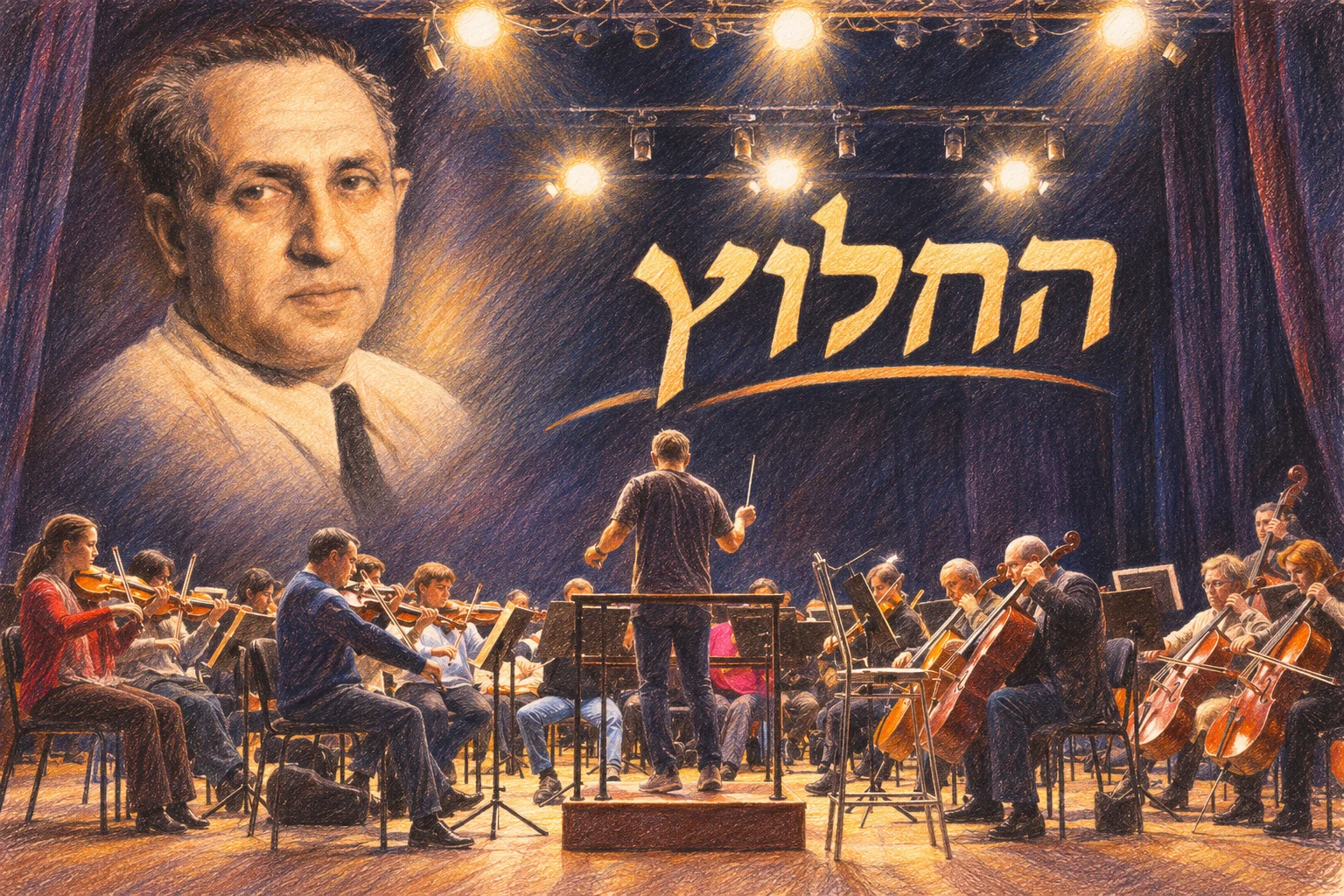
A Jewish Symphony Returns to Ukraine After 95 Years of Silence. The image was created using AI.
Born in Ukraine, composed in Vienna, and connected to the birth of Israel, a forgotten Jewish symphonic work has finally been heard again — while Ukraine fights for its own survival.
On November 5, 2026, an orchestra in the Ukrainian city of Khmelnytskyi performed a piece of music that had not been heard on a concert stage, as far as surviving records show, since February 1, 1931.
Ninety-five years of silence ended in a concert hall in a country at war.
The composition was Hechaluz (החלוץ), or The Pioneers, a symphonic poem by Israel Brandman, a Jewish composer born in what is now Ukraine who would later make his home in the Land of Israel.
The performance was not simply a rediscovery of forgotten classical music. It brought together the history of Ukrainian Jewry, the Zionist movement, the cultural world of prewar Vienna, and the early Jewish community of British Mandatory Palestine.
And it happened in Ukraine, while Russian attacks continue to threaten the country’s cities, infrastructure, and cultural life.
There is something profoundly moving about that choice.
A journey from Kamianets-Podilskyi to Vienna — and Israel
Israel Brandman was born in 1901 in Kamianets-Podilskyi, a historic city in the Podolia region of present-day Ukraine, then part of the Russian Empire.
Like many gifted Jewish musicians of his generation, he looked toward Vienna, one of Europe’s great musical capitals. In the 1920s, he traveled there to study, eventually becoming a pupil of the Austrian composer Franz Schmidt.
In Vienna, Brandman developed a musical language that brought Jewish themes into dialogue with the European symphonic tradition.
In 1931, his symphonic poem Hechaluz was performed by the Vienna Symphony Orchestra, with Brandman himself conducting.
Then the music disappeared from concert programs.
Four years later, in 1935, Brandman immigrated to British Mandatory Palestine.
He would spend much of his life in the Jewish community that eventually became the State of Israel, serving for many years as conductor of the Tel Aviv Workers’ Choir.
He died in Israel in 1993.
Yet how many Israelis today recognize his name?
How many know that a composer who helped shape the musical life of the Jewish Yishuv had been born in a Ukrainian city and had written an orchestral work dedicated to the pioneering spirit of Zionism?
These are questions worth asking.
Why the Hebrew title matters
The title Hechaluz is not merely a poetic reference to pioneers.
It belongs to the history of the Zionist movement He-Halutz, which prepared young Jews for immigration to Eretz Israel and for the agricultural labor and collective life that would help build the Jewish national home.
In the early twentieth century, groups associated with this movement operated in towns and cities across the lands of present-day Ukraine.
Young Jews studied Hebrew, learned practical trades, prepared for agricultural work, and imagined a future beyond the constraints of Jewish life in Eastern Europe.
Some would eventually reach the kibbutzim and agricultural settlements of Mandatory Palestine.
Their aspirations were expressed not only in political speeches and organizational meetings, but also in songs, dances, literature, and music.
Brandman’s sixteen-minute symphonic poem was part of that cultural world.
According to Japanese-Austrian conductor Koki Totsuka, who brought the work back to the stage, the original score preserved in New York contains a dedication connected to the pioneering movement.
The composition ends with an energetic hora — a circle dance that became closely associated with the culture of Jewish pioneers.
Consider that historical journey.
A Jewish composer from Podolia studies in Vienna, writes music inspired by the dream of a Jewish national home, immigrates to Palestine, and lives to see the State of Israel established.
Nearly a century after the composition’s last known performance, Ukrainian musicians bring it back to life in the region where he was born.
History has an extraordinary way of returning.
The conductor who refused to let the music remain silent
The story behind the performance began in the autumn of 2025, when Koki Totsuka visited the Khmelnytskyi Regional Philharmonic as assistant to conductor Parviz Yahyavi.
He returned in spring 2026 for the Khmelnytskyi Classic Fest, conducting Boris Lyatoshynsky’s Third Symphony.
During that visit, colleagues suggested a trip to nearby Kamianets-Podilskyi.
There, Totsuka learned about Brandman.
A musical investigation followed.
For approximately six months, the conductor and his collaborators searched for scores and orchestral materials that could make a modern performance possible.
Musicologist Jascha Nemtsov provided a copy of the work. The library of the Vienna Symphony Orchestra helped locate additional materials. Orchestral parts and another version of the score were found at the Jewish Theological Seminary in New York.
Copyright questions also had to be addressed.
Without the surviving materials, preparing the work for a full orchestra could have required hundreds of hours of additional work.
The complete story of this remarkable recovery, including the archival search and accounts from the Ukrainian musicians, was documented in NAnews’ original report on the return of Hechaluz to the concert stage.
What makes Totsuka’s achievement especially striking is that this was not a project built around a famous composer whose name would guarantee an audience.
It was an act of curiosity, persistence, and respect for a largely forgotten musical inheritance.
Another Jewish composer, another Ukrainian birthplace
Brandman’s composition was not the only work connecting Ukraine and Israel that evening.
The program, titled From Kamianets to Vienna, also included Four Jewish Dances by Joachim Stutschewsky, orchestrated by Alexander Boskovich.
Stutschewsky was born in Romny, a town in what is now Ukraine’s Sumy region.
A cellist, composer, and educator, he was active in Vienna’s musical world before moving to Eretz Israel in 1938.
His music followed a trajectory strikingly similar to Brandman’s: from a Jewish childhood in Ukraine, through European musical culture, to the emerging Jewish homeland.
The score for Four Jewish Dances was located in the archives of the Jewish community of Cluj-Napoca, Romania.
One evening in Khmelnytskyi therefore brought together two compositions whose revival depended on international archival cooperation.
The concert also included Franz Schmidt’s Fourth Symphony, written in 1933 after the death of his daughter Emma.
Schmidt regarded the symphony as a requiem in her memory.
For Ukrainian musicians living through a war marked by personal loss, displacement, and grief, that music carried a particular emotional weight.
Before the concert, clarinetist Vitalii Hudz described Brandman’s composition as philosophical music that brings deeply buried thoughts and feelings to the surface.
Violinist Oksana Hut spoke about the emotional relevance of Schmidt’s symphony, whose tragedy resonates differently in a country where so many families have experienced loss.
The performers were not simply reconstructing a historical program.
They were bringing their own lives into its interpretation.
Jewish music carries the memory of Ukraine
For Israelis, the story opens a much larger conversation.
The Jewish cultural history of Ukraine cannot be reduced to the history of persecution, pogroms, or the Holocaust, however essential those chapters remain.
For centuries, Jewish communities in Ukrainian towns and cities created an extraordinary musical world.
Klezmer musicians performed at weddings and celebrations. Hasidic melodies traveled between communities. Jewish and Ukrainian musical traditions influenced one another across generations.
In an earlier NAnews exploration of the roots of Jewish music and the role played by Ukraine, we examined this shared musical heritage — from klezmer and Hasidic nigunim to the work of researchers who preserved melodies that might otherwise have vanished.
Brandman and Stutschewsky belong to another dimension of that same history.
Their music crossed geographical boundaries.
It entered the concert halls of Central Europe and became part of the cultural life of the Jewish homeland.
When we speak about Israeli musical history, we should remember that some of its roots lie in the cities and towns of Ukraine.
Kamianets-Podilskyi and Romny are not distant footnotes to Israel’s story.
They are part of it.
Why this concert matters during Russia’s war
Ukraine is fighting a war for its independence and survival.
Its musicians work in conditions that would make ordinary cultural life extraordinarily difficult.
And yet they continue to rehearse, organize festivals, welcome international conductors, and recover forgotten compositions.
The November 5 performance was a powerful example.
According to accounts from those present, the audience greeted the musicians with prolonged applause, shouts of “Bravo!” and a standing ovation.
Members of the Jewish community attended the concert.
What they heard was more than a reconstruction of a score from 1931.
It was the return of a piece of their own history.
There is an important lesson here for Israel.
Supporting Ukraine’s ability to preserve its cultural heritage is not a gesture directed toward a foreign country’s past.
Part of that heritage is Jewish heritage.
Part of it belongs to the history of Zionism.
Part of it belongs to the story of the people who came to build modern Israel.
That does not mean the histories of Ukraine and Israel are identical. Nor does it erase the difficult and painful chapters in relations between Ukrainians and Jews.
It means recognizing that the same towns, streets, schools, and concert halls can belong to more than one people’s historical memory.
And that a culture is richer when those connections are acknowledged rather than forgotten.
The next chapter remains unwritten
Koki Totsuka hopes to make a recording of Brandman’s symphonic poem.
He is also searching for other works by the composer, including one whose complete musical score has not yet been located.
As of the latest reporting, there is no confirmed release of a recording.
Perhaps this rediscovery will encourage Israeli orchestras, conservatories, and music historians to take a closer look at Brandman’s legacy.
Perhaps someone will find additional manuscripts.
Perhaps one day Hechaluz will be performed in Tel Aviv or Jerusalem, where its connection to the history of the Jewish pioneers would carry an entirely different resonance.
That would be a fitting continuation of the story.
But we should not overlook what has already happened.
On November 5, 2026, musicians in a Ukrainian city brought back a Jewish symphonic work that had been silent for approximately ninety-five years.
Its composer was born in Ukraine, studied in Austria, and lived much of his life in Israel.
Its title spoke of the pioneers who helped lay the foundations of the Jewish state.
And its music returned not in Vienna or Tel Aviv, but in Khmelnytskyi, while Ukraine was defending its own right to exist as an independent nation.
A century ago, Brandman wrote about pioneers who dreamed of building a home.
Today, another generation of Ukrainians is struggling to protect theirs.
The histories are different. The music allows us to hear them together.
Ninety-five years later, the pioneers have found their voice again.
Related Topics
Related Posts