
A Letter to Elisabeth
A Wehrmacht soldier described the Kaunas killings to his wife four days into the occupation. It was not testimony. That is why it counts.
On June 29, 1941, a German soldier sat in the driver’s seat of his car in Kaunas, out of the rain, and wrote to his wife. He told her about the beer, which he had been lucky to reach before the rush. He told her the day was probably Sunday, though he had lost track. He told her how foul the eastern towns were and how freely a man breathed once he cleared the city limits. Folded between the beer and a closing dream of home leave, he told her what he had watched in a garage yard.
His name was Heinrich Sandt. He was thirty-two, nearly thirty-three, a man of the baggage train, Tenth Company of Infantry Regiment 89, which had crossed the Nemunas four days before. He was not one of the men with the bars.
He was not a witness summoned to a courtroom, not a defendant trimming his story, not a survivor whose memory a skeptic could wave away. He was a rear-echelon soldier with a blotting pad balanced on his steering wheel, writing to Elisabeth because it was raining and there was time. Yad Vashem Archives identifies the letter as Record Group O.75, Letters and Postcards Collection, File 4254, Heinrich Sandt to Elisabeth Sandt, 29 June 1941, item 13344639: https://collections.yadvashem.org/en/documents/13344639. The Sandt provenance and biographical details are summarized by Andreas Kuck: https://alles-ueber-litauen.de/litauen-geschichte/lietukis-massaker-1941/kaunas-holocaust-beweise.
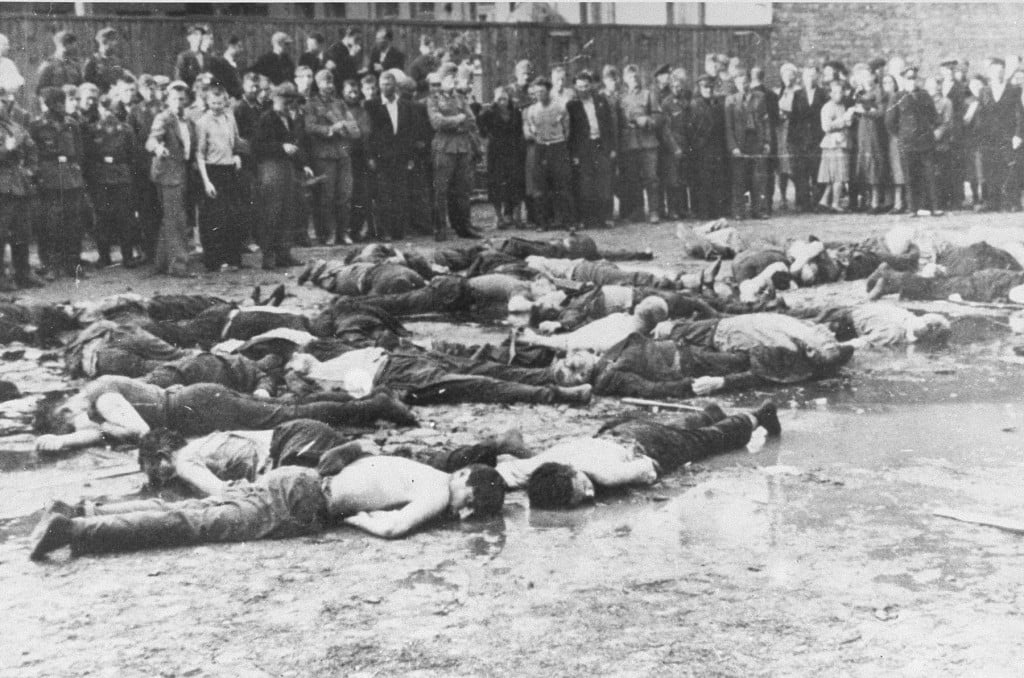
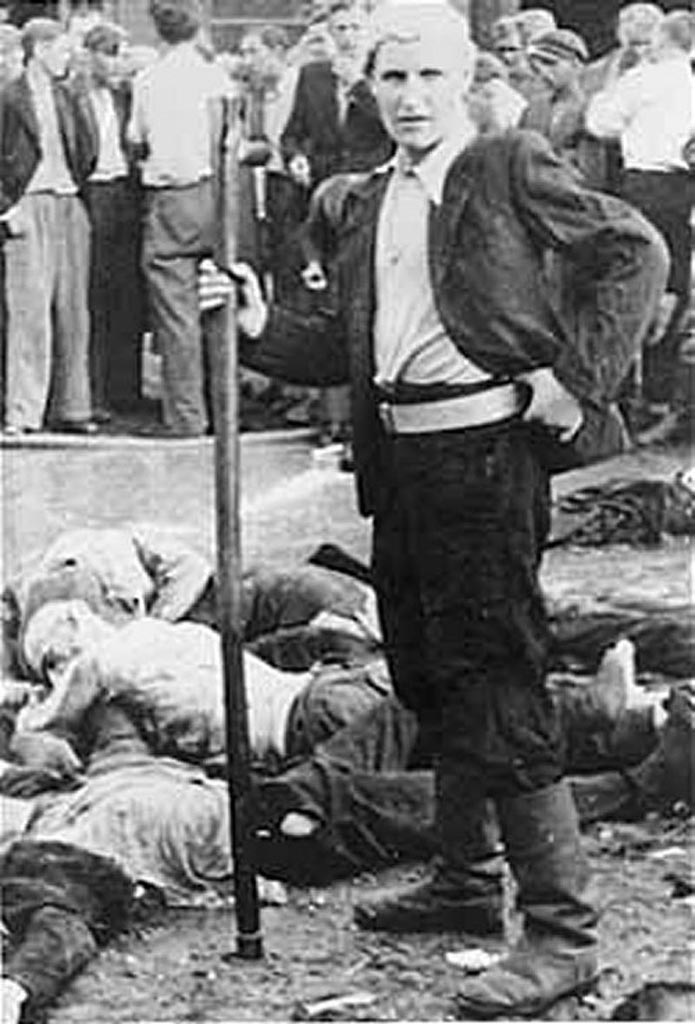
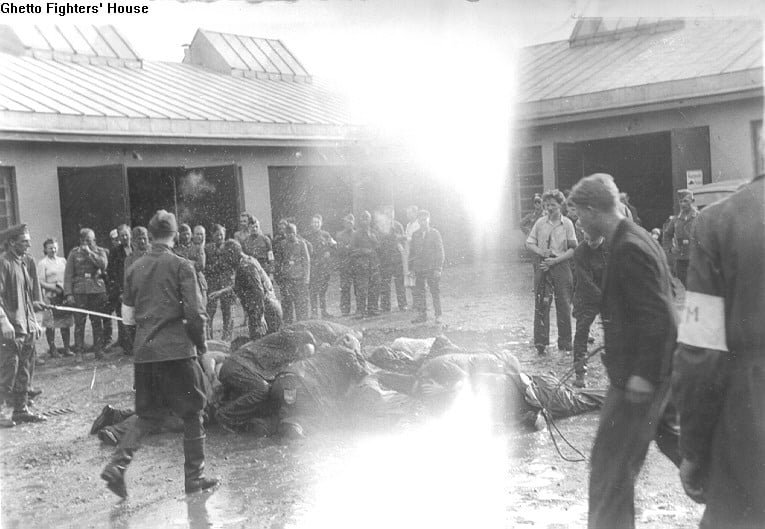
What he described, paraphrased, is this. He had driven into the city that afternoon. Lithuanian self-protection men and White Russians were racing through the streets in trucks, hunting Jews. A crowd had gathered on a square between a cemetery and a garage, and from a distance he could feel the excitement of it. He came closer and heard crying and laughter at once, hooting and screaming. He saw iron bars and gunstocks and wooden clubs swinging down.
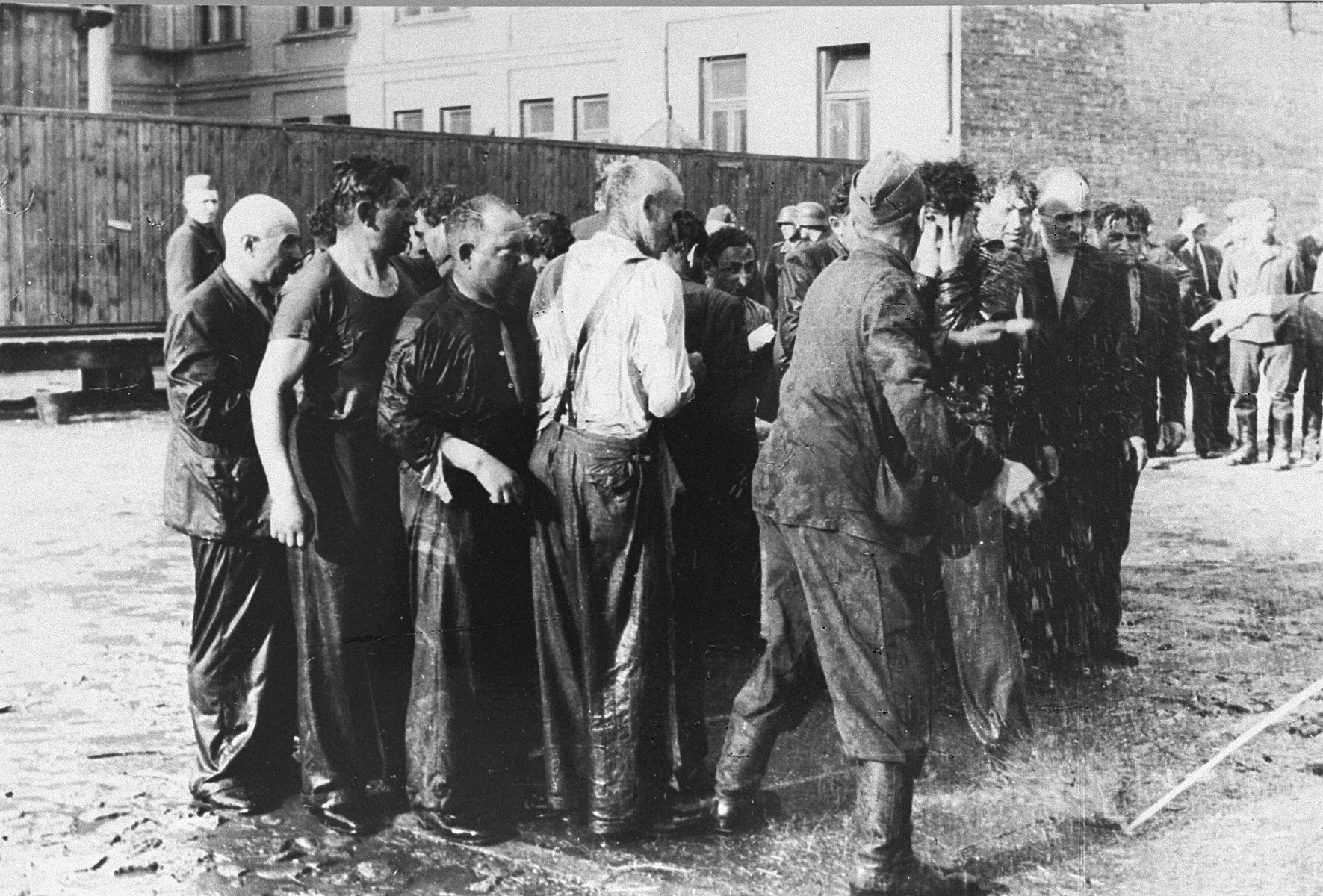
Jews were herded forward and beaten. He wrote that the scene could not be exceeded in horror, and that he would not set down the detail. That evening, he told his wife, the crowd held a festival on the bodies. An accordion played.
People danced on the corpses and jeered. The women were the worst, he wrote, and even heavily pregnant women took their pleasure in the dance of the dead. English translation by Christine Bombeck, published by Andreas Kuck: https://alles-ueber-litauen.de/litauen-geschichte/lietukis-massaker-1941/lietukas-massacre-proof.
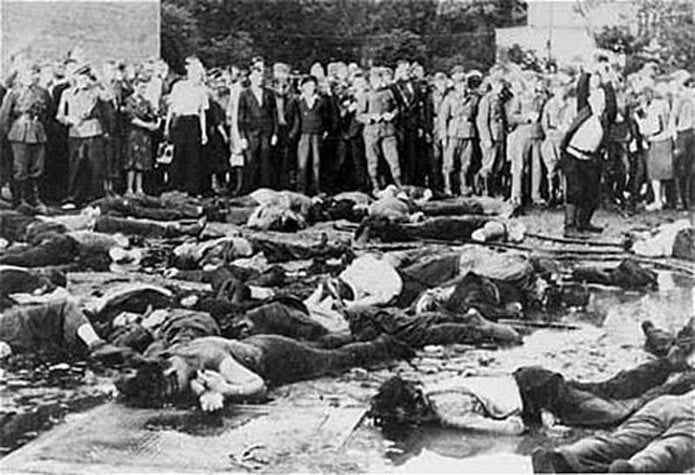
This is the Lietūkis garage massacre as it survived in a private German letter dated June 29. I have written about that courtyard in The Wreath and the Knife, and about the week that contained it in the companion essay to this one. The Wreath and the Knife: https://blogs.timesofisrael.com/the-wreath-and-the-knife/. Sandt’s letter is the same crime seen from the rear echelon, by a man with no reason to invent it.
A letter is worth more than testimony here, and it is worth more for a precise reason. The accounts Lithuania’s defenders have spent decades discounting are the ones that can be discounted. Statements taken from Germans in Soviet custody can be called coerced. Courtroom evidence can be called shaped. The famous photographs of the garage have been called Soviet fabrications.
Another German who reached that yard, Colonel Lothar von Bischoffshausen, called what he saw a brutality beyond anything in two world wars, and his account is sworn, and therefore, to a determined skeptic, suspect. See Ernst Klee, Willi Dressen, and Volker Riess, The Good Old Days: The Holocaust as Seen by Its Perpetrators and Bystanders (New York: Macmillan, 1991), testimony of Colonel Lothar von Bischoffshausen. None of that reaches a private letter, dated and postmarked on June 29, 1941, carried home through the German field post and sealed inside a family’s papers for the rest of the century. Sandt was not performing for a tribunal that did not yet exist. He was telling his wife what he had seen, the way a man does.
There is one line a careful reader will seize on, and it should be met head-on. Sandt did identify Lithuanian self-protection men and White Russians racing through the city and hunting Jews. But when he reached for a racial category to explain the cruelty, he wrote that only the Slav could be that cruel, and a few lines later he noted, without unease, that the Lithuanians were well disposed toward the Germans for freeing them from the Soviets. A defender of the Lithuanian record will reach for this. He should not be allowed to hold it long. The translated letter is here: https://alles-ueber-litauen.de/litauen-geschichte/lietukis-massaker-1941/lietukas-massacre-proof.
Sandt’s shift in vocabulary is not a problem for the case. It is part of the case. A baggage-train soldier four days into a foreign country, watching a massacre run by men he could not fully name, grabbed the nearest racial category and wrote Slav. He did not know whose operation it was because it was not an operation he had been briefed on. The German command, in fact, had taken pains to keep its own hand invisible, recording later that the Kaunas pogrom was set going through a Lithuanian partisan leader so that no German order could be seen from the outside. Stahlecker Report, 15 October 1941: https://www.yadvashem.org/docs/einsatzgruppe-report-baltic-countries.html; backup text: https://www.jewishvirtuallibrary.org/report-by-einsatzgruppe-a-in-the-baltic-countries-october-1941.
Had the visible work been German, Sandt had every reason to describe German units. He did not. He described Lithuanian self-protection men and White Russians hunting Jews, exactly the kind of local surface the German command wanted the world to see. The men with the bars belonged to the place. Yad Vashem, cataloging the letter, had no such trouble naming them. Its archivists set down what Sandt could not fully organize: a massacre of Jews by Lithuanians in a Kaunas garage, the killing done with crowbars before a crowd that included women. Yad Vashem catalog entry: https://collections.yadvashem.org/en/documents/13344639. His warmth toward the Lithuanians makes the horror heavier, not lighter. He liked them. He had no grievance to feed. He still recorded a festival of murder and told his wife he could not bear to describe the rest.
The Germans do appear in the letter, and they appear in a way that should be familiar by now. The Field Gendarmerie arrived and intervened. It did not stop the killing. It changed the method. After it stepped in, Sandt wrote, the Jews were handled more mercifully.
Vilna produced the same inversion. On July 9 and July 25, 1941, Herman Kruk recorded that Jews seized by Lithuanians appealed to passing Germans, who sometimes forced their release. I documented those entries and related cases in Is it possible to be worse than Nazis? The German uniform was not safety. It was sometimes the only authority capable of restraining Lithuanian hands.
At Lietūkis, even that intervention did not save the victims. Sandt’s ‘more mercifully’ meant that they were herded in hundreds and shot after digging their own graves. The German correction was to the manner, not the fact. This is the same reflex recorded two hundred meters from that garage, where the German Sixteenth Army asked only that the murder be moved off the open street, and the same reflex in the Provisional Government cabinet, which objected to the visibility of the Lietūkis killings and left every measure against the Jews in force. See Sužiedėlis and Dieckmann, Mass Killings, including the Lietūkis discussion and Provisional Government minutes. Three authorities, German and Lithuanian, in the same days, in the same city, all reached for the same edit. Make it quieter. None reached for the obvious one. Make it stop.
The letter survived by accident, the way most truth does. Sandt wrote roughly five hundred letters to Elisabeth. His son kept them, and near his own death handed the family’s papers to Chris Steinbrecher, an art historian in Bremen, who digitized them. The collection went to Yad Vashem and was entered as Record Group O.75, File 4254. Yad Vashem catalog entry: https://collections.yadvashem.org/en/documents/13344639; provenance and digitization account: https://alles-ueber-litauen.de/litauen-geschichte/lietukis-massaker-1941/kaunas-holocaust-beweise. I note for the record that the archive holds the documented letter, not the physical autograph, and I claim no more than that. It is enough.
So here is the shape of it. Eighty-five years on, Lithuania still litigates the question of whose hand held the bar at the Lietūkis garage.
It funds centers, convenes historians, and dates the killing with care, always leaving room to wonder whether the locals were the principals or merely the help.
A German baggage clerk answered the question on June 29, 1941, in a letter to his wife, and then went to sleep in a Lithuanian barn and dreamed of going home. His wording shifted between what he saw and the racial category he reached for to explain it. That does not weaken his account, because he was not assigning guilt. He was reporting a celebration. The guilt assigns itself. The crowd that danced on the bodies was at home.
The soldier who could not watch was the foreigner.
A state that wants the world to believe the killing was done to its people, and not by many of them, has to hope that no one reads the mail. Heinrich Sandt mailed his on the twenty-ninth. It arrived.