A Moroccan Journalist
A Moroccan hears a familiar beginning in Rosh Hashanah
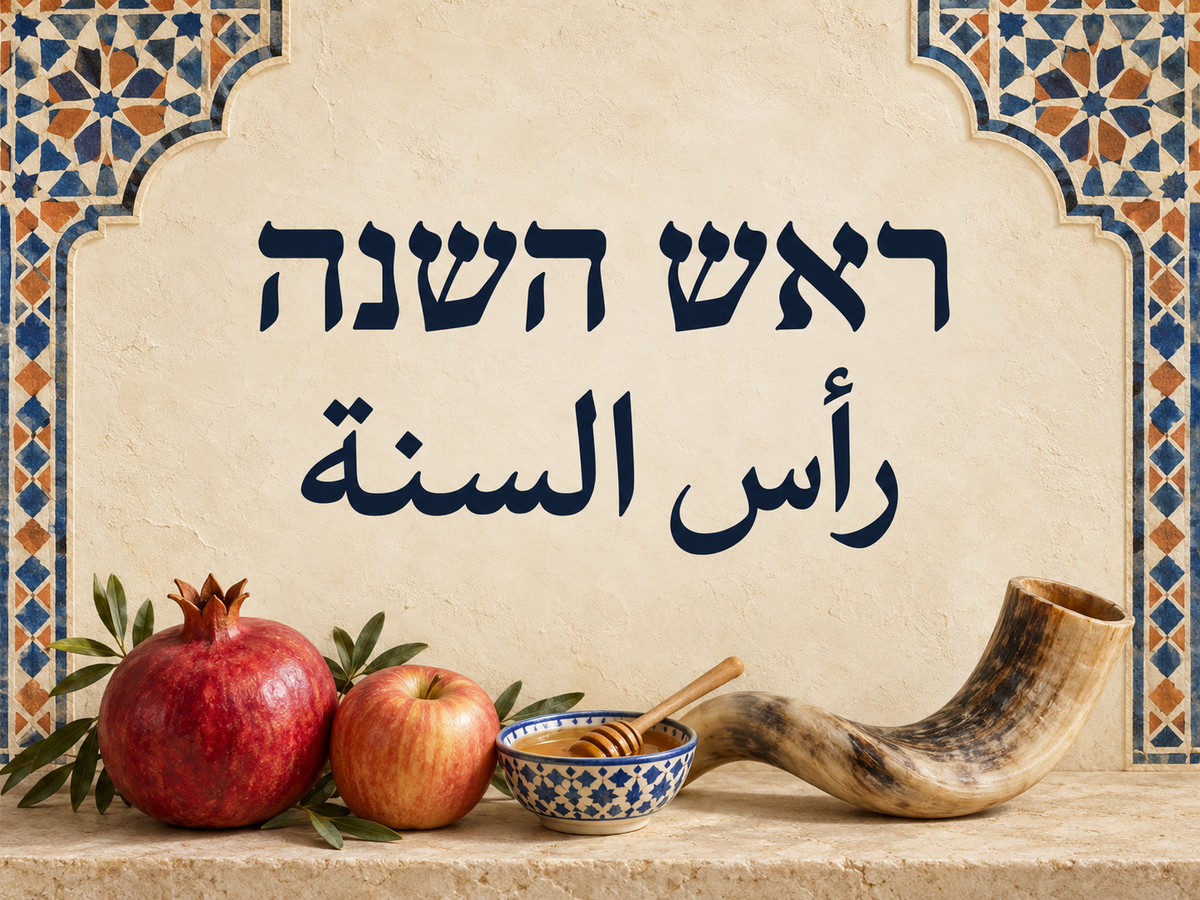
An AI-generated Rosh Hashanah illustration pairs Hebrew and Arabic text with Moroccan zellige, a shofar, apples, honey, and a pomegranate.
Rosh Hashanah is a Hebrew phrase I could almost understand before anyone translated it for me. Rosh is close to the Arabic ra’s: head. Shanah sounds like sana: year. In Arabic, ra’s al-sana is the beginning of the year. The languages do not become one, but their words stand near enough here that I can hear the meaning before it is explained.
I am an Amazigh Moroccan, and Arabic is one of the languages I speak. The Jewish New Year is not my religious observance. I cannot borrow the weight of its prayers, or pretend that recognizing two words tells me what it means to hear the shofar after the year Jewish communities have endured. The resemblance does something smaller, and more useful: it keeps me from calling your celebration foreign.
That matters where I live, in Marrakech. A person can walk through the mellah, encounter its synagogue and Jewish cemetery, and come away knowing something of the city’s Jewish past. It is easy to admire these places. The harder question is what happens after we leave them. A Jewish past is no substitute for Jewish people in the present.
In 2011, Morocco included its “Hebraic” influences in the preamble of its constitution. That recognition matters. But a sentence in a constitution cannot tell us how to speak about Jews at a dinner table, in a newsroom, or online. Restoring a synagogue matters too; it cannot discharge our responsibility to the people who pray in one.
Moroccan Jews are not merely the subject of a memory project. Some still live among us; many more built lives elsewhere, including in Israel, and kept their connections to this country. Their departures belong to our history as surely as the centuries they spent here. If we remember only the part that flatters us, we are not remembering them.
None of this asks me to be silent about Gaza. Palestine is not a distant abstraction to me. On October 7, 2023, Hamas murdered Israeli civilians and abducted others. The war that followed brought death and devastation to Palestinian civilians in Gaza. These truths are not interchangeable, and they do not cancel each other. A Jewish neighbor should not have to answer for an Israeli government before receiving a New Year greeting. A Palestinian family should not have to prove its innocence before its loss is mourned.
I work with words for a living. That makes me more aware of how quickly careless shorthand widens the circle of blame. “Jews” is not a synonym for an Israeli cabinet. “Palestinians” is not a synonym for Hamas. We can contest a government’s actions fiercely and still be precise about whose actions we mean. Precision is a refusal to make someone answer for a wrong they did not commit.
Rosh Hashanah does not promise that a change of date will repair what people have broken. The days it opens lead toward Yom Kippur, a time for taking account. Even someone who does not observe them can understand the question beneath them: What will we do differently now that we can see where our words have taken us?
For me, an answer begins by refusing to treat Moroccan Jewish life as a beautiful chapter that ended. It means speaking to Jewish people as people, without making a holiday greeting conditional on politics. I can hold fast to Palestinian rights and want Jewish families to enter a synagogue in safety. Neither commitment needs permission from the other.
Perhaps that is why the sound of the words stays with me. In ra’s al-sana and Rosh Hashanah, I hear a point of contact, not a solution. Languages can carry a memory of closeness across centuries. They cannot do the work of closeness for us.
To Jews marking 5787 in Morocco, Israel, and beyond: shanah tovah. I can hear the words in my own language. The harder, more hopeful task is to make sure that, when I say them, you hear that I mean them.
Related Topics
Related Posts