Jewish values, leadership, and honest conversation
A Mourning Text Became a Morning Prayer
The Canadian Jewish Barometer, created with Claude AI
Robert Brym and Rhonda Lenton open their new study with a sentence that should stop every Canadian Jew cold: the golden age of Canadian Jewry ran from the early 1960s to the early 2020s, and it is over.
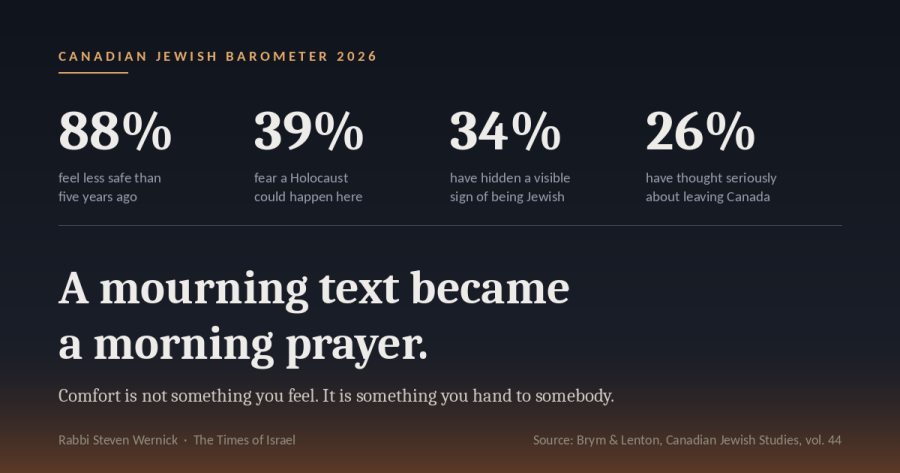
Their Canadian Jewish Barometer 2026 (Canadian Jewish Studies, vol. 44) surveyed more than three thousand Canadians, six hundred of them Jews. Eighty-eight percent of Canadian Jews now say they feel less safe here than five years ago; two years ago it was sixty-three. Thirty-four percent have stopped wearing something in public that marks them as a Jew — a kippah, a Star of David, the necklace their grandmother gave them. Twenty-six percent have thought seriously about leaving the country.
And thirty-nine percent — nearly four in ten of us — have begun to worry that a Holocaust could eventually happen in Canada.
That number is not hysterical. In 2024 there was one anti-Jewish hate crime in this country for every 366 Jews, and we are the only community in Canada that needs bollards, cameras and a guard at the door of its house of prayer.
So let me say what Tisha B’Av exists to say: the danger is real, and our mourning was never nostalgia. It was a siren.
And let me say the second thing, which we say almost never. Memory alone did not save us. Our long memory did not prevent 1096, or 1492, or 1942. Anyone who tells you that remembering is a strategy has confused spiritual practice with a security plan.
So, what I want to offer is not reassurance. It is evidence.
The first thing a Jew says
In sixteenth-century Tzfat — a town built largely by refugees expelled from Spain and Portugal — a kabbalist named Rabbi Moshe ben Makhir set down the first words a Jew is to say upon waking (Seder HaYom). Before washing, before the tallit, before we have done a single thing to deserve the day: “I am grateful before You, living and enduring Sovereign, that You have restored my soul to me with compassion — great is Your faithfulness.”
That closing phrase is not his. He took it. It comes from Eicha, the scroll we read on Tisha B’Av, from a poet sitting in the rubble of Jerusalem: The kindness of God has not ended, God’s mercies are not spent. They are renewed every morning — great is Your faithfulness (Lamentations 3:22–23).
A mourning text became a morning prayer.
The scroll of destruction was quarried for words of gratitude — not despite the grief, but out of it. And notice what the prayer does not claim. It does not say the exile is over. It says the soul came back this morning, and that the mercies are renewed for the mornings, plural, one at a time. Not a messianic assertion. A claim about tomorrow.
Evidence, entered into the record
When the sages climbed to the ruined Temple Mount, three of them wept and Rabbi Akiva laughed — not at the ruin, but because the prophecies of destruction and of return were bound together (Makkot 24b). Having watched the first come true, he knew the second was still possible. The prophecy he was waiting on was Zechariah’s: old men and old women shall yet sit in the streets of Jerusalem, and the streets shall be filled with children playing (Zechariah 8:4–5).
Two days before we sat down to mourn, I was in Jerusalem. The restaurants were full. The Film Festival was full. There were cranes on every third block. The country is at war and bitterly divided, elections are coming, and Tisha B’Av has things to say about all of it that we are not permitted to minimize.
And the streets were full of children.
That is not triumph. It is evidence.
Which brings us home
Some readers of this site will look at that twenty-six percent and see an opportunity. I chair the Jewish Agency’s committee on Aliyah and absorption; I want more Jews to come to Israel, and I will help them. But a Jew who arrives at Ben Gurion fleeing rather than choosing has not solved the problem. He has relocated it.
The Torah portion read on the Shabbat after Tisha B’Av tells us what to do with what we have seen with our own eyes: “guard your soul exceedingly, lest you forget — and make it known to your children and your children’s children” (Deuteronomy 4:9). The sentence does not end in the soul. It ends in transmission.
Comfort is not something you feel. It is something you hand to somebody.
There is a legend — almost certainly apocryphal — that Napoleon heard wailing from a synagogue on Tisha B’Av, learned the Jews were mourning a Temple destroyed eighteen centuries earlier, and said such a people would one day return and rebuild.
He had it backwards. It is not that a people who weep will be permitted to return. It is that a people who can take the scroll of their own destruction and make from it the first sentence they say every morning — that people is already, in some measure, home.
Including Bathurst Street.
Related Topics
Related Posts