A New Lens for Teshuvah: Repairing a Sefer Torah
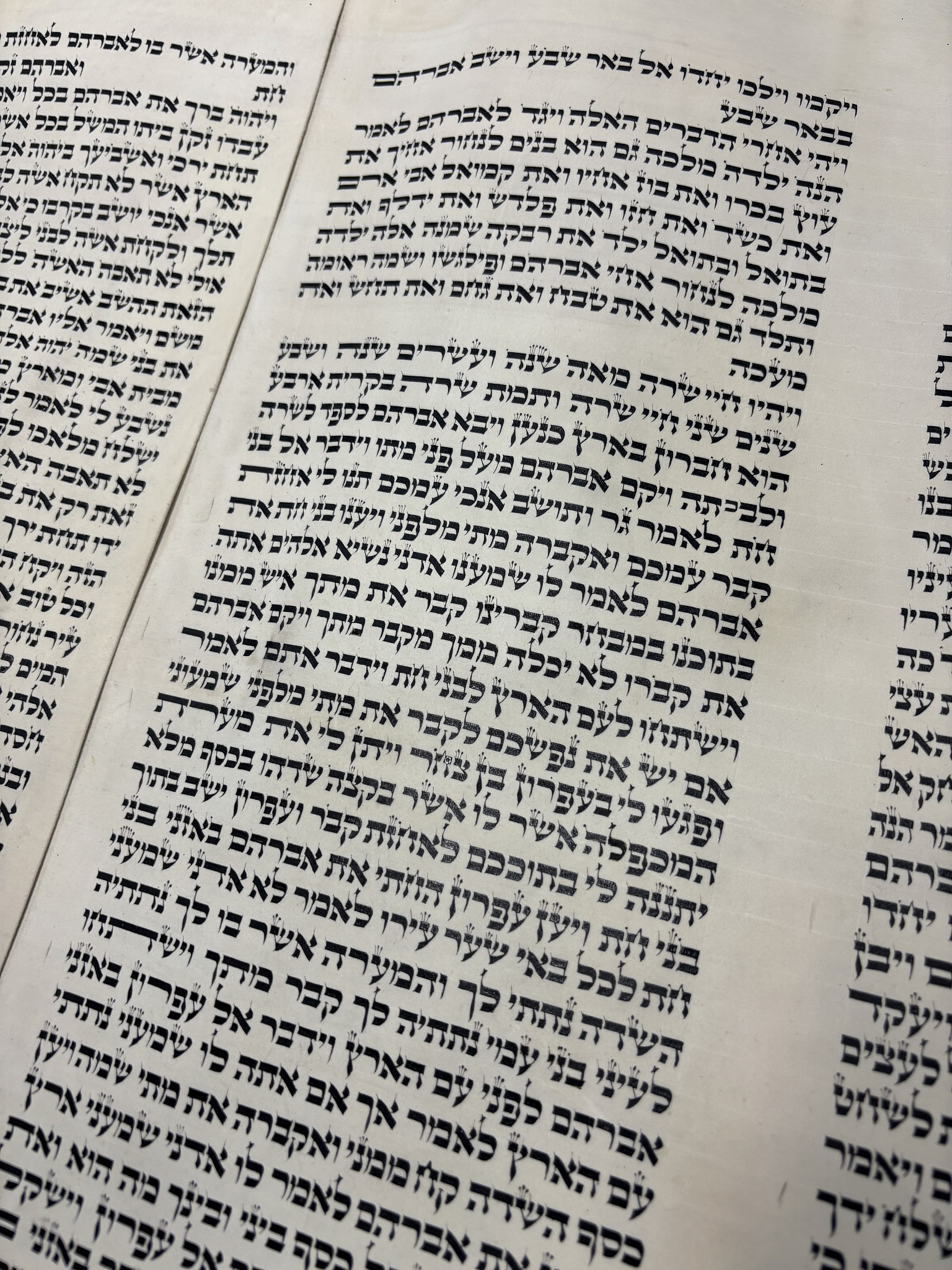
This Rosh Hashanah at Congregation Netivot Shalom in Teaneck, NJ, one of the sifrei Torah (Torah scrolls) we read from was new to our community, a repaired sefer Torah.
As the sofer (scribe), Rabbi Rephael Hirsch, was repairing it, he told me that letters needed to be re-inked throughout. But the places that needed the most repair were in Parshat Chayei Sarah, parts of Sefer Bamidbar and much of Sefer Devarim. Strikingly, in Sefer Devarim, the repairs started to get better in Parshat Vaetchanan (which we read after Tisha B’Av as a sign of comfort and hope). When he told me this, I was overcome. The parts that needed repair were moments of transition, loss, rebuilding, and hope. This did not feel like a coincidence. Rather, it felt inextricably connected to our experience of Rosh Hashanah 5786.
Our rabbis traditionally draw a comparison between a sefer Torah and a person: Rebbe Shimon ben Elazar teaches in Moed Katan 25a, העומד על המת בשעת יציאת נשמה חייב לקרוע, “a person who is accompanying the dead at the time the soul leaves the body is obligated to tear kriyah (to rip one’s clothing)”. למה זה דומה לספר תורה שנשרף שחייב לקרוע “Why? Because a person who has died is comparable to a sefer Torah that has been burned, for which we tear kriyah. Just as we tear kriyah for the sefer Torah, so too for the person.”
On how the writing of a sefer Torah works, the Tosafot explain that the sofer is required to pronounce the words before writing them (as with a mezuzah or tefillin). Rav Soloveitchik poignantly comments, “What has the greater ability to absorb God’s Word – simple parchment and black ink or a passionate heart in a warm Jewish body?…The halacha that a scribe must enunciate a word before it is written down expresses the aforementioned idea, that the sanctity of the ‘external’ Torah scroll flows from the personal, living Torah scroll which is hidden in the depths of the soul.”
With this in mind, I offer this framing for our teshuvah and tefillot for 5786: We are in need of repair, just as our restored sefer Torah was. Whether because we have personally erred, willingly or unwillingly, and need to do teshuvah bein adam lechaveiro (between each other) or bein adam laMakom (between ourselves and God). Or because we feel broken by no fault of our own. From the trauma, loss, and fury we continue to hold from October 7th and all that has happened since.
At the Yamim Noraim, we repent as we always do because as Jews, we strive to grow and be as close to God as possible, to make our world more whole and holy. But this doesn’t feel like a year when we heavily beat our chests to break through our hardened hearts. Instead, I would suggest this is a year when we need Hashem, each other, and the words of the machzor (prayer book) to be our spiritual sofrim (scribes). Re-inking the letters within us that have been worn down, repairing the broken columns. כתיבה וחתימה טובה, בספר החיים–what if this is how we envision being written and sealed for goodness in the book of life?
With this kavanah (intention), let us reflect on the passages that needed repair, so that we may mine within them restoration in ourselves and our wider world. In Parshat Chayei Sarah: After Sarah has been remembered and Yitzchak is born (which we read on first day Rosh Hashanah) and after the Akeidah (which we read on second day Rosh Hashanah), Sarah herself dies. Some commentaries say she died of a broken heart when she heard about Avraham taking Yitzchak for the Akeidah (Binding of Isaac). In Parshat Chayei Sarah (literally “the life of Sarah”), Avraham buries Sarah, mourns her, and tries to pick up the pieces to keep living– finding Rivka for Yitchzak, who brings nechama (comfort) and hope for the future after the death of his mother Sarah. Parshat Chayei Sarah ends with Yitzchak and Yishmael who had been estranged, coming together to honor and bury their father Avraham at marat hamachpelah, beside Sarah. We can’t help but hear the themes of family loss, hope to rebuild, resilience, and the vision of future unity calling out to us.
At the end of Sefer Bamidbar and throughout Sefer Devarim (the other areas that needed the most repairs), we experience the consequences of our sins, as we truly wander in the desert. Sefer Bamidbar grapples with national discord and yearning, blessings and curses from within and without, which continue to this day. In Sefer Devarim, Moshe retells his story and ours, knowing he will not bring us into Eretz Yisrael and that dor hamidbar (the generation of the wilderness) will die in the desert. Devarim in particular is full of calls for teshuvah (repentance), looking forward and paving a path that, though different than we thought, is nevertheless Divinely directed. It emphasizes recognizing right from wrong, building a just society, and listening to God’s voice in our tradition and lives– even when that may be contrary to our own desires. Devarim names our personal and communal longing for Divine justice and peace.
Eli Sharabi, a hostage who came home to learn that his wife Lianne, two daughters Noiya and Yahel, and brother Yossi had been murdered– recently published a memoir entitled “Hostage”. After reading an advance copy (with gratitude to The Lisa and Michael Leffel Foundation, The Paul E. Singer Foundation, and Maimonides Fund for providing advanced copies to a group of interdenominational clergy across the country), I found myself holding two moments from the book with me in my Rosh Hashanah davening (prayers): The first, as an IDF officer accompanies Eli to change his clothes and meet his mother and sister, Eli reflects: “I won’t harm myself, I want to tell [the officer]. You have no idea how badly it hurts, but also how badly I want to live.” And after his first visit to the cemetery, Kfar HaRif, he writes: “I fall to my knees. I can’t see anything. Everything’s blurry. The sky. The view. The other headstones. The people who came with me. Everything fades away. Only Yahel, Noiya, and Lianne exist. Forty minutes later, I tell [my sister] Osnat, ‘OK, let’s go’. She looks at me puzzled. ‘It’s OK,’ I tell her. ‘Let’s go.’ I pick myself up and start walking slowly toward the exit of the cemetery. This here is rock bottom. I’ve seen it. I’ve touched it. Now, life.”
Eli Sharabi’s words stand on their own. How he wrote them, I cannot imagine.
And the story of the Jewish people throughout history echoes through them, including in the sections of our restored sefer Torah that needed repair– and in our own experiences at this moment. We hear them as Avraham Avinu stands at marat hamachpelah, burying Sarah Imeinu, followed by Yitzchak and Yishmael, who bury Avraham Avinu. We hear them in Moshe pleading to God to let him into the land, only to stand from afar seeing both where he has been and where his legacy will go. We hear them in the agricultural charity mitzvot of leket, shikcha, and peah, embracing the orphan, widow, and stranger in their own rock bottom. And on Rosh Hashanah, we her them in the cry of the shofar, whose wordless sounds give voice to that which we can’t bring ourselves to say. בראש השנה יכתבון וביום צום כיפור יחתמון… You have no idea how badly it hurts, but also how badly I want to live.
As Rav Soloveitchik said, we each have a living Torah scroll hidden in the depths of the soul. As the Torah is completed and reread, it is eternal, and the repair of the Torah is connected to that part of us– something that is kodesh (holy) and that we can always discover and recover. We must remind ourselves that redemption and renewal are not only possible but waiting to be found…We come together at the Yamim Noraim to find and actualize them.
And so, I invite each of us to include this refrain in our tefillot (prayers) in the coming days: May the letters and words within us be re-inked, our broken columns repaired. Our living souls, restored. It is no coincidence that our rabbis compare the value of a life to the highest level of kedusha, of holiness: that of a whole, kosher sefer Torah. May our repaired Torah at Netivot Shalom be a reminder of all of the gifts we are given for renewal, not just during the chagim (holidays), but every Shabbat and every day. As the kedusha (holiness) of this Torah is restored, so too may we and our world be. כתיבה וחתימה טובה, בספר החיים. “Now…life”.
—
*With tremendous gratitude to Temple Beth El and Rabbi Robert Schumeister, for generously sharing this Sefer Torah with our community.*
This was originally given as a Rosh Hashanah drasha at Congregation Netivot Shalom.