London based entrepreneur, cybersecurity analyst doing a PhD in AI
A New Measure for the Economy: GDP to GLP
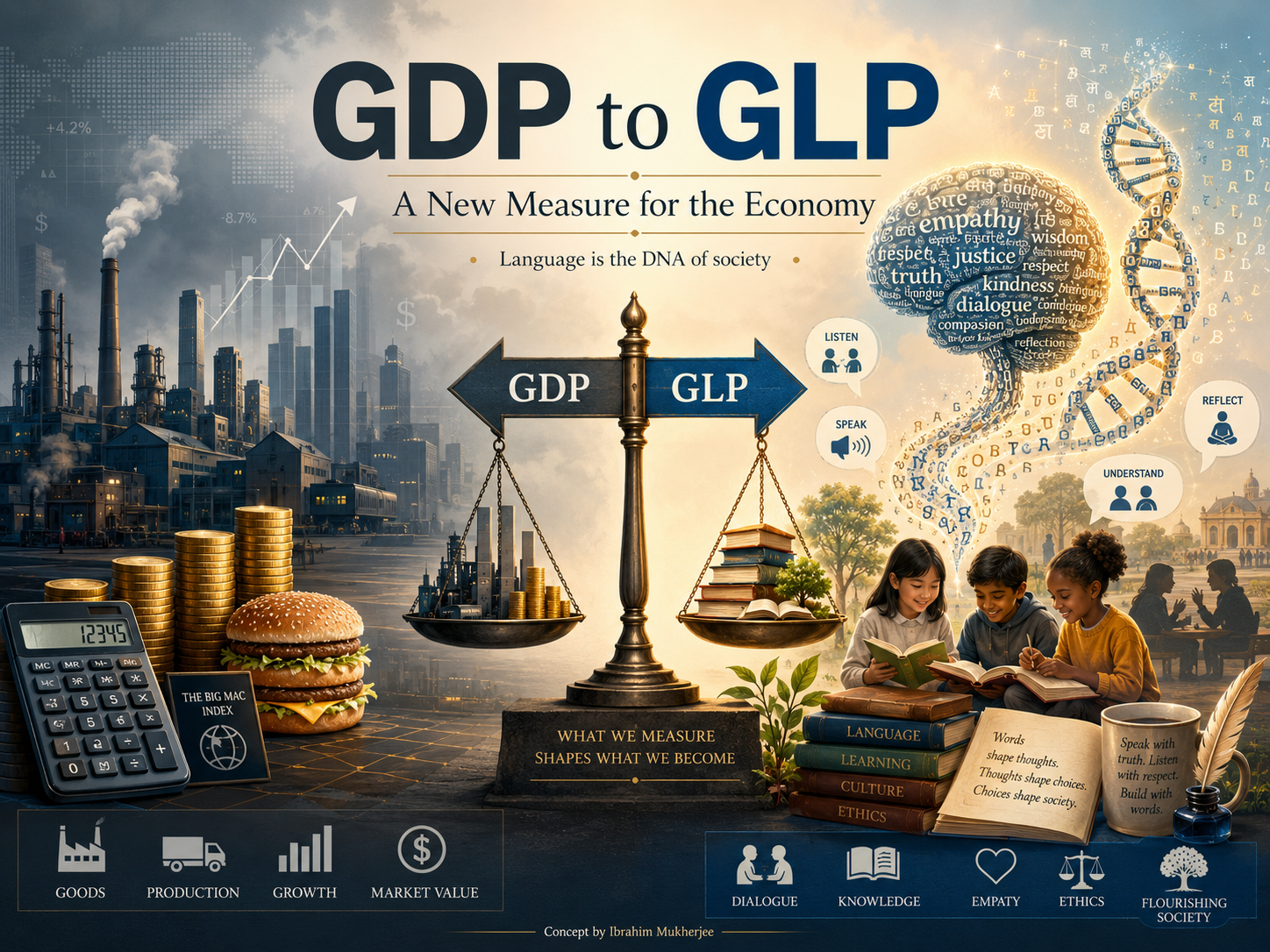
From GDP to GLP – Understanding Language as a measure of economic and societal growth.
This article introduces a new concept to measure the economy and society – any academics or journalists who use this concept – must attribute it back to me. Please read the footnote.
Economists measure almost everything: output, prices, productivity, employment, debt, trade and growth. Gross Domestic Product remains the headline number. It tells us how much economic value a country produces. But it tells us little about the quality of the society doing the producing.
Imagine two countries with identical GDP per capita. In one, children read widely, citizens can distinguish evidence from opinion, political disagreement remains articulate, and people possess the vocabulary to describe emotions without immediately turning them into accusations. In the other, public language has collapsed into slogans, obscenity, humiliation and outrage. Children read less, political opponents are routinely dehumanised, and words such as “evil”, “trauma”, “fascist”, “genocide” or “narcissist” are thrown at radically different phenomena until moral language loses resolution. I am thinking of countries like the US (under Donald Trump) & China vs Netherlands, Norway, Sweden, Finland, Germany here. Countries like India also fall under it, however less so under the Modi government where public discourse has taken a sharp “nationalistic” turn. Israel would also fall under this in the Netanyahu government.
Economically, these societies may look similar. Civilisationally, they are not.
We therefore need another measure: GLP — Gross Language Product.
The Alternative Big Mac Index
The Economist’s Big Mac Index works because of its simplicity. A hamburger cannot describe an entire economy, but comparing a similar product across countries gives an intuitive window into purchasing power.
GLP could do something comparable for social health. Instead of asking, “What does a Big Mac cost here?”, ask: “What does the average 15-year-old understand here?” This is not simply measuring the maths scores and overall education levels, but simply seeing the output the education produced in what I would term are linguistically and morally “real” terms. Their ability to discern truth from falsehood, look through propaganda, and course correct their governments through the ballot in a functioning democracy.
Give students the same concepts: dignity, remorse, resentment, ambivalence, causation, evidence, uncertainty, proportionality, integrity, compassion, justice and vengeance. Can they define them? Distinguish them? Use them properly? Can they explain the difference between criticism and humiliation, correlation and causation, certainty and probability, justice and revenge?
That would not measure intelligence. It would measure conceptual equipment.
These don’t need to take the form of qualitative surveys. They can be discerned using social media platforms such as Twitter, Threads, Facebook, Reditt etc.
Language as Social DNA
Language may be the closest thing society has to DNA. DNA carries biological information across generations; language carries cultural information.
There is also some evidence from Islam for this. The below Hadith provides a view of a “nation” in a Islamic context :-
Narrated An-Nu`man bin Bashir:
Allah’s Messenger (ﷺ) said, “You see the believers as regards their being merciful among themselves and showing love among themselves and being kind, resembling one body, so that, if any part of the body is not well then the whole body shares the sleeplessness (insomnia) and fever with it.” (Sahih Bukhari 6011).
https://sunnah.com/bukhari:6011
A child repeatedly hears: “Tell the truth.” “Say thank you.” “What evidence do you have?” “That was unfair.” “You should apologise.”
The child is not merely learning sentences. The child is inheriting a civilisation: truth, gratitude, evidence, justice and repentance.
Language is therefore more than decoration. A word is a compression device for a concept. If I know “ambivalence”, I can identify simultaneous conflicting feelings. If I understand “confirmation bias”, I acquire a tool for examining my own reasoning. If I understand “proportionality”, I can think more carefully about punishment, war or justice.
Each useful word adds another distinction, and civilisation depends on distinctions.
Law distinguishes murder from manslaughter, intent from negligence, allegation from evidence. Science distinguishes correlation from causation and hypothesis from observation. Psychology distinguishes guilt from shame, fear from anxiety, anger from aggression.
When language loses precision, judgment often follows.
Language Poverty Is Poverty
This has direct implications for education.
Vocabulary should not be treated as an ornament for clever children. It is intellectual infrastructure. A child born into a book-rich household may encounter thousands of concepts through conversation, reading and discussion that another child does not encounter at home.
Education should close that gap.
The aim is not to erase slang, dialect or culture. It is addition, not subtraction. Keep the home vocabulary. Keep the cultural vocabulary. Then give every child thousands more conceptual tools.
A serious GLP could therefore include vocabulary, reading comprehension, emotional granularity, epistemic reasoning, civility under disagreement and the ability to distinguish closely related moral concepts.
Crucially, GLP should not reward pompous language or punish ordinary speech. A society with plain, precise, compassionate language may be healthier than one full of jargon. The purpose is not status. It is usable cognitive range: whether people possess enough words and concepts to think clearly, disagree fairly, regulate emotion and recognise manipulation.
The Qur’anic Language Index
The Qur’an treats speech as morally causal, not socially weightless.
It commands believers: “Fear Allah and speak words of appropriate justice” (Qur’an 33:70). (Quran) In the work commonly transmitted as Tafsir Ibn ‘Abbas, the command is explained as obeying Allah and speaking words that are “straight to the point” and fair. The emphasis is not merely eloquence; speech must align with truth and moral rectitude. (Altafsir.com)
The Qur’an also says: “Tell My servants to say that which is best. Indeed, Satan seeks to sow discord among them” (Qur’an 17:53). (Quran.com) The sequence matters: speech can either restrain conflict or become one of its mechanisms. This is why “free speech” can become a loaded term in a political context if not put through the same rigour as a court of law does, and Meta’s trial shows the impact speech and language has on the mental health of children – and acts like the UK’s partial ban on social media for children is so crucial.
Surat al-Hujurat prohibits ridicule, insulting labels, suspicion and backbiting (Qur’an 49:11–12). (Quran) And Qur’an 50:18 reminds us that not a word is uttered without being recorded. (The Quranic Arabic Corpus)
The Prophet Muhammad ﷺ supplied an extraordinarily compact linguistic standard: whoever believes in Allah and the Last Day should “speak good or remain silent” (Sahih Muslim 47b). (Sunnah) Another hadith describes the Muslim as one from whose tongue and hand others are safe (Sahih Muslim 41). (Sunnah)
This is not a prohibition on disagreement. It is a demand that language retain a moral rudder.
From Nafs to Newsfeed
The Qur’an describes the nafs al-ammarah, the self inclined toward harmful impulses (12:53); the nafs al-lawwamah, the self-reproaching soul (75:2); and the nafs al-mutma’innah, the reassured soul (89:27).
Applied carefully as a social metaphor, they offer a powerful model of communication.
Ammarah language says: I feel it, therefore I say it.
Lawwamah language says: I feel it, but is it true, fair and necessary?
Mutma’innah language can experience anger without becoming ruled by anger.
The difficulty is that modern social media often rewards the first state most efficiently. Research on online networks shows that moral-emotional language spreads effectively, that social rewards reinforce posting behaviour, and that expressions of outrage can be amplified through network norms.
The danger is not free speech itself. The danger is an environment in which low inhibition, weak accountability, instant amplification and visible social reward train people to speak before conscience has finished its work.
A National Language Balance Sheet
GLP should complement GDP, not replace it.
A national dashboard might one day show GDP growth beside adult literacy, median vocabulary, reading comprehension, epistemic reasoning, misinformation discrimination, emotional vocabulary and civility across disagreement.
What gets measured becomes politically visible.
GDP asks: how much did we produce?
GLP asks: what quality of thought does our language make possible?
And just as education would be related to GDP, I would consider GLP to be the “probe” that tells us – did the education actually work, and is the quality of thought “high” in society. If it is, the GDP should follow. (This is a hypothesis – and I am sure some academic would pick up the mantle and test this soon enough).
The real wealth of nations is not merely what citizens can buy, but what they can understand, explain, question and communicate. For every Industrial Revolution Britain produced – there was also an Adam Smith, Newton, Faraday and Keynes produced. Likewise, America produced Franklin, Steve Jobs and Bill Gates. And not surprisingly, reading about Elon Musk – he saw the US as the place to be growing up based on what he was able to read of the US. So thought precedes matter. A nation poor in ideas won’t be rich in material terms. A good experiment to do is to see the countries that have “cracked” the toughest engineering challenge – Jet Engines – and the richness of language in these countries compared to the GDP. One striking factor of the two that produce commercial jet engines – UK and US – is that both have large amounts of immigrant populations. This of course needs to be empirically tested – Brookings has some research – but more needs doing. I suspect – the diversity of thought produced by different languages, cultures, “lenses” – immigration brings – is largely part of this. More research needs to be done. One reason, I similarly suspect, Israel had a high innovation ratio is because the “Jewish population” is diverse – from Europe, Russia, Africa, the Middle East – that all bring – both linguistic, cultural diversity – and diversity of thought. This also makes the case of more and tighter integration of the native Palestinian population into Israel more important. An economic gold mine is being ignored – and more importantly – the tighter the integration – the more religious freedom to practice Christianity and Islam – the less the foreign policy friction. Neighbouring “Arab states” won’t have a “point” if the Muslim population in Israel is thriving, worshipping at Al Aqsa, enjoying and contributing to the economic and social fabric of the country.
This also makes a case against “right wing” leaders some of whom recently called the UK – “an Islamic Republic”. If UK was an “Islamic Republic” – well then it has a commercial jet engine – which so far many other countries failed to produce. These leaders would be well advised to focus their energies on a quantum research programme, a jet engine programme, a data science based social policy programme rather than worrying about the things that will ultimately sink their country if left to fester like a wound on public conscience. The point here is simple – the more diversity – cultural and linguistic- the higher the innovation ratio. Bigotry doesn’t produce that. Contrary to what people say about Islam, Islam built in multi-culturalism into its fabric. A good example is Salman Al Farsi who was consulted in a key moment in Islamic history – and his insight – drawing from his Persian background – helped save the day.
Similarly, Judaism, repeatedly refers to Ger Toshav.
Islam is far stricter than the 7 Noahide laws on which this rests, in many cases stricter than Judaism itself – we pray 5 times a day, not 3. Someone who is seriously lacking in mental faculties would claim, a religion that commands prayers 5 times a day, has a more extensive and sophisticated legal code than the 613 Mitzvot, is lacking in either religious obedience, moral compass, or mindfulness of God or not able to contribute to society economically. A “ruthless” businessman, statesman or economist – who wasn’t sentimental even about “fluffy” ideas like “diversity”, “pluralism” or “multi-culturalism” would say – Hey! We are leaving money on the table. In my estimates somewhere close to 0.25T in GDP per year based on a 5.5 Million Palestinian population on a back of the envelope calculation. So instead of “waving rival flags” on social media – a better strategy is to “integrate economically”.
The idea of any “religious cover” – that any “right wing” leader uses – goes completely “out of the water” with LGBTQ+ rights. I am not debating the morality, I am talking about the “double standards”. A leader says “We will not allow the Ger Toshav who pray, but we will allow a position exactly opposite to the Torah to be “celebrated” in the country. “
Make sense of that ?!! You can’t because it’s illogical.
Back to the main point and ending the essay on this note :-
Want to know the state of a civilisation? Look at its schools, books, newspapers and social networks. Listen to its children. Observe what language receives prestige and what language receives reward.
GDP measures what society manufactures.
GLP would measure, in part, what society is becoming which would be a precursor to GDP.
And if language is the DNA of society, improving vocabulary, literacy, emotional precision and moral speech may be more than education policy.
It may be civilisation policy. UK, Brazil, Australia, Indonesia and Malaysia are leading the pack, and other countries (where their leaders care about their populations more than showboating) would be wise to follow suit.
Authorial note on provenance: The concept of Gross Language Product (GLP) as a proposed societal and economic-adjacent metric—measuring the linguistic, conceptual, epistemic and moral quality of a society—was developed and proposed here by Ibrahim Mukherjee. Researchers, economists or other authors who subsequently develop, formalise, test or publish this concept should cite and acknowledge this originating formulation rather than presenting GLP as their own independently originated metric. This notice is intended to establish clear intellectual provenance and an expectation of appropriate scholarly attribution.
Related Topics