Crisis Communicator, Droll Dragon
Have We Made It Too Hard to Become Jewish?
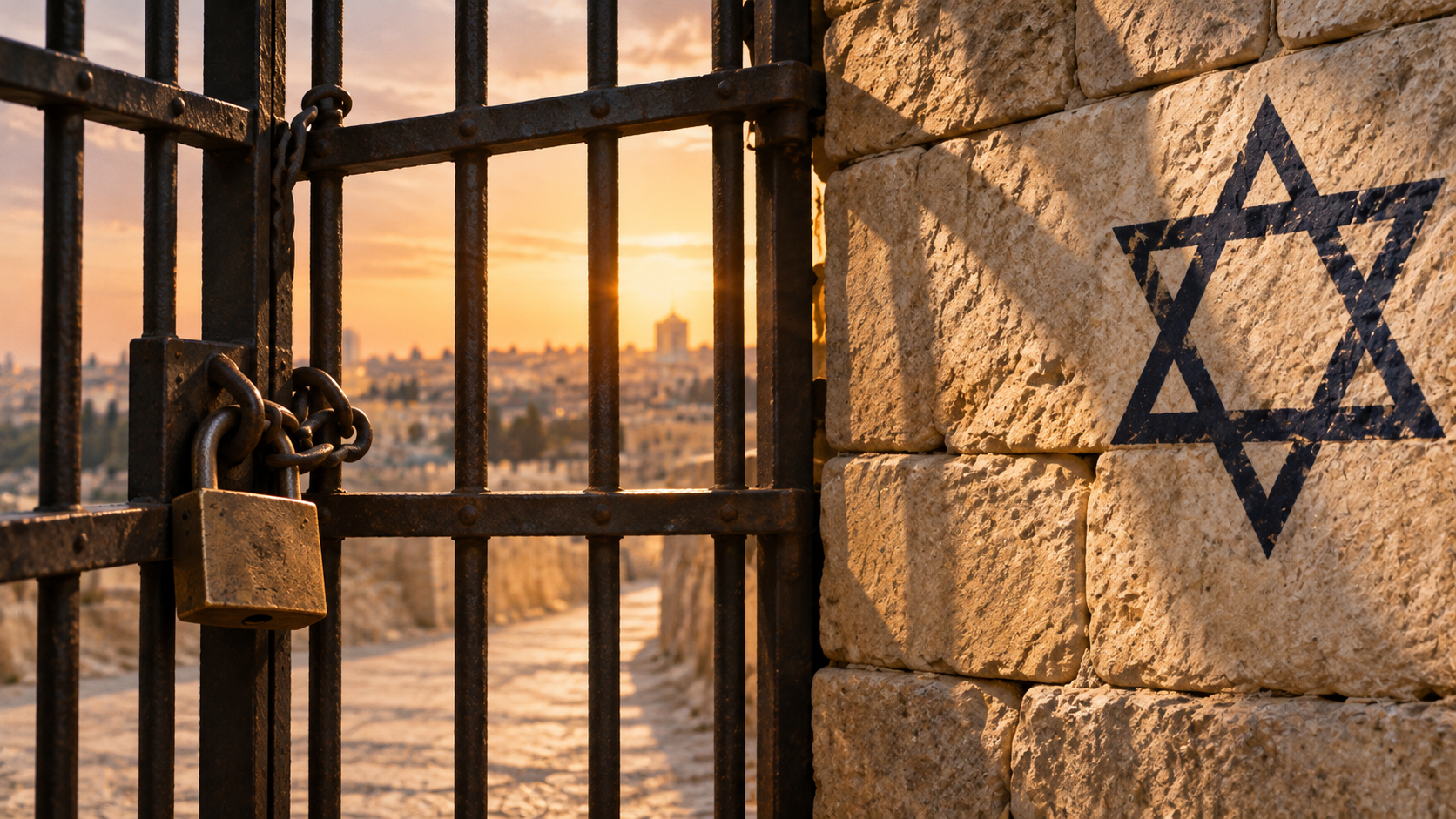
Gates of Judaism Locked
Judaism, the promise to Abraham, and the future of the Jewish people
In the recent weekly chapters of the Torah, we read that God promised Abraham descendants as numerous as the stars in the heavens and the sand along the seashore. He promised Ishmael that he would become a great nation and told Jacob, later named Israel, that his descendants would spread across the earth.
So how did Jews end up with fewer than sixteen million today?
Christianity has approximately 2.3 billion adherents worldwide. Islam has about two billion. More than eighty years after the Holocaust, the Jewish population still hasn’t recovered to its prewar size of approximately 16.6 million.
I know religious affiliation isn’t the same as biological ancestry. Not every Muslim is descended from Ishmael, just as not every Christian can trace a family line to the biblical figures associated with Christianity. The same is true of Judaism. People have been joining the Jewish people through conversion for centuries, becoming just as Jewish as those whose families have been Jewish for generations.
I’m also not suggesting that God’s promises should be measured by a modern census. Still, the contrast is difficult to ignore, and it has me wondering whether we’ve contributed to our own small numbers by making it unnecessarily difficult for people who genuinely want to become Jewish.
There’s an interesting historical irony here. Christianity began as a Jewish movement. Jesus and his earliest followers were Jews who practiced Jewish traditions and understood their beliefs within the Jewish world of the first century. They weren’t initially setting out to establish an entirely separate religion.
One of the great turning points came when Paul, himself Jewish, argued that non-Jews could become followers of Jesus without undergoing circumcision or accepting the full obligations of Jewish law. It was an enormous development. A movement that had begun among Jews could now spread throughout the Roman world without requiring its new adherents to become Jewish.
Christianity’s eventual growth involved many other factors, including missionary activity, political power, and the support of the Roman Empire. Yet that early decision helped open the movement to people who might never have considered accepting the obligations of Jewish religious life.
Judaism continued along a different path. Becoming Jewish meant joining a people, accepting a covenant, and assuming religious obligations that touched nearly every aspect of daily life. I understand that distinction. Judaism isn’t simply a collection of beliefs that someone adopts. It’s a people, a history, a religion, and a shared identity.
I don’t think we should abandon any of that. Still, I wonder whether we’ve become so concerned with maintaining the boundaries of Jewish identity that we’ve neglected the possibility of expanding the Jewish people.
Consider something that has bothered me for years.
A person born to a Jewish mother can reject Judaism entirely. He can never observe Shabbat, never enter a synagogue, eat whatever he wants, marry outside the faith, and declare himself an atheist. Some even work tirelessly to foment frustration, anger, and hatred against Jews and Israel (shout-out to George Soros and Bernie Sanders). Under traditional Jewish law, they remain Jewish.
Someone who wasn’t born Jewish, however, may have to spend years studying, changing how they live, and demonstrating a level of religious commitment that many Jews by birth have never practiced and have no intention of practicing. Why?
I know the halachic explanation. Jewish status by birth and conversion are different legal categories, and the requirements for entering the covenant are not the same as those for someone already born into it. So, that explains the distinction within Jewish law. It doesn’t necessarily resolve the question of whether the disparity makes sense for the future of the Jewish people.
Consider a child whose father is Jewish but whose mother isn’t. That child might grow up in a Jewish home, attend Jewish schools, celebrate Jewish holidays, go to synagogue, and identify entirely as Jewish. Yet under traditional Jewish law, that child isn’t Jewish unless he or she undergoes conversion.
Reform Judaism in the United States recognizes certain children of Jewish fathers as Jewish when they are raised Jewish and meet its requirements. Orthodox and Conservative Judaism do not. So, we have people who have spent their entire lives believing they are Jewish, only to discover that some Jewish communities don’t recognize them. What exactly are we protecting in those circumstances?
I’m not suggesting that Jewish law should be casually discarded or that becoming Jewish should require nothing more than filling out an application. There is meaning in the process of conversion, and there should be a genuine commitment to joining the Jewish people.
Yet shouldn’t we be looking for responsible ways to welcome people who sincerely want to belong, rather than creating obstacles that sometimes seem greater than those faced by people who were simply born Jewish?
We spend an enormous amount of time worrying about assimilation, intermarriage, declining religious observance, and the future of Jewish communities. Those concerns are legitimate. Yet how often do we discuss growing the Jewish population? Not merely encouraging Jews to have more children or trying to prevent people from leaving the community, but welcoming those who want to join it.
I think about this more now than I did twenty or thirty years ago, particularly after my recent trip to Poland. Before World War II, Poland was home to approximately 3.3 million Jews, about ten percent of its population and one of the largest Jewish communities in the world. Warsaw alone had a Jewish population representing roughly a third of the city. Today, that world is largely gone.
I walked through places where Jewish families had lived for generations. They worked, studied, prayed, argued, married, and raised children. They had plans for the future, just as we do. Then entire communities were murdered.
Standing in those places, I kept thinking about the generations that never came into existence.
The six million Jews murdered during the Holocaust would have grown older. Many of the children would have married and had families of their own. Those children might have had children, and those families might have produced still more generations.
The Holocaust didn’t only take six million lives. It also destroyed the futures those people might have created.
I have children and grandchildren. When I think about those lost generations, I can’t help imagining the families that never had the opportunity to exist.
Of course, numbers alone wouldn’t have saved Polish Jewry. Three million Jews couldn’t protect themselves against the military power and systematic extermination policies of Nazi Germany.
Nor have Jews always been particularly good at standing together.
Some assimilated German Jews looked down on their Eastern European counterparts, considering themselves more educated, cultured, and sophisticated than the Jews of the shtetls. They believed their place in German society distinguished them from those other Jews. We should all internalize the fact that the Nazis made no such distinction. To them, a German Jew was no different from a Polish Jew.
I find that history particularly troubling because we still divide ourselves over who is Jewish enough, whose traditions are legitimate, and whose religious practices deserve recognition. We have Orthodox, Conservative, Reform, secular, Zionist, anti-Zionist, religious, and nonreligious Jews. Some of these divisions reflect fundamental disagreements about faith, Jewish law, and national identity. Others are cultural or political differences. Yet, when the Nazis decided who was Jewish, none of these distinctions mattered. They didn’t care how observant we were, what we believed, or whether we even considered ourselves Jewish. To them, we were all Jews.
Disagreement, however, has always been part of Jewish life. We have argued over the meaning of our texts and traditions for thousands of years. Maybe, though, we have become so accustomed to arguing over the boundaries of Jewish identity that we’ve forgotten how small a people we really are.
The Holocaust wasn’t the only time Jewish communities disappeared. Across the Middle East and North Africa, Jewish populations that had existed for centuries, and in some cases thousands of years, were uprooted during the decades surrounding Israel’s establishment. Hundreds of thousands left countries where their families had lived for generations, under circumstances that included persecution, discrimination, political pressure, slaughter, expulsions, and some voluntary emigration.
Today, many of those once-thriving Jewish communities barely exist. A community can have centuries of history in a country and still find itself with no future there. That’s something Jews understand perhaps better than most.
We have survived expulsions, forced conversions, massacres, discrimination, and genocide. We have rebuilt our communities repeatedly, often in places where we arrived with little more than the determination to remain Jewish.
Our survival is extraordinary. Yet survival and growth aren’t the same thing.
Judaism itself has endured because it found ways to preserve its identity through changing circumstances. When the Second Temple was destroyed, Jewish religious life increasingly centered on prayer, Torah study, Jewish law, and communal institutions. Judaism continued without the Temple that had once stood at the center of its worship. The rabbis didn’t abandon Judaism. They helped sustain it in a world that had changed dramatically.
I’m not suggesting that revisiting conversion practices is equivalent to the religious transformations that followed the destruction of the Temple. I am suggesting that Jewish history demonstrates the importance of confronting difficult questions about how we preserve our future.
For centuries, the greatest challenge was simply remaining Jewish. Today, we have Israel, established Jewish institutions, schools, synagogues, universities, and communities throughout the world. We have opportunities to practice Judaism openly that many of our ancestors could scarcely have imagined. Yet we remain fewer than sixteen million people.
There’s something wonderful about being Jewish that deserves to be shared. That doesn’t mean pressuring people to convert or measuring our success by how many people we persuade to join us. Judaism has never made proselytizing a central mission. Our calling is to be a light unto the nations, to lead by example rather than demand that others believe as we do.
We don’t need the rest of the world to become Jewish to believe that Judaism has something valuable to offer it. Still, some people already want to belong.
Some have Jewish fathers and have spent their entire lives identifying as Jews. Some are married to Jews and want to build Jewish homes. Others have no Jewish ancestry at all but find meaning in our history, traditions, beliefs, and communal life. Why shouldn’t we be more interested in helping them become part of our future?
I know there are serious religious questions involved. Traditional Jewish law establishes requirements that cannot simply be set aside because someone finds them inconvenient. Different Jewish movements disagree over what constitutes a valid conversion, and those disagreements won’t disappear because I raise them in an article.
I don’t pretend to have the halachic answers, nor would anyone with authority take my views on halacha seriously. Yet I think the question deserves more attention than it receives, particularly from those of us who worry about what Jewish life will look like for our children and grandchildren.
We talk constantly about preserving the Jewish people. We raise money for Jewish education, support Israel, fight antisemitism, build institutions, and encourage Jewish families to pass their traditions to the next generation. All of that matters.
I believe it should also mean taking a serious look at those standing outside our communities who genuinely want to come in. We don’t have to abandon our traditions to question whether every barrier we’ve created is necessary, nor do we diminish what it means to be Jewish by welcoming more people into the Jewish people.
After everything we’ve experienced, perhaps it’s time to ask whether we should simply accept remaining such a small people, or whether God’s promise to Abraham was something we were meant to help fulfill.
Related Topics