
A Plan to Transform Iran From a Regional Menace Into a Normal State
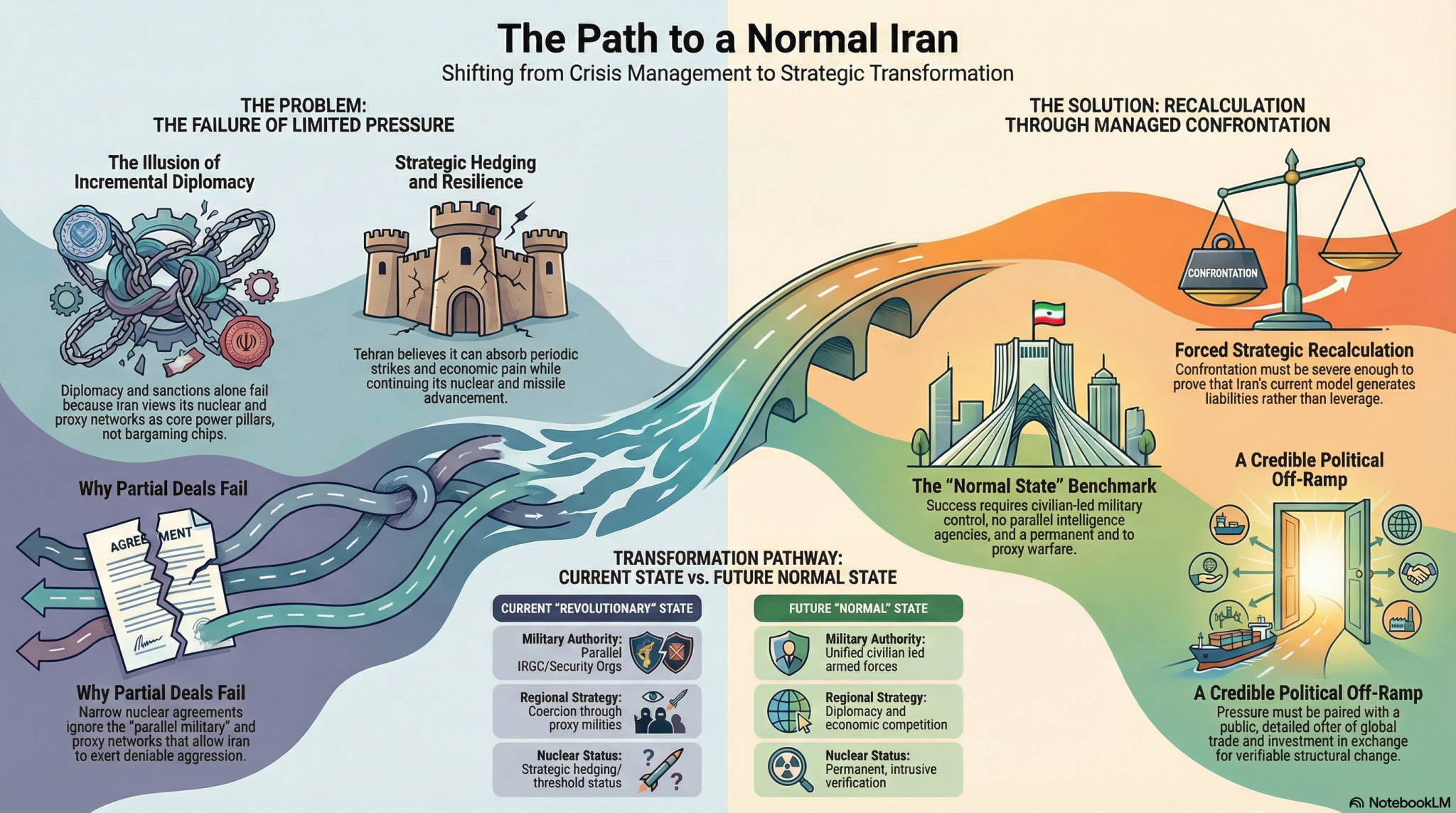
For more than two decades, Western policy toward Iran has been trapped between two illusions: that diplomacy alone can persuade Tehran to abandon its most dangerous behaviors, or that limited pressure can contain them indefinitely.
Both illusions have failed.
Iran’s conduct is not the product of misunderstanding. It is the product of a governing system designed around coercion, regional subversion, and strategic hedging. That system will not negotiate away the foundations of its power simply because a better deal is offered.
A serious strategy must begin with an uncomfortable truth:
Iran will not accept fundamental transformation unless it is forced to conclude that its current model is failing.
Warnings will not produce this realization.
Sanctions alone have not produced it.
Episodic, symbolic strikes have not produced it.
Tehran’s leadership understands that it cannot defeat the United States or Israel in a full-scale war. But it believes it can avoid such a war, absorb periodic blows, manage economic pain, and continue advancing its nuclear threshold status, missile forces, and proxy networks.
As long as that belief holds, Iran has no incentive to change.
This means that some level of sustained confrontation is not a breakdown of diplomacy. It is a strategic prerequisite for diplomacy.
Not total war.
Not regime annihilation.
Not occupation.
But conflict severe and persistent enough to force Iran’s ruling establishment to confront the limits of endurance.
Iran must reach the conclusion that:
- Its deterrence is eroding, not strengthening
- Its economic base is becoming more vulnerable, not more resilient
- Its regional posture is generating liabilities, not leverage
Only then does negotiation become meaningful.
The purpose of such confrontation is not punishment. It is recalculation—to convince Tehran that preserving Iran as a state and a nation requires abandoning the model that currently defines it.
Pressure alone, however, is not sufficient.
Pressure without a political exit produces radicalization.
An exit without pressure produces stalling.
Transformation requires both.
What Outcome Would Actually Reassure Israel and the Region
Not promises.
Not new slogans.
Not a reshuffled leadership cadre.
The minimum acceptable end-state is an Iran that functions as a normal state, not a revolutionary security enterprise.
That means:
- A civilian-led government that truly controls the armed forces
- No parallel military or intelligence organizations operating outside state authority
- A nuclear program locked into intrusive, permanent verification with no fast path to a bomb
- Meaningful constraints on long-range missiles and drones
- An end to proxy warfare as state policy
- A regional doctrine based on non-interference rather than deniable aggression
Anything short of this leaves Iran structurally capable of recreating today’s threat.
Changing personalities without changing institutions guarantees strategic continuity.
Why Incremental Deals Keep Failing
Partial agreements focused narrowly on the nuclear file misunderstand the nature of the problem.
Iran’s nuclear program is not an isolated project. It is embedded in a broader strategy built around:
- Deterrence through ambiguity
- Coercion through missiles and drones
- Influence through proxies
As long as these pillars remain intact, Iran retains both the incentive and the capacity to pressure its neighbors and threaten Israel.
This is why Tehran periodically signals willingness to discuss enrichment levels but refuses serious engagement on missiles or proxy forces.
Those tools are not bargaining chips. They are the core of its power model.
The Only Path That Has a Chance
First, sustained confrontation must make clear that the old model is failing.
Second, a credible political off-ramp must demonstrate that a different future is available.
Not surrender.
Not collapse.
But normalization.
A future in which Iran remains a sovereign state, trades with the world, attracts investment, and competes regionally through economics and diplomacy rather than militias and missiles.
This off-ramp must be public, detailed, and backed by major powers. It must spell out what Iran gains in exchange for verifiable structural change—and what it permanently relinquishes.
Most importantly, it must be designed to survive leadership changes in Tehran.
Why Israel’s Role Is Central
Israel is not merely a potential victim of Iran’s strategy. It is one of the few actors capable of convincing Tehran that the status quo carries escalating risk.
Deterrence is not only about preventing attack. It is about shaping political calculations.
A strategy that combines Israeli military credibility, American economic and diplomatic leverage, and regional alignment is far more likely to produce Iranian recalculation than diplomacy alone.
The Strategic Choice
The choice is not between diplomacy and confrontation.
The real choice is between:
- Managed confrontation paired with a transformational offer
or - Endless crisis management while Iran inches closer to nuclear threshold status and expands its regional reach
There is no painless path.
But there is a realistic one.
Iran can remain a revolutionary power locked in permanent confrontation.
Or it can become a normal state.
It will not choose the second option until the first becomes untenable.
That is the starting point of any serious plan.