
A roadmap to tackling antisemitism in higher education
TL;DR: Antisemitism in academia has intensified since October 7, with some universities failing to condemn or even tacitly supporting harmful rhetoric. While Jewish students, faculty, and allies have mobilized through protests, petitions, and legal action, universities have largely avoided accountability. The article proposes a strategic framework for responses, ranging from observation (low-cost, low-impact) to legislation (high-cost, high-impact), with tools like public warnings, scorecards, reputational pressure, and litigation in between. The key message is that reactive outrage must evolve into coordinated, strategic action that escalates through this continuum to achieve lasting institutional change. Approaches should be tailored to context, especially when comparing US and European systems, and all efforts should be viewed as part of a long-term strategy, not isolated actions.
Since October 7, many in academic communities have found themselves shocked not only by the massacre itself, but by what followed: faculty justifying terrorism, student organizations blaming Israel for Hamas’ atrocities, universities issuing statements that selectively apply their values, and administrations that have either remained silent or, worse, validated antisemitic expressions under the guise of legitimate political speech, blurring the line between academic freedom and bigotry. In some cases, universities have gone further, engaging in discriminatory practices and endorsing academic boycotts of Israel, its institutions, and related companies. These are often framed as acts of ethical responsibility, but they overlook the real impact on Jewish and Israeli students and staff.
Jewish students, faculty, alumni, and allies have mobilized with admirable dedication. There have been protests, petitions, legal letters, op-eds, testimonies before governing bodies, campaigns by donors advocating for accountability, and attempts to engage administrations in dialogue. All these actions are rooted in a deep moral impulse and communal responsibility. And yet, the net result in most places has been little or no institutional accountability. Antisemitic incidents continue, and universities have largely been able to move forward unchallenged.
This moment calls for a shift from emotional reaction to coordinated strategic planning, guided by a clear framework for escalation. That doesn’t mean suppressing outrage. It means asking: What works? At what costs? What is the lasting impact?
If we want results, we must begin to map out the tools available to us, understand their strengths and limitations, and apply them according to context and objectives. Different approaches exist not just because of personal preferences, but because each serves a distinct strategic purpose.
From observation to legislation
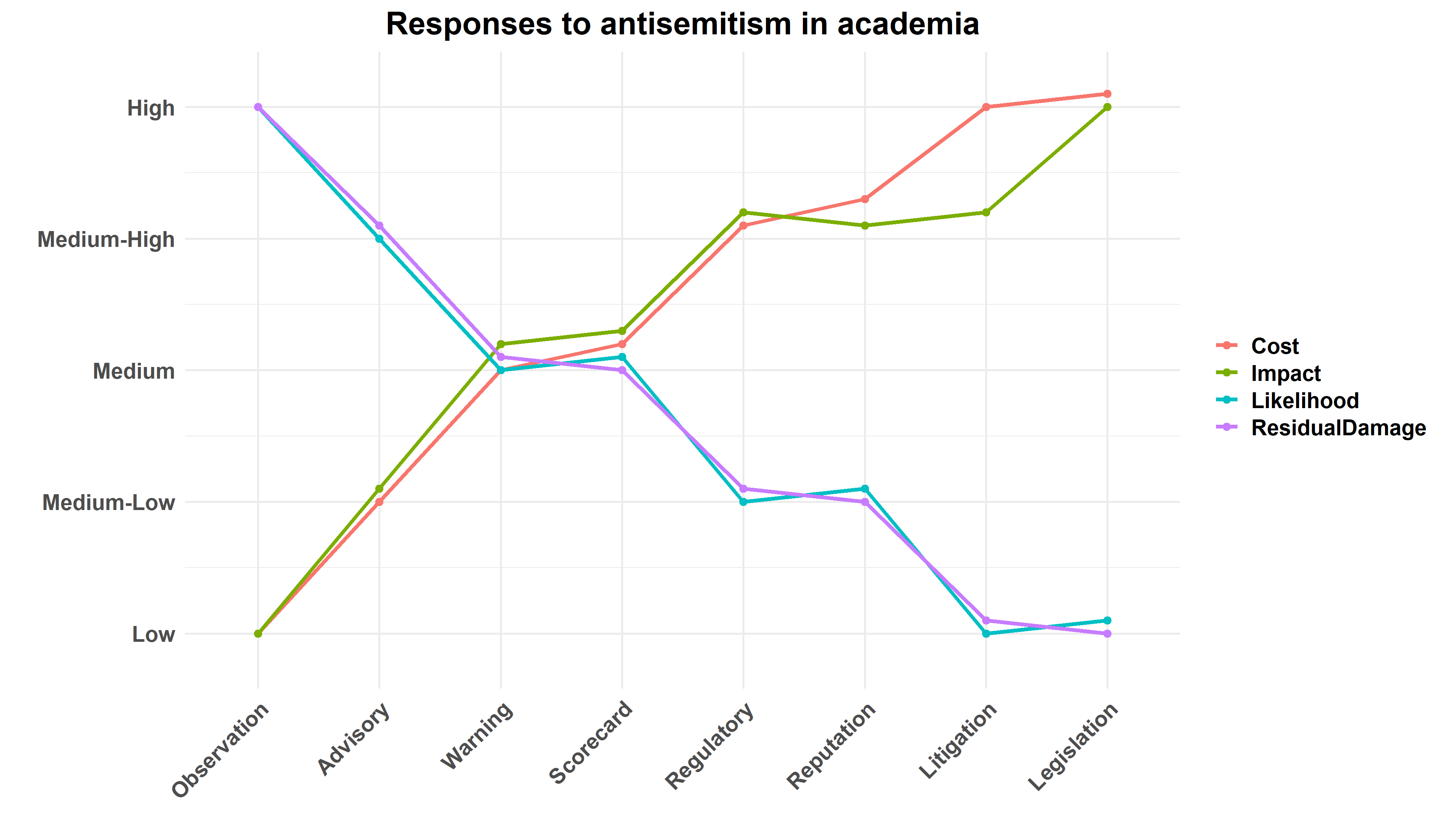
The chart below is a simplified visualization of the continuum of typical, institutional responses to antisemitism in academia. This is not a perfect or exhaustive model; reality is far more nuanced. But it’s a valid and practical way to think about the options and their consequences. While each stage in the continuum can play an important role, their value lies in understanding when and how to use them effectively.
The horizontal axis in the chart represents stages of possible intervention or institutional response, starting from Observation, where incidents are noted but not acted on, to Legislation, where structural and enforceable change has taken place. The lines represent different metrics that should guide our strategic thinking: cost (financial, social, political), likelihood of success, impact (on the university and broader society), and residual damage (what remains unresolved or unaddressed even after action is taken). The vertical axis represents the relative intensity of each metric across the intervention spectrum.
Let’s unpack the different responses:
Observation
Cost: Very low | Impact: Very low | Likelihood of continuation: Very high | Residual damage: Very high
Passive documentation of antisemitic incidents, whether through testimony, internal logs, or informal networks. While foundational for future action, it does not challenge institutions or change outcomes. Without escalation, it risks normalizing discrimination and leaving affected individuals exposed.
Advisory engagement
Cost: Low–medium | Impact: Low–medium | Likelihood of continuation: High | Residual damage: Medium–high
Includes informal meetings, recommendations, or participation in advisory bodies. Advisory engagement relies on institutional goodwill. It can open communication, but without external pressure, it frequently leads to symbolic gestures rather than structural change.
Public warning
Cost: Medium | Impact: Medium | Likelihood of continuation: Medium | Residual damage: Medium
Open letters, media statements, or coordinated public messaging that signal discontent and readiness to escalate. Warnings are effective when they are credible and well-timed, but without follow-up, they risk being dismissed or absorbed into institutional PR strategies.
Scorecards and benchmarking
Cost: Medium | Impact: Medium | Likelihood of continuation: Medium | Residual damage: Medium
Ranking institutions based on their handling of antisemitism creates transparency and reputational incentives. These tools are useful for advocacy and long-term pressure, though they require visibility and credibility to have real impact.
Regulatory engagement
Cost: Medium–high | Impact: Medium–high | Likelihood of continuation: Low–medium | Residual damage: Low–medium
Involves formal complaints to oversight bodies or compliance mechanisms. This reframes antisemitism as a procedural or legal issue rather than political disagreement. It creates institutional accountability, but can be slow and complex.
Reputational pressure
Cost: Medium–high | Impact: Medium–high | Likelihood of continuation: Low–medium | Residual damage: Low–medium
Sustained campaigns involving media, donors, alumni, or student networks that challenge the institution’s public standing. Reputational risk is one of the most powerful motivators for university leadership, especially when well-documented and strategically framed.
Litigation
Cost: Very high | Impact: Medium–high | Likelihood of continuation: Very low | Residual damage: Very low
Legal action, via lawsuits or formal complaints, signals a refusal to tolerate continued harm. It often forces institutional change through binding outcomes. However, litigation is resource-intensive and should be pursued with broad support and clear goals.
Legislation and structural reform
Cost: Very high | Impact: Very high | Likelihood of continuation: Very low | Residual damage: Very low
The most enduring interventions create legal mandates and institutional norms through policy or legislation. Though slow and politically challenging, these reforms embed long-term protections and shift the framework from reactive to preventative.
Why does this framework matter?
Many of the actions we’ve seen since October 7 have been necessary, courageous, and morally sound. But without coordination, they rarely build on one another. Universities have learned to wait out the outrage. By failing to connect our efforts strategically, to move institutions up the ladder of accountability, we let them off the hook.
This continuum should serve as a strategic map, not just a model. Every meeting, every letter, every campaign should be understood as part of a broader effort to change institutional behavior. If we only focus on short-term success or media visibility, we risk leaving the deeper structures of antisemitism intact.
Some tactics bring quick wins but leave lasting damage, allowing universities to check a box without addressing underlying hostility. Others fail often but, when successful, change the rules of the game. Understanding that trade-off is key to prioritizing resources.
US vs. Europe: A note on context
Legal and institutional conditions differ. In the US, universities are exposed to lawsuits and government oversight. Donors have leverage, and political scrutiny is high. In Europe, especially in publicly funded systems, universities often enjoy more protection and act with greater autonomy. Civil society and public discourse may offer the most effective viable levers, requiring reputational, not just legal pressure.
That’s why understanding where you are and what tools apply is crucial. What works in one setting might fail in another, but the strategic logic remains.
Where do we go from here?
If you’re a student, think about which stage your efforts currently occupy, and whether they can escalate. If you’re an alum or donor, consider whether your engagement is transactional or transformative. If you’re faculty, consider how your position could lend authority to coordinated demands. And if you’re part of a Jewish or allied organization, ask not only what can we do, but what will move the institution?
We need to start thinking in systems, not just moments. Antisemitism in academia will not be solved through moral clarity alone. It will take coordinated pressure, tactical diversity, and a clear-eyed understanding of how institutions change.