
NAnews - Nikk.Agency Israel News
A Ukrainian Wine with a Hebrew Name Restores a Jewish Colony’s Memory
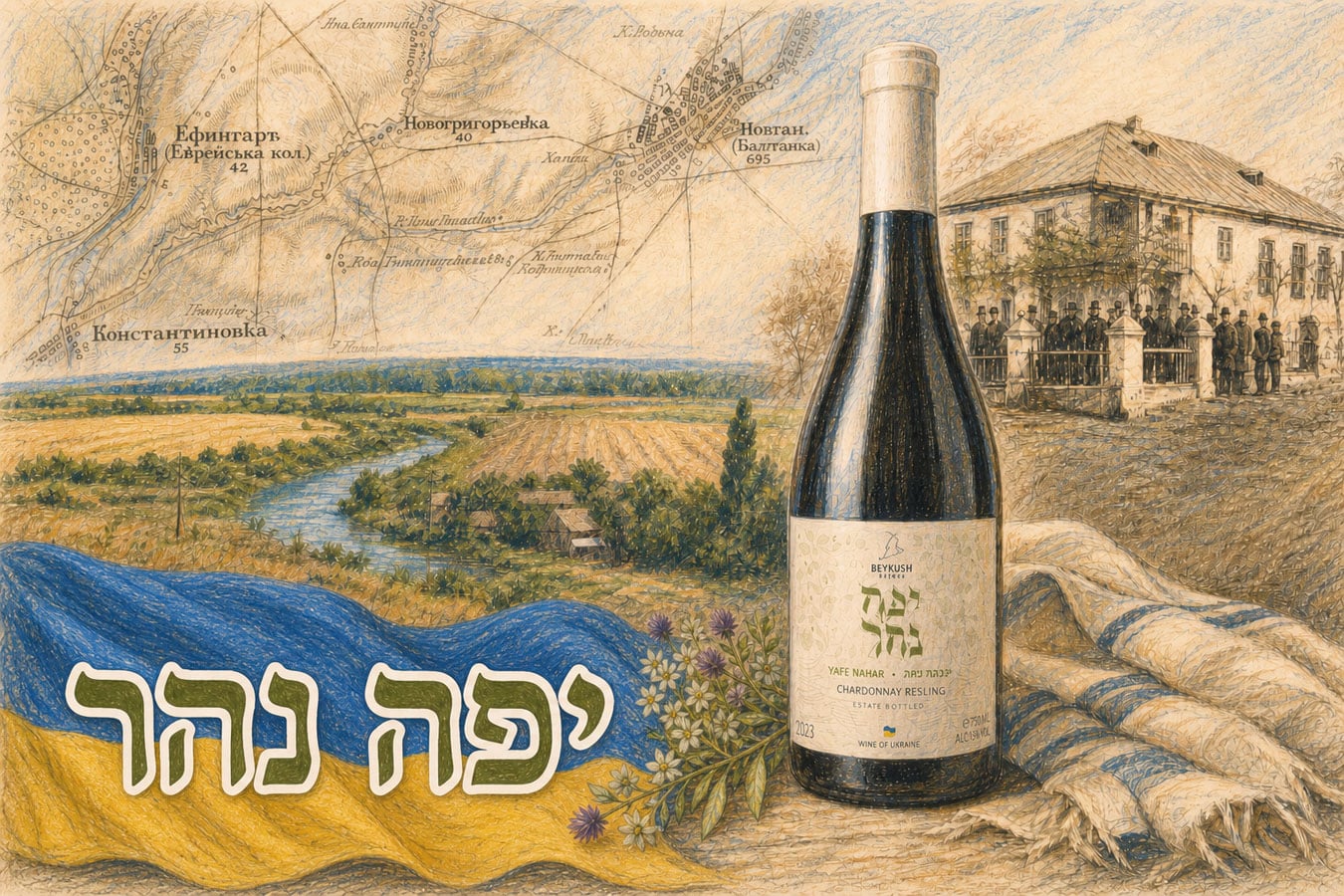
A Ukrainian Wine with a Hebrew Name Restores a Jewish Colony’s Memory. Illustration created with AI
In Ukraine — the very country that Russian propaganda has spent years trying to portray as needing “denazification” — there is a wine with a Hebrew name: Yafe Nagar / יפה נהר.
This is not marketing exotica and not a random play with a Jewish theme. The wine, produced by the Ukrainian winery Beykush, is dedicated to the Jewish winemakers of the Black Sea region and to the memory of the colony of Efingar — a Jewish agricultural settlement in southern Ukraine whose history began in the early nineteenth century and was tragically cut short during the Holocaust.
The official page of the Ukrainian producer Beykush, located at 73/2, Chornomorka, Mykolaiv region, Ukraine, describes Yafe Nagar as a dry white wine from its historical series: a blend of Chardonnay and Riesling dedicated to the Jewish winemakers of the Black Sea region.
The name Efingar is connected with the Hebrew expression יפה נהר — “beautiful river.” In Slavic usage, several forms appear: Efingar, Efingary, and Efengar. The Electronic Jewish Encyclopedia describes it as a Jewish agricultural colony on the Inhul River, in the former Kherson Governorate, on the territory of today’s Mykolaiv region of Ukraine.
There is a small discrepancy regarding the date of its foundation. Beykush, on the wine’s page, gives the year 1807, while the Electronic Jewish Encyclopedia gives 1809. The most careful formulation is therefore this: the colony was founded in the early nineteenth century, with 1807 and 1809 both appearing in different sources.
In 1835, the colony had 755 residents. In 1845, Efingar had 99 households — 60 stone houses and 39 earthen homes — two Jewish prayer houses, a shop, and a bathhouse. There were 111 families registered there, while 15 families were listed as not yet permanently settled.
This detail matters because it does not change the essence of the story. In southern Ukraine, there truly existed a Jewish agricultural settlement connected with farming, viticulture, crafts, trade, and the life of a Jewish community outside the usual image of the Eastern European shtetl.
Not Only Memory, but Labor
The history of Efingar is the story of people who tried to build a new life on the land. The first decades were difficult: lack of experience, poor harvests, poverty, and a struggle for survival.
One detailed historical account of the colony recalls the disastrous harvest of 1811. The settlers lived in houses without roofs because the straw had to be taken down to feed the livestock, while they themselves survived on boiled sorrel. Later, the colony became stronger. Sources mention shops, workshops, mills, oil presses, a cheese dairy, a winery, and a soda-water plant.
A particularly important detail appears in the work of Joseph Perl, where the colonists’ products were described as high quality: even Christians bought their butter and cheese despite the high price. This breaks several stereotypes at once — about the Jews of Eastern Europe, about southern Ukraine, and about how deeply Jewish, Ukrainian, and Black Sea histories were intertwined.
For an Israeli audience, this story has a special depth. It is not an abstract “Jewish trace” somewhere far away in Eastern Europe. It is the story of people who spoke Jewish languages, used a Hebrew name, worked the land, built an economy, and left behind a memory that others later tried to erase twice.
September 10, 1941: The Day Efingar Ceased to Be a Jewish Settlement
The most terrible date in the history of Efingar is September 10, 1941.
After the arrival of the German occupiers, the entire Jewish population of the colony that remained under Nazi rule was destroyed. The Electronic Jewish Encyclopedia gives the number as 521 people. More detailed materials about Efingar add that among those murdered were 377 children.
According to these accounts, the Jews were first driven into a school, then taken to a sand quarry several kilometers from the village and shot there. This was not merely another episode of the Holocaust on occupied territory. It was the end of an entire community.
A colony that had existed for more than a century disappeared in one day.
After the war, Efingar was renamed Plyushchivka. The Electronic Jewish Encyclopedia notes that the inscription on the memorial did not state that those who had been shot were Jews, and that the old Jewish cemetery had been destroyed.
This is what makes the story even more painful.
First, people were murdered as Jews.
Then their memory was deprived of its Jewish name.
In the Soviet formula, they became “peaceful citizens,” “victims of fascism,” or “local residents” — without the name of their people, without Jewish history, without language, without the very יפה נהר from which the story began.
Why This Matters Today
For NAnews — Nikk.Agency Israel News, this story matters not only as a historical episode. It shows that deep Jewish life existed on Ukrainian soil, and that it cannot be reduced either to tragedy or to propaganda clichés.
Ukraine is not only Babyn Yar. It is not only Odesa, Lviv, or Uman. It is also small Jewish colonies whose names have almost disappeared from memory. It is people who grew grapes, made butter and cheese, ran workshops, built homes, raised children, spoke their languages, and lived next to Ukrainian villages.
That is precisely why the story of Yafe Nagar sounds so powerful.
Because here memory returns not through an official memorial report and not through a dry archival note. It returns through a wine label, through a Hebrew name, through a Ukrainian product that says: this story existed, these people existed, and their name cannot be erased.
Beykush and Yafe Nagar: When Wine Becomes a Vessel of Memory
The Beykush winery is located in the Mykolaiv region, in the Black Sea area. On the Yafe Nagar page, the winery states directly that this wine belongs to its historical series, that its name translates from Hebrew as “beautiful river,” and that the wine is dedicated to the Jewish winemakers of the Black Sea region.
Wines from Ukraine also describes Beykush Yafe Nagar as a tribute wine dedicated to the Jewish winemakers of the Black Sea region. It identifies it as a dry white wine made from Chardonnay and Riesling and connected with the Mykolaiv region.
There is one more important detail. In a separate Beykush publication, the winery notes that Jewish colonists were connected with winemaking, and that the white wine Yafe Nagar preserves the memory of the contribution Jewish farmers made to the development of the region.
This is not simply a beautiful gesture. It is an example of how Ukrainian business, regional culture, and Jewish memory can work together.
Wine becomes not a souvenir, but a form of conversation.
When someone opens a bottle of Yafe Nagar, they can tell friends not only about grape varieties, aging, or region. They can tell them about Efingar. About the Inhul River. About Jewish farmers. About September 10, 1941. About the children who were murdered. About the memorial on which the authorities did not allow the most important fact to be written: that the victims were Jews.
And that is already a different level of memory.
An Answer to Russian Lies Is Not a Slogan, but a Fact
There is also a modern political nerve in this story.
While Moscow continues to sell the world the myth of Ukraine’s “denazification,” a Ukrainian winery produces a wine with a Hebrew name in memory of a Jewish colony destroyed by the Nazis. This does not cancel the complex pages of Ukrainian history. But it does show what Russian propaganda deliberately refuses to see: in Ukraine, there is a living space of memory in which Jewish history is not foreign.
For Israel, this is especially important.
The memory of the Holocaust must not be turned into an instrument of Kremlin manipulation. Those who are destroying Ukrainian cities today must not be allowed to hide behind words about fighting Nazism. And we must not forget that real memory is not a slogan, but specific names, places, and dates.
Efingar.
יפה נהר.
September 10, 1941.
521 murdered.
377 children.
NAnews — Nikk.Agency Israel News reminds readers that stories like this matter precisely because they restore a name to people. Not “local residents,” not faceless statistics, not abstract “victims of war,” but the Jews of Efingar — a community that was destroyed, yet whose memory can still be brought back.
Why Stories Like This Must Not Be Lost a Second Time
Some stories do not disappear all at once.
First, people disappear. Then the name disappears. Then the cemetery disappears. Then the word “Jews” disappears from the official inscription. Then a new generation no longer knows that on this site there once stood a Jewish town, a colony, a community, a school, workshops, a winery, families, and children.
And then, suddenly, a bottle of wine appears with a Hebrew name.
And memory returns.
Not completely. Not instead of an archive, not instead of a memorial, not instead of historical research. But it returns in a way that allows it to be spoken aloud again.
Yafe Nagar is not only a wine from the Mykolaiv region. It is a small sign that the Jewish history of Ukraine did not end in mass graves and did not dissolve into Soviet formulas.
It can return through language.
Through a name.
Through a label.
Through a story told at the table.
And if that story is passed on, then Efingar has not disappeared a second time.
The reason for writing this publication was a Facebook post. Unfortunately, it was later lost, but thanks are due to its author.
Related Topics
Related Posts