
CFO | Empower Society for Good I Author
A World of Fortresses: Global Fear, Broken Narratives
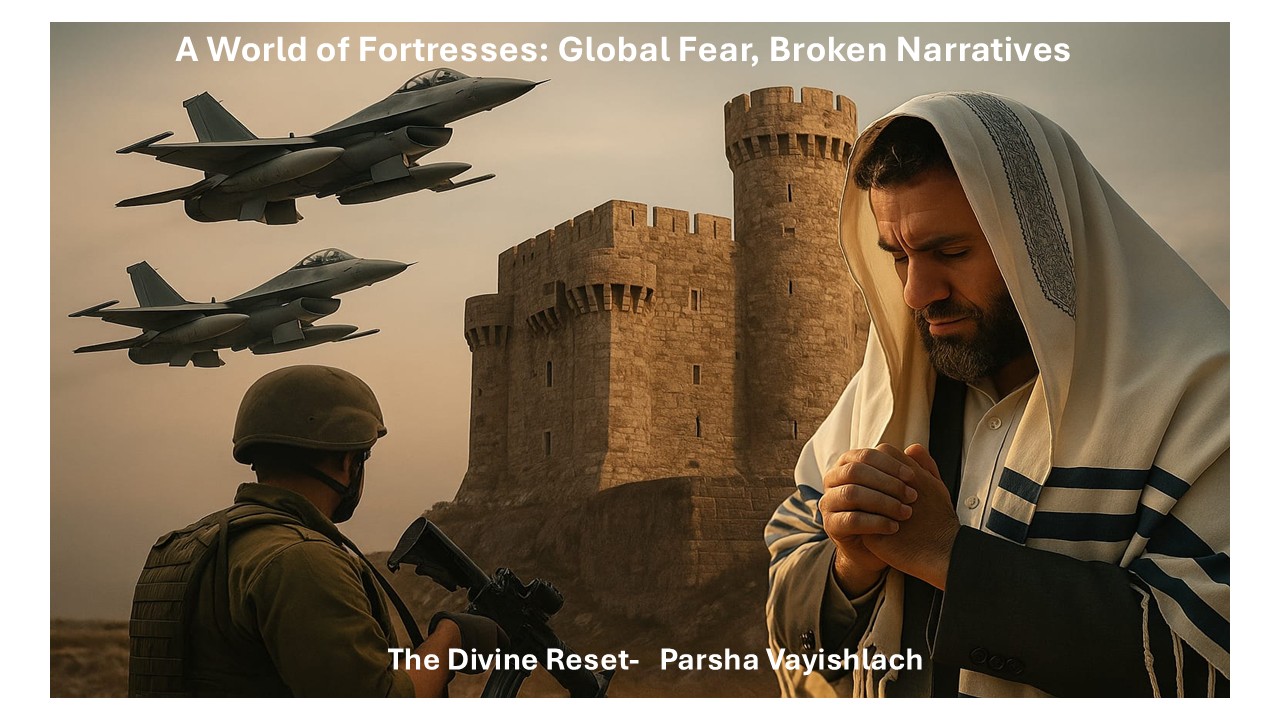
Forgive me if I sound cynical. It feels as though the world around us is coming apart. Violent anti-Israel marches continue to sweep across Europe, identity politics metastasises into open hatred, and global powers continue buying advanced weapons in a frenzy — Saudi Arabia’s pursuit of F-35s being the latest emblem of a deeper crisis.
Why?
What exactly is everyone so afraid of?
Historian Yuval Noah Harari warns that humanity is drifting into an age of fortresses — nations retreating behind walls, stockpiling weapons, and building armies instead of ideas. The metaphor is painfully accurate. In a century where our true existential threats are climate collapse, water scarcity, AI disruption, cyber instability, food insecurity, and economic fragmentation, the world responds not with unity but with fear.
And fear, tragically, is profitable.
Fear fuels weapons.
Weapons fuel conflict.
Conflict fuels narrative.
Narrative fuels identity.
We are living in a world where war is big business — and business is booming.
The Arms Race Nobody Wants — But Everyone Buys
The global defense industry thrives not on peace but on the possibility of war.
Each geopolitical tension point becomes a pipeline of revenue:
- India vs. Pakistan
- Greece vs. Turkey
- Saudi Arabia vs. Iran
- China vs. Taiwan–United States
- Russia vs. Ukraine (NATO)
- And of course, Israel vs. the Palestinians, Hezbollah, Iran et al.
Every drone strike, every border clash, every military parade is a sales pitch.
Nations buy F-35s not because war is certain, but because unpreparedness is unthinkable. Fear drives procurement. Procurement drives escalation. Escalation fuels yet more fear.
A perfect, self-perpetuating loop.
And into this global theatre steps the Pope — smiling for photographs with Erdoğan, avoiding any mention of Turkey’s role in fueling Hamas, exporting jihadism, destabilizing Syria, or persecuting minorities. He then continues to Lebanon, a nation whose Christian population once exceeded 50% but now hovers around 32%, hollowed out by decades of war, emigration, Hezbollah’s armed domination, and Iran’s shadow. Yet the Pope avoids naming the very force suffocating Lebanon, including Christians: Hezbollah, which is continuing its long-term religious jihad war on Israel.
He could have visited Nigeria, Sudan, Pakistan, or other places where Christians are actually being slaughtered.
Instead, he offers moral theater — soft words, photo-ops, and diplomatic neutrality — while calling for a “two-state solution” built atop historical distortion, geopolitical naïveté, and moral blindness.
Selective outrage has become the West’s most reliable currency.
The Continued War on Israel — Played Out on the World Stage
If anyone doubts the world’s war on Israel, this week’s UN General Assembly vote should end the debate.
A resolution submitted by Egypt “demands once more that Israel withdraw from all the occupied Syrian Golan,” calling Israel’s presence “a stumbling block” to peace.
It passed with:
- 123 in favor
- 7 against
- 41 abstentions
Nothing about reality.
Just one target: Israel.
This is not diplomacy.
This is an ideological war fought through resolutions.
Meanwhile, Hezbollah re-arms openly, and the world pretends not to notice.
The PR Battle — Hillary Clinton Says the Quiet Part Out Loud
Even Hillary Clinton — hardly an ally of the Israeli right — said this week:
“Israel has the worst PR I have ever seen.”
She explained how, after October 7, her university students received distorted information through TikTok and manipulated clips. Over 50% of young Americans receive their news through these platforms — unfiltered, unverified, and driven by algorithmic outrage.
This is not a partisan issue.
It is civilizational.
Generation Z — the TikTok Generation — forms opinions not through facts, books, or history, but through 12-second videos engineered to provoke, not inform.
Israel speaks in paragraphs to a generation that listens in fragments.
It is a losing battle unless the narrative changes.
Israel’s Strength Amid Global Confusion
Meanwhile, Israel continues to build — even as our brightest minds are exhausted.
Fathers who should be teaching AI or building startups are in the north and other fronts.
Researchers, engineers, and founders — drained by over 400 days of reserve duty across two years.
Internally, we face moral challenges:
- The Haredi draft-evasion law is indefensible.
- The government’s refusal to take responsibility for October 7 is a stain.
- It is time for accountability, including at the highest levels.
Meanwhile, Antisemitism and anti-Israelism rise globally with shameless speed — proof that history teaches nothing.
Parsha Reflections — Wrestling With Truth in a World of Illusions
In turbulent times, the weekly Parsha becomes a grounding force.
Jacob Wrestling the Angel — Becoming Israel
Jacob emerges wounded but transformed.
His new name, Yisrael, is given to one who wrestles with truth, God, and destiny.
He emerges wounded but transformed.
This is us: bruised, battered, but blessed with purpose
This is our national character.
Jacob and Esau — Coexistence Without Naivety
Jacob prepares with strategy, gifts, prayer, and humility.
Coexistence is possible — but not naïve.
His strategy is a formula for coexistence without illusions.
Dinah — Moral Complexity, Then and Now
The story of the rape of Dinah, and Shimon, and Levi’s response is raw and complex
This is a reminder that justice is never simple, and peace is never guaranteed.
Shechem: Where the Jewish Story Becomes Land, Language, and Stone
If the world truly wants to understand the Jewish story, it must begin where the Torah places us: Shechem — today’s Nablus.
Jacob Purchases Shechem — The First Jewish Land Deed
Genesis records:
“And he purchased the parcel of land where he pitched his tent, from the sons of Hamor, father of Shechem, for one hundred kesitah.”
(Genesis 33:19)
In this week’s Parsha, Jacob buys land in Shechem for 100 kesitah.
A clear, legal, witnessed transaction.
This is not a myth.
It is Torah’s insistence on record-keeping.
Before there was a State of Israel, before anyone spoke of “occupation,” Jacob held a deed to the land.
The world denies Jewish history.
The Torah records it.
Joseph’s Tomb — A Monument That Will Not Disappear
Buried in Shechem is Joseph, the bridge between exile and redemption.
Today Joseph’s Tomb sits behind Palestinian lines, vandalised again and again, burned, desecrated — not out of politics, but out of existential hatred for memory itself.
Every vandalism at Joseph’s Tomb is an attempt to erase Jewish identity.
And yet we continue to come back — soldiers, rabbis, young people, old men — at night, under fire, through rubble.
Because a nation that forgets Joseph forgets itself.
Joseph’s bones came home.
And so did we.
Mount Eval — Joshua’s Altar Unearthed in Our Time
Just above Shechem lies Mount Eval, where archaeologists discovered the remains of what many identify as Joshua’s altar — a perfect match to the biblical description.
An altar from the early Israelite period, built with:
- uncut stones
- an inner ramp (not steps)
- burnt bone fragments
- kosher species
- sherds dating to the early Iron Age Israel
This is not politics.
This is archaeology confirming scripture.
The world denies Jewish indigeneity.
The stones do not.
The Mountains of Blessing and Curse — A Drama of Covenant
Shechem sits between two mountains:
Har Gerizim (the Mountain of Blessing)
and
Har Eval (the Mountain of Curse).
Here the tribes stood after entering the Land.
Six tribes on each mountain.
The Levites in the valley.
Calling out:
Blessing if you walk with God.
Curse if you abandon your moral purpose.
This was not just ceremony.
This was a national contract.
At Shechem, Israel publicly accepted responsibility for:
- justice
- morality
- truth
- holiness
- dignity
- the weak and the poor
- the land itself
This is the Jewish mission.
This is the Jewish identity.
This is the Jewish story.
The covenant was not whispered.
It was shouted across the mountains.
And the echo has never stopped.
The World Denies Our Story Because It Has Lost Its Own
Shechem is why narratives built on denial are so fragile.
You cannot uproot a people whose identity is older than the empires trying to erase it.
- Before Rome
- Before Byzantium
- Before Islam
- Before Christianity
- Before the nations that vote against us in the UN
We were already here.
Jacob bought the land.
Joseph returned to it.
Joshua consecrated it.
The tribes declared their destiny upon it.
And modern archaeology affirms it.
Our enemies destroy stones.
But stones testify.
Our enemies burn tombs.
But memory persists.
Our enemies rewrite history.
But the mountains of blessing and curse remain.
But Where Did the Arabs of Nablus Come From?
Another question the world refuses to ask:
If Shechem is an ancient Jewish site, how did Nablus become an overwhelmingly Arab city?
When did this shift happen — and why?
A core historical fact is routinely erased:
Large waves of Arab migration into the Land of Israel occurred after the first waves of modern Jewish pioneers began rebuilding the land in the late 19th and early 20th centuries.
This is not ideology — it is documented by Ottoman, British, and Arab sources.
When the Jewish return began:
- Malaria-infested swamps were drained.
- Barren land was cultivated.
- Industry, citrus groves, and ports were built.
- New economic opportunities emerged in the Galilee, Sharon, Jezreel Valley, and around Nablus.
And as the land came back to life, migrants from across the Arab world followed the jobs.
Many of the families who call themselves today trace their origins not to ancient Canaan but to:
- Balqa tribes (Jordan)
- Hauran (Syria)
- Egyptian immigrants were brought during the rule of Muhammad Ali in the 1830s
- Arab clans were settled by Ottoman governors for political loyalty and taxation purposes.
This is not criticism — it is simply the story of migration following opportunity, just as it does everywhere else in the world.
Even the British Peel Commission (1937) — no Zionist document — reported:
“The Arab population has increased more than it would have without Jewish immigration…
owing to the employment and improved conditions brought by the Jews.”
In other words:
Jews did not come because Arabs were there.
Arabs came because Jews returned.
This pattern held in Jaffa and Haifa. Hadera, the Jordan Valley, Tiberias, Jerusalem, and the wider Samaria region surrounding Shechem
No honest historian denies this.
What they argue about is scale, not existence.
Which means the question must be asked:
If Jewish pioneers revived the land, created jobs, built infrastructure, and drew migrants seeking work and stability —
How can anyone claim that Jews “stole” a land they themselves rebuilt?
It defies logic — and history.
Shechem was Jewish long before anyone called it Nablus.
And when modern Jews returned to rebuild the land,
others followed them — not the other way around.
This is not a slogan.
This is the demographic truth of the land.
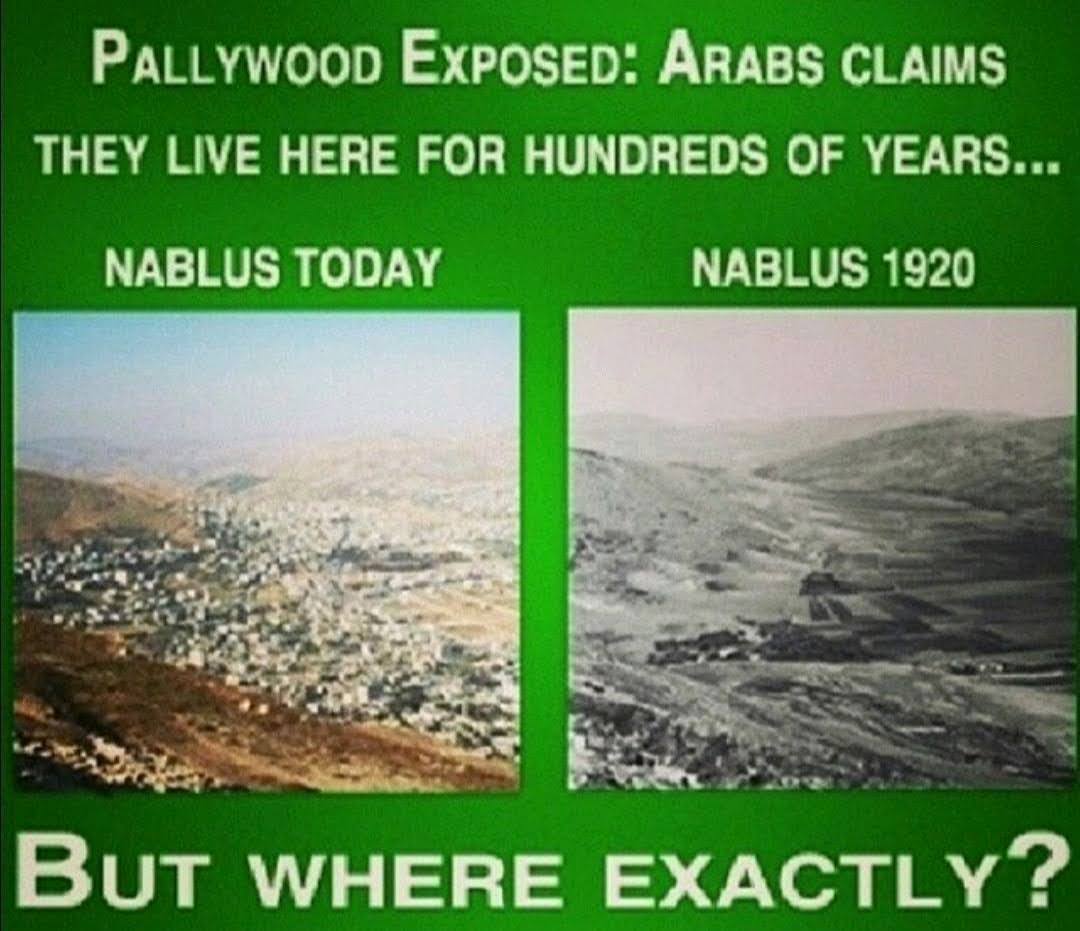
As This Photo Testifies — History Has a Landscape
Early photographs reveal the truth visually:
Nablus today — dense, sprawling.
Nablus 1920 — barren hills, sparse homes, empty valleys.
Not an ancient metropolis.
A recently grown city.
The land itself testifies:
Where Jews built, populations followed.
This Is the Jewish Story
A people bound not by empire, but by covenant.
A land not held by conquest, but by promise.
A memory not erased by exile, but strengthened by return.
When the world tries to lecture Israel about history, morality, and belonging, the answer lies not in slogans or PR campaigns, but in Shechem:
- In the land that Jacob purchased,
- in the tomb where Joseph rests,
- in the altar Joshua built,
- in the mountains that declared our destiny.
This is not occupation.
This is origin.
This is not nationalism.
This is narrative.
This is not politics.
This is prophecy.
This is the soul of Israel.
The Choice Ahead — and the Soul of Israel
Humanity stands at a crossroads:
- one path leads to fortresses, fear, hatred, and denial
- the other to cooperation, memory, identity, and renewal
Civilizations rise when they share a story.
They fall when that story collapses.
The Jewish people know their story.
We carried it through exile, persecution, and genocide — and returned home with purpose.
Europe is still searching for its own. The Arabs for theirs.
Until it finds one, it will continue projecting its confusion onto the one nation that refuses to forget who it is.
A Divine Reset begins when the world chooses:
Memory over denial,
Identity over fragmentation,
Cooperation over fear,
Truth over projection.
Only then can we build a world worth defending —
not merely a world preparing to destroy itself.
Cover image – created by ChatGPT. Nablus image -sourced from Facebook
Related Topics
Related Posts